Arimura Jizaemon and the Assassination of Ii Naosuke

On an unseasonably snowy spring morning in 1860 the most powerful man in Japan was cut down in broad daylight as he was about to enter Edo Castle, the seat of government of the Tokugawa Shogun, whose military regime, the Tokugawa Bakufu, had ruled for two and a half centuries.

The shogun at the time was a fifteen-year-old boy, and his regent, Ii Naosuke, who ruled with an iron fist, was widely reviled for wresting power from his political enemies, perceived lèse–majesté against a powerless yet sanctified Emperor in unilaterally concluding foreign trade treaties against the Imperial will, and his notorious purge of his political enemies from the highest echelons of the government. Ii’s assassination, which marked the beginning of the end of the shogun’s rule, was followed by eight years of chaos and turmoil and violence, which would not subside until the collapse of the shogun’s government and the restoration of Imperial power—the series of events collectively called the Meiji Restoration.

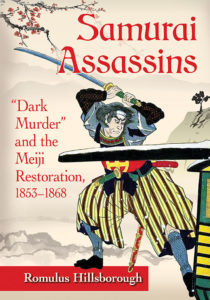
The assassination of Ii Naosuke is the subject of Part I of my three-part Samurai Assassins: “Dark Murder” and the Meiji Restoration, 1853-1868. I tell the story of this most important event of the era from the perspective of Ii’s enemies, including the band of eighteen samurai who colluded to assassinate him.

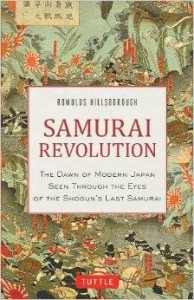
One of the eighteen, Arimura Jizaemon, who beheaded Ii, is depicted on the cover of the book. The image is part of a series entitled Kinseigiyuden (“Biographies of Loyal and Courageous Men”) by Ichieisai Yoshitsuya (1822 – 1866), originally published in a magazine called “Nishikie.”


hillsborough_978-1-4766-6880-2
widget_buy_amazon

Katsu Kaishū: The Shōgun’s Last Samurai

Katsu Kaishū is the “shogun’s last samurai” of Samurai Revolution. I introduce him in the Prologue as follows:

[In early 1868, in the wake of the collapse of the Tokugawa Bakufu], Katsu Kaishū, who had risen through the ranks by force of character and a keen and creative mind, was in command of the Tokugawa military. He had at his disposal a fleet of ships and thousands of troops raring to attack the enemy. But just who was this multifaceted, enigmatic man upon whom the deposed shōgun rested his life and the fate of his family and indeed the entire country? Unlike [last shogun Tokugawa] Yoshinobu’s other advisors, he hailed neither from a noble house of feudal lords charged for generations with the Bakufu’s highest offices, nor from the privileged families of Tokugawa samurai whose sons traditionally filled the most important magistracies and commissionerships. Born to the humblest of samurai families in service of the shōgun, he was at once the consummate samurai and streetwise denizen of downtown Edo; an expert swordsman who refused to draw his sword even in self-defense; a statesman who commanded the respect of allies and foes alike; an inviolable outsider within the shōgun’s regime; an iconoclast, historian, prolific writer, and creator of the Japanese navy. And though his loyalty to the Tokugawa was unsurpassed, he was nevertheless a friend and ally of men who had overthrown the government.
14713704_1097987676957531_9140689117727583012_n
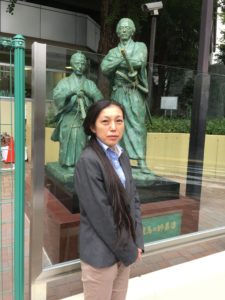
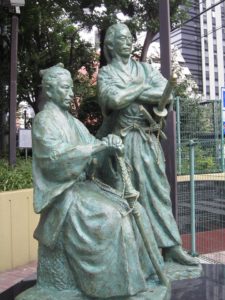
This statue of Katsu Kaishū and his most famous student, Sakamoto Ryōma, was unveiled in the fall of 2016, where Kaishū’s house once stood in Tokyo’s Akasaka district.

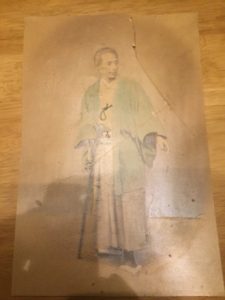
[The photo of Katsu Kaishū was taken at the British Legation in Yokohama by Ernest Satow, secretary to Sir Harry Parkes, the British minister to Japan, around the time the shogun’s castle was surrendered to the new Imperial government in the spring of 1868. “I was so very sleepy at the time,” Kaishū recalled years later. “But they dragged me over there. Satow took it, because, as he said, ‘You’re going to be killed.’” The photo is from the family album of Professor Douglas A. Stiffler, a great-great grandson of Katsu Kaishū, who has given me permission to use it.]

Samurai Revolution Miniseries Project

644502_247397672083151_1209814990_n

widget_buy_amazon

Takasugi Shinsaku and the Chōshū Domain

Takasugi Shinsaku

During the first two months of 1866, around two years before the fall of the Tokugawa Bakufu, the anti-Bakufu rebels in Chōshū, led by the indomitable young samurai Takasugi Shinsaku, ousted the ruling conservatives in a bloody civil war. As leader of Chōshū’s powerful army, Takasugi envisaged Chōshū as becoming “the most powerful and wealthy nation among the five great continents.”

Chōshū (modern-day Yamaguchi Prefecture) was one of two samurai clans most responsible for overthrowing the Bakufu and bringing about the Meiji Restoration. The other was its rival Satsuma (modern-day Kagoshima Prefecture). After the United States, Great Britain, France and others forced unfair trade treaties on the thus far isolated country in 1858, samurai from Chōshū, Satsuma, and other parts of Japan, most notably Tosa (modern-day Kochi Prefecture and home domain of Sakamoto Ryōma), called for a “strong military and rich nation” under a newly restored monarchy to fend off Western imperialism. They developed a military strong enough to overthrow the Tokugawa Bakufu, which, under the shogun, had ruled the country for over two and a half centuries.

For Takasugi “the five great continents” were synonymous with “the world,” suggesting his belief that Japan’s future lay with Chōshū. And to a great extent he was right. Former samurai of Chōshū and Satsuma would control the Meiji government into the twentieth century. During its infancy, the new Meiji government was dominated by the triad of Saigō Takamori, Ōkubo Toshimichi, and Kido Takayoshi (formerly Katsura Kogorō), and the Court nobles Sanjō Sanétomi and Iwakura Tomomi. After the deaths of Saigō, Ōkubo, and Kido within one year of each other (Kido of illness in May 1877, Saigō on the battlefield that September, Ōkubo by assassination in May 1878), the Japanese government continued to be dominated by Satsuma and Chōshū men, including Itō Hirobumi, Inoué Kaoru and Yamagata Aritomo. Itō, architect of the Meiji Constitution of 1889, was the Meiji government’s first prime minister (from 1885 to 1888). Of the first fourteen cabinets (1885 to 1912), eight were led by former Chōshū samurai (Itō, four times Yamagata Aritomo, twice; Katsura Tarō, twice), and three by men of Satsuma (Kuroda Kiyotaka, once; Matsukata Masayoshi, twice). And while Katsu Kaishū, “the shōgun’s last samurai” of my Samurai Revolution, headed up the Imperial Navy in its nascent years, after Saigō’s death the Imperial Army was dominated by Yamagata, though Satsuma’s naval leadership was stronger than Chōshū’s. It is noteworthy that current Prime Minister Shinzo Abe is a descendent of Chōshū samurai.

Related articles:

Takasugi Shinsaku’s Indomitable Spirit

Takasugi Shinsaku: The Dynamic Leader of the Choshu Rebels

Takasugi Shinsaku: “To Think While on the Run”

Prime Minister Abe’s Choshu Connection


Takasugi Shinsaku, along with Chōshū and Satsuma,  features prominently in Samurai Revolution.

644502_247397672083151_1209814990_n

widget_buy_amazon

“Man-Cutter” Izō

Okada (“Man-Cutter”) Izō was one of the three most notorious assassins of the Bakumatsu era. As I wrote in my forthcoming Samurai Assassins, “… the original purpose of a sword was to kill people. But ‘in the Tokugawa era it became a philosophy. Izō [however] . . . taught himself fencing as a means of killing.’”

Okada Izō was Takechi Hanpeita’s favorite fencing student and, as it turned out, his “chief hit man” during a spree of assassinations in Kyoto and elsewhere.


hillsborough_978-1-4766-6880-2
widget_buy_amazon

Takechi Hanpeita: Samurai

unknown-2

(excerpted from Samurai Assassins)

Until he would conceive of the [revolutionary] Tosa Loyalist Party, Takéchi Hanpeita was first and foremost a swordsman—but the Japanese sword he wore at his side, nearly three feet long, represented “his belief in the Imperial Country,” wrote his earliest biographers. . . .  A Confucian scholar and martial artist who also excelled in the arts of poetry, painting, and calligraphy, the extraordinarily strong-willed Takéchi was a stoic whose adherence to bushidō had become the stuff of legend even before his stunning seppuku in …1865. Around six feet tall, he had an imposing physique. His portrait by an unknown artist depicts a meticulously groomed, handsome man of a light complexion, long nose, and slightly protruding lower jaw, who “was praised by the local people and honored and revered by his students.” He rarely showed emotion, neither joy nor anger, while his large, piercing eyes shone with a distinctive brilliance. So firm of character was he, that his “gaze shot right through a man,” recalled fellow Tosa Loyalist Sasaki Takayuki, a future court chamberlain and member of Emperor Meiji’s Privy Council. But perhaps Takéchi’s most distinguishing trait was sincerity—that cardinal virtue that ranked with courage, loyalty, and honor as the true measure of a man.

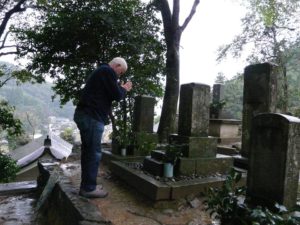
at-hanpeitas-grave

(Photo shown above is at Hanpeita’s grave in Kochi, November 2015.)

Takéchi Hanpeita is the focus of Part II of my forthcoming Samurai Assassins, to be published by McFarland in spring 2017.


hillsborough_978-1-4766-6880-2
widget_buy_amazon