
At a house in the Shimabara pleasure quarter of Kyoto, probably around the Fourth Month of Genji 1, the Japanese calendrical year corresponding to 1864, Kondō Isami, commander of the Shinsengumi, inscribed three characters on the back of an iron-ribbed fan owned by his friend Tomizawa Chūémon, a village headman from his native Tama near Edo:
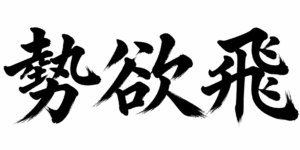
I translated Kondō’s calligraphy in my forthcoming Samurai Swordsmen: The Definitive History of the Shinsengumi amid the Fall of the Tokugawa Shogunate (1863–1869).
It expresses a particularly powerful desire of Kondō Isami, which he would realize in less than two months in the Shinsengumi’s notorious raid on a meeting of anti-Bakufu rebels at the Ikédaya inn in Kyoto. The translation is revealed in Chapter 14: The Ikédaya Incident.