Ryōma’s Eerie Foresight

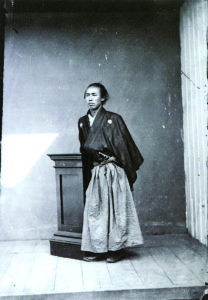
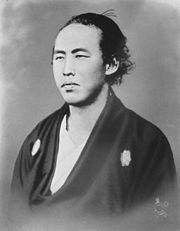
That Sakamoto Ryōma was endowed with an uncanny power of prescience is beyond dispute, as he demonstrated on numerous occasions during the last five years of his life. I have documented these over the years, starting with the biographical novel Ryoma: Life of a Renaissance Samurai, and more recently in Samurai Revolution and Samurai Assassins.

On the 150th anniversary of Ryōma’s assassination let’s consider two striking examples of his apparent foresight of his own death:

• In a letter to his sister, Sakamoto Otomé, about two and a half years before his death, he wrote: “I don’t expect that I’ll be around too long. But I’m not about to die like any average person either. I’ll only die when big changes finally come, when even if I continue to live I’ll no longer be of any use to the country.” (quoted in Samurai Revolution)

• In a letter to a friend written four days before his assassination in Kyōto, he alluded to the great danger facing Japan under the Bakufu and urged his friend to be careful for his life. “Now is the time for us to act. Soon we must decide on our direction, whether it lead to pandemonium or paradise.” (quoted in Samurai Assassins)


Samurai Assassins Part II: Takéchi Hanpeita

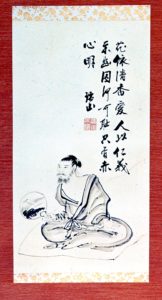
Part II of my new book, Samurai Assassins, is the first in-depth biographical treatment in English of Takéchi Hanpeita, charismatic leader of the Tosa Loyalist Party and mastermind of “divine punishment,” which wreaked terror on the streets of Kyōtō. Takéchi’s important role in the “samurai revolution” is covered in detail, including his meteoric rise to power and his sudden arrest and imprisonment ending with his stunning seppuku (self-disembowelment). I referred to Takéchi’s journals, contained in an early biography published in 1912; and more heavily to his letters from jail to his wife and cohorts on the outside. To the best of my knowledge, Takéchi’s letters have rarely, if ever, been used by Western writers. (Takéchi Hanpeita’s self-portrait, painted in prison at Kōchi in 1864, is courtesy of Kochi Prefectural Museum of History.)

hillsborough_978-1-4766-6880-2
widget_buy_amazon

The Motives Behind Sakamoto Ryōma’s Assassination

Based on his resistance to the social iniquities and restraints under the Tokugawa Bakufu – i.e., the shogun’s government – Sakamoto Ryōma changed history through a series of unparalleled historical achievements: the founding of Japan’s first trading company; the brokering of a military-political alliance between the Bakufu’s most formidable enemies; and his great plan for peaceful restoration of Imperial rule.

After the shōgun’s historical announcement at his castle in Kyōto to relinquish power to the Imperial Court based on Ryōma’s peace plan, the situation in Kyōto was dangerous and volatile, with samurai “thirsty for blood” gathered there from all over the country, recalled Watanabé Atsushi, a Bakufu samurai who later claimed to have killed Ryōma. “Since Sakamoto was no good for the Bakufu or the Imperial Court…, I thought we had to kill him,” said Imai Nobu, a cohort of Watanabe’s, decades later.

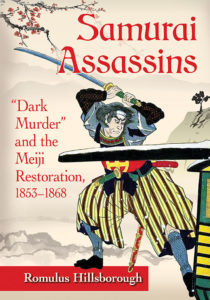
Read more about Ryoma’s assassins and their motives in my new book, Samurai Assassins.


hillsborough_978-1-4766-6880-2
widget_buy_amazon


The Assassination of Sakamoto Ryōma (1)

The assassination of Sakamoto Ryōma on the eve of a revolution of his own design was probably the most tragic event of the Meiji Restoration. And certainly it was one of the most historically significant assassinations in what was thus far the most bloody and tumultuous period in Japanese history (1853-1868). In the Prologue of my novel, Ryoma: Life of a Renaissance Samurai (Ridgeback Press, 1999), I describe Ryōma as follows: “outlaw-samurai, pistol-bearing swordsman, freedom-fighter, pioneering naval commander, entrepreneur and statesman, a youth ahead of his time with an imagination as boundless as the Pacific Ocean–was a leader in the revolution to overthrow the shogunate and form a unified democracy in Japan.”

In my new book, Samurai Assassins, the printed edition of which was released today, I wrote, “To fully understand the scale of Ryōma’s tragedy, we must realize that he was a visionary and a genius—if genius means to conceive of original ideas and to have the courage and audacity to bring them to fruition.”

Part III of Samurai Assassins, is titled “The Assassination of Sakamoto Ryōma” His murder is shrouded in mystery. Samurai Assassins provides the first in-depth study of the tragic event in English, based mostly on primary sources.


hillsborough_978-1-4766-6880-2
widget_buy_amazon

Katsu Kaishū’s Portrait by US Navy Sailor Edward Kern

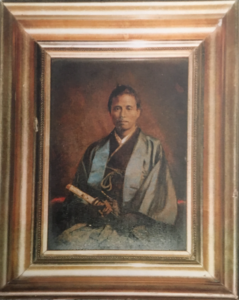
I really like this portrait of Katsu Kaishū. The artist was Edward M. Kern, one of the US Navy sailors under Lieutenant John M. Brooke who joined Capt. Kaishū and company on their historical journey aboard the warship Kanrin Maru, the first Japanese ship to reach North America upon landing at San Francisco on March 17 (St. Patrick’s Day), 1860. Based on the inscription on the backside of the painting, Kaishū was apparently known to the Americans as “Capt. Katzlintaro” (and at least one SF newspaper referred to him as Capt. Katsintarroh), Rintarō being his given name. Kern was a draftsman who had served in John Charles Fremont’s third expedition to the American West. Fremont named the Kern River in California after him. As I wrote in Samurai Revolution, the only full-length biography of Katsu Kaishū in English, the local San Francisco newspaper Daily Evening Bulletin described Katsu Kaishū as “a fine looking man, marvelously resembling in stature, form and features Colonel [John Charles] Fremont, only that his eye is darker, and his mouth less distinctly shows the pluck of its owner.”


Samurai Swordsmen: The Definitive History of the Shinsengumi (Helion, 2026) is now in production.
For professional guidance on Bakumatsu–Meiji Restoration history, see Historical Consulting.
Explore my books at Books at a Glance.