The Mysterious Death of a Japanese Emperor: Was It Deicide?

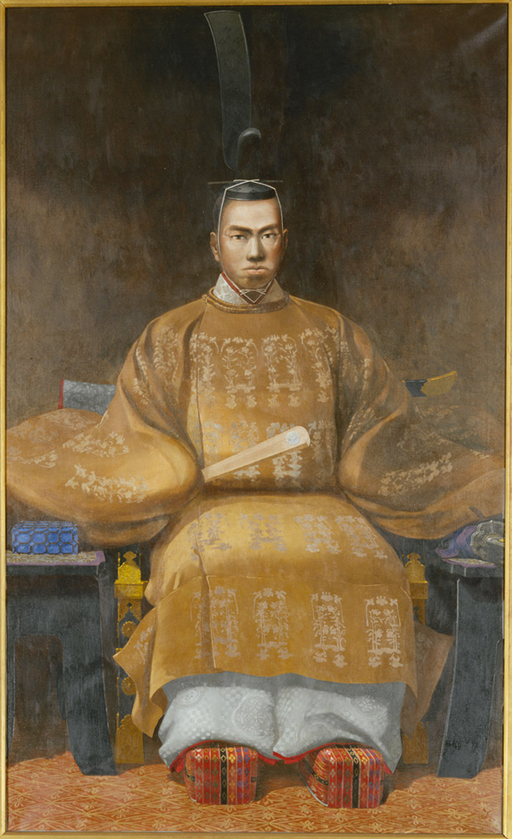
Portrait of Emperor Kōmei (1831–1867), the penultimate Emperor of pre-Meiji Japan, who died suddenly in January 1867 during the final months of the Tokugawa Bakufu (Shogunate).

[Portrait of Emperor Kōmei (1831–1867) by Koyama Shōtarō, 1902. Public domain via Wikimedia Commons.]

In the opening days of 1867, Emperor Kōmei of Japan died suddenly at the age of thirty-six. His death came only weeks after he had appointed Tokugawa Yoshinobu as shogun—an act that threatened the ambitions of the Satsuma and Chōshū domains to overthrow the shogunate and restore Imperial rule.

Twenty days before his sudden death, Emperor Komei had conferred upon Tokugawa Yoshinobu the title of shogun, placing him at the helm of the Bakufu, the teetering regime that had ruled Japan for over two and a half centuries. While the samurai clans of Satsuma and Chōshū, in collusion with the radical faction at the Imperial Court, were determined to eliminate Yoshinobu, overthrow the Bakufu, and restore Imperial rule, the Emperor had wanted nothing more than peace in his empire. But that peace had been threatened for over a decade by Western powers that had forced the formerly isolated country to conclude trade treaties against the Emperor’s wishes. The Imperial Court had not ruled in centuries, and so amid such dire straits the Emperor preferred to leave the governance of the country in the tried and true hands of the Bakufu. In fact, the Emperor was the greatest obstacle to Satsuma and Chōshū in their drive to make him the ruler of Japan. Komei’s son and heir, who would become the Emperor Meiji, was just a child who Satsuma and Chōshū expected would be more amenable to their plans to restore Imperial rule.

Komei was just thirty-six years old, robust, and in good health. In fact, the cause and circumstances of his death constitute a grim mystery of Japanese history—a mystery that has never been solved. But it seems certain that the cause of death was either smallpox or poisoning. Those who suspected assassination remained silent for nearly a century out of fear of imprisonment in pre-WWII Japan where the Emperor was worshipped as a god. Before WWII there was not even one document written in Japanese that openly stated that the great grandfather of the wartime Emperor Hirohito had been poisoned. I wrote in detail about the incident and the assassination theory in Samurai Revolution, Chapter 22: The Shōgun, the Emperor, and the Opposition at Court.


For more about my books in English, including Samurai Revolution, visit my Books at a Glance page. Read about my forthcoming Samurai Swordsmen here.

Follow me on Facebook | Amazon Author page
Giri: Is It Alive in Japanese Society Today?

義理

Giri, usually translated as “duty,” “obligation,” or “moral debt,” is one of the most misunderstood elements of Japanese ethics. In the Bakumatsu era it shaped the behavior of men like Takéchi Hanpeita, Katsu Kaishū, and Sakamoto Ryōma, and it raises an important question today: does giri still survive in modern Japan?

In Samurai Revolution (Chapter 5) I wrote the following: “Giri was integral to bushidō, the code of the samurai, a basic tenet of which was “strictness with superiors, and leniency with subordinates.” Based on loyalty to one’s feudal lord (i.e., obligation for favor received from one’s lord) and integrity founded on shame, giri, to a great extent, accounted for the harmony in samurai society, and it was an inherent element of both the aesthetics and the moral courage of the samurai caste.

unknown-2

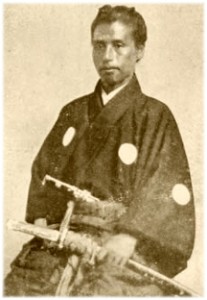
Takechi Hanpeita (武市半平太), leader of the Tosa Loyalist Party in the 1860s, wrote: “to be born a human being and not to have a sense of giri and gratitude is to be less than a beast.” (人と生まれて義理と恩とをしらざれハちくしょふにもおとり申し候)

 
Katsu_Kaishu
In Samurai Revolution (Chapter 5) I reported that Katsu Kaishū, in his history of the Japanese navy (海軍歴史), compared the Japanese navy to the navies of other countries. He implied that in the Japanese system severe punishment of sailors by commanding officers was probably unnecessary because, “We sustain the hearts and minds of our people only through obligation and justice, and integrity and shame.” (「皇国は属殊にして外国の風に似ず、ただ恩義と廉恥を以て衆心を維持」する)
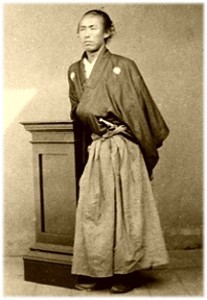
Sakamoto Ryoma
When Sakamoto Ryōma famously led a Chōshū warship against the Tokugawa Navy at Shimonoseki, more than the danger of battle he feared that he might encounter his former mentor, Katsu Kaishū, in command of the enemy fleet. “I could never fight against him,” he later told Tosa’s minister of justice, Sasaki Sanshirō (later Sasaki Takayuki).
 
Clearly giri was alive and powerful in the Bakumatsu years. Whether any of it survives in 21st-century Japan is another question entirely.
 
[For a fuller discussion of giri and its role in samurai ethics, see my Samurai Revolution, Samurai Assassins, and Samurai Swordsmen: The Definitive History of the Shinsengumi (forthcoming from Helion).]


“Without war there can be no true letters, and without letters there can be no true war”

Bushido, “way of the warrior,” was fundamental to samurai society. It was an unwritten code which incorporated the eight virtues of Confucianism: benevolence, justice, loyalty, filial piety, decorum, wisdom, trust, and respect for elders. Its most cherished values were courage and loyalty to one’s feudal lord. Chapter 8 of Samurai Revolution is titled “A Brief Discussion on Bushido.” I included it because a fundamental understanding of bushido is essential, I think, to understanding Japanese history.

Bushido Kyokai (武士道協会), a Tokyo-based NPO, describes bushido as “the spiritual foundation of the development of modern Japan.” The organization, which exalts life and world peace, states that its purpose is to “revive bushido in the hearts of modern Japanese people and people from around the world who live in Japan.”

Samurai were expected to be accomplished in bunbu ryōdō— “both the literary and martial arts.” As I mentioned in Samurai Revolution, the Confucianist Nakaé Toju (1608-1648) wrote of the reciprocal relationship between the literary and martial arts, as both were fundamental to government. “Without war there can be no true letters, and without letters there can be no true war.” Literature is the root of martial arts, and war is the root of literature—the purpose of war being to facilitate governing through the threat of arms. The Chinese character for war, pronounced bu (as in bushi, a synonym of “samurai”), is a combination of two simpler characters: “arms” (hoko) and “cease” (yamu). In other words, the true purpose of war and the martial arts is to keep the peace.

[Originally published August 2, 2015. Substantially revised and retitled November 2025.]

Follow me on Facebook | Amazon Author page

The Shinsengumi in English: Separating Myth from History with the Forthcoming Book

English language-based popularization of the Shinsengumi seems to keep on growing, as a quick Google search reveals. Unfortunately, most of this information is distorted, or simply wrong. Twenty or thirty years ago, almost nothing serious on the Shinsengumi existed in English. Today, the internet is filled with articles, videos, and discussions—most of them recycling the same half-remembered stories and television myths, mixed with manga- and anime-base fantasy.

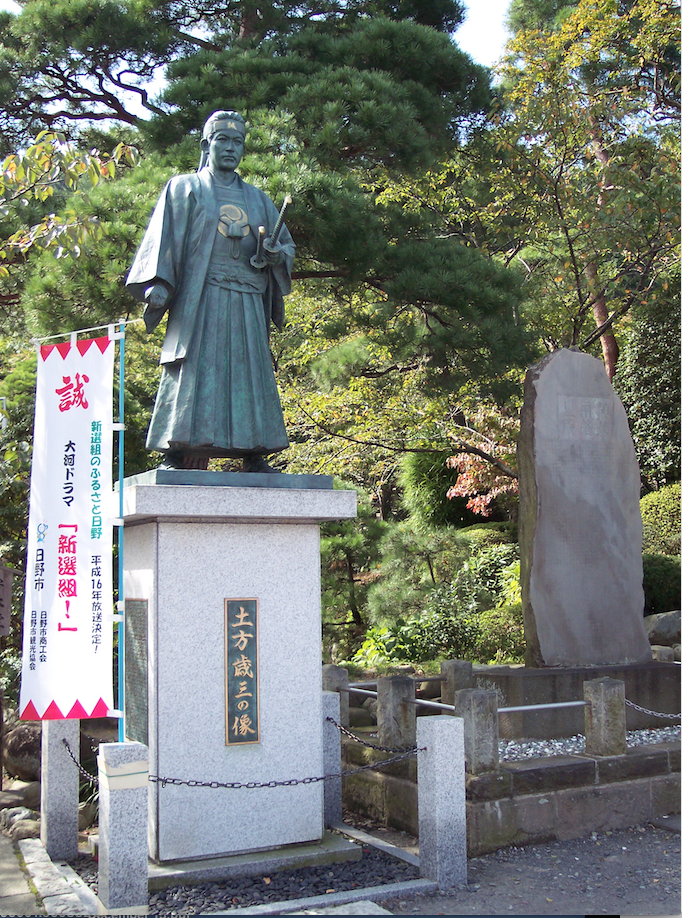
Statue of Hijikata Toshizō at Takahata Fudō Temple, Hino
(The photo of the statue of Shinsengumi Vice-commander Hijikata Toshizō at the Takahata Fudō Temple in Hino was taken by the author.)

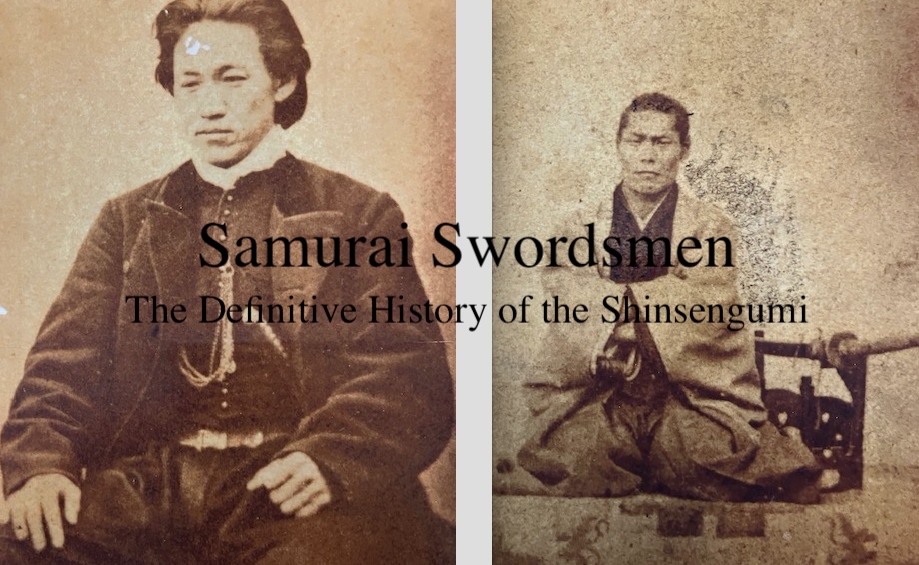
The only credible book in English about the Shinsengumi is my own, published by Tuttle in 2005. But it’s an introductory volume on the “shogun’s last samurai corps,” which is why in July 2017 I began writing my forthcoming Samurai Swordsmen: The Definitive History of the Shinsengumi amid the Fall of the Tokugawa Shogunate (1863–1869), to be published by Helion in fall 2026.

As the title indicates, I believe it will be both the definitive history of the Shinsengumi and a comprehensive history of the Bakumatsu–Meiji Restoration era, from the perspective of the losing side of the upheaval. In that sense, it is the perfect companion volume to my previous comprehensive history of the era, Samurai Revolution, which focuses on the victors, “through the eyes of the shogun’s last samurai.”

Updates and background materials related to Samurai Swordsmen: The Definitive History of the Shinsengumi amid the Fall of the Tokugawa Shogunate (1863–1869) will appear on the Shinsengumi Hub.


Samurai Swordsmen: The Definitive History of the Shinsengumi amid the Fall of the Tokugawa Shogunate (1863–1869) (Helion, 2026) is now in production.
For professional guidance on Bakumatsu–Meiji Restoration history, see Historical Consulting.
Explore my books at Books at a Glance.

Shinsengumi Hub Updated — Essays, Sources, and New Connections

Over the past week I’ve updated the Shinsengumi Hub, linking together essays and research notes written over the past decade—from early reflections in 2016 to recent studies leading toward my forthcoming Samurai Swordsmen: The Definitive History of the Shinsengumi (1863–1869). The Hub now serves as a single access point for readers following my ongoing work on the Shinsengumi and the era that shaped them.

Many of these posts—some written years apart—are newly interlinked and arranged chronologically, tracing the evolution of my research and writing as Samurai Swordsmen has taken shape. Together they form a record of how this project has grown over time, from early source notes to full historical essays.