Did Sakamoto Ryōma Hold the Rank of Kaiden? A Historical Reassessment of His Swordsmanship

Sakamoto Ryōma’s level of expertise with a sword has long been a topic of debate among historians, writers, filmmakers, and so-called “Ryōma fans” throughout Japan. That he was an accomplished swordsman has never been questioned. He practiced the Hokushin-Itto style of kenjutsu at Chiba Sadakichi’s school in Edo for several years, receiving the respectable rank of mokuroku. But he famously used a pistol to defend himself during an attack by Tokugawa police at the Teradaya inn in Fushimi in early 1866. And less than two years later, he was assassinated at his hideout in Kyoto. If he was an expert swordsman, some ask, why did he use his pistol instead of his sword at the Teradaya? And why wasn’t he able to defend himself at Kyoto?

list of Ryoma certifiicates

The mokuroku is the only extant certificate that Ryōma received from Chiba. But notably it was for the halberd (naginata) and not the sword. Nor was it for the rank of kaiden, awarded to a swordsman who had mastered the style. And so, some argue, Ryōma wasn’t such a skilled swordsman after all. But as reported by Yomiuri Shinbun on October 14, 2015, a recently revealed handwritten list of certificates in the Hokushin-Itto style that Ryōma had supposedly received includes certificates of heiho kaiden (“expert in the art of warfare”) for the halberd and the sword, along with a mokuroku for the sword. The scrolled certificates were reportedly kept at the Hokkaido home of a Sakamoto family descendent, which was destroyed in a fire in the early part of the twentieth century.

The late Meiji Restoration historian Mamoru Matsuoka offered a cautious view at the time. In a 2015 note on Facebook, he observed that while the list includes the mokuroku certificate for the sword, it omits the intervening ranks that would normally precede kaiden. Therefore, he considered the “kaiden” entry a copying error for mokuroku.

Saigō Takamori’s “kindness, gentility and modesty”

“I don’t know about difficult things such as affairs of state.” Saigō Takamori

Saigo Takamori

Katsu Kaishu told an anecdote illustrating Saigō’s kindness and gentility—and his modesty. It has to do with a man named Hitomi Yasushi, who had been among those in the Bakufu opposing Shogun Tokugawa Yoshinobu’s abdication. Hitomi had fought against the Satsuma troops at the outbreak of civil war at Toba-Fushimi in Keio 4/1 (1868), and later against the forces of the Imperial government at Hokodate. Not long after the Meiji Restoration of 1868, Hitomi visited Kaishu at his home. Saying that he wanted to meet Saigō, he asked for a letter of introduction. “But it seemed that he intended to kill Saigō,” Kaishu recalled:

“I wrote the letter for Hitomi, but included the following warning: ‘This man intends to kill you. But please meet with him anyway.’ So Hitomi went down to [Saigō’s home in] Satsuma. The first person he met there was Kirino [Toshiaki]. Kirino . . . had a discerning eye. . . . So when he opened and read my letter to Saigō, he understood the situation. Even the fearless Kirino was a little startled—and immediately informed Saigō. But Saigō remained absolutely calm. ‘If he’s got an introduction from Katsu, I’ll meet him,’ he said. So on the next day Hitomi visited Saigo’s home. ‘My name is Hitomi Yasushi,’ he announced. ‘I’ve come to talk to you.’ Saigō was lying down near the front door. Hearing Hitomi’s voice, he calmly got up and said, ‘…I don’t know about difficult things such as affairs of state. Just listen to this. The other day I took a trip. . . . Along the way I got very hungry. So I bought some potatoes and ate them. Certainly you can’t expect a guy like me, who can satisfy his hunger [with just potatoes], to know about the state of things in our country.’ Then he opened his mouth wide and burst out laughing. The impetuous Hitomi was caught off-guard by the sudden words. Far from killing Saigo, he left without saying so much as ‘goodbye.’ He was struck with admiration, and when he got back told me, ‘Saigō is truly a great man.'”

Hikawa Seika (Kodansha, vol. 21, p. 56)

Read more about Saigō Takamori’s philosophy in “Revere Heaven, Love Mankind” (敬天愛人)


For more about my books in English, including Samurai Revolution, visit my Books at a Glance page.

Follow me on Facebook | Amazon Author page


“Revere Heaven, love mankind” (敬天愛人): Saigō Takamori’s Words of Wisdom

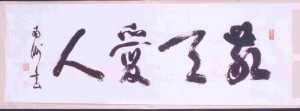
敬天愛人

敬天愛人 — “Revere Heaven, love mankind” — was Saigō Takamori’s cherished motto. In Samurai Revolution, I wrote the following:

“Revere Heaven, love mankind” represents a Confucian ethic that dictates the relationship between the people, the government, and the Emperor—in a universe ruled by Heaven. But Heaven cannot feasibly watch over each and every person, assuring peace and harmony in human society. That role, then, is allotted to the Emperor, the Son of Heaven. Assisting the Emperor in his holy obligation are the feudal lords. Assisting each feudal lord in assuring peace and harmony for the people in his domain are the government officials, selected from among the lord’s samurai vassals.

Heavy is the responsibility of the officials who oversee the everyday affairs of the feudal domains. Since they directly control the fate of the people, one blunder by just one official can mean catastrophe for a great number. As a leader of the people, a government official must win the hearts and minds of the people. To do so, he must put aside self-interest for the benefit of the people, who have no choice but to obey him. [end excerpt]
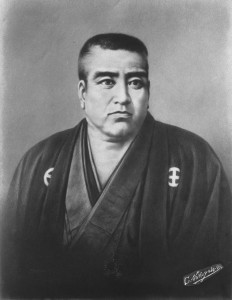
Saigo Takamori

Saigō’s philosophy is timeless. It expresses an enduring moral vision rooted in compassion, duty, and leadership. More than a political maxim, “Revere Heaven, love mankind” embodies the moral foundation of his life and actions—a teaching that continues to illuminate Japan’s transformation in the Bakumatsu–Meiji era.

[The image of Saigō’s calligraphy is from the website of Kagoshima Prefectural Library (鹿児島県立図書館). The image of Saigo is used in Samurai Revolution, courtesy of Japan’s National Diet Library.]

___________________

Read more about Saigō Takamori’s character in Saigō Takamori’s ‘gentility, kindness, and modesty’.

For a full account of Saigō Takamori’s life and philosophy, see Samurai Revolution.
The Mysterious Death of a Japanese Emperor: Was It Deicide?

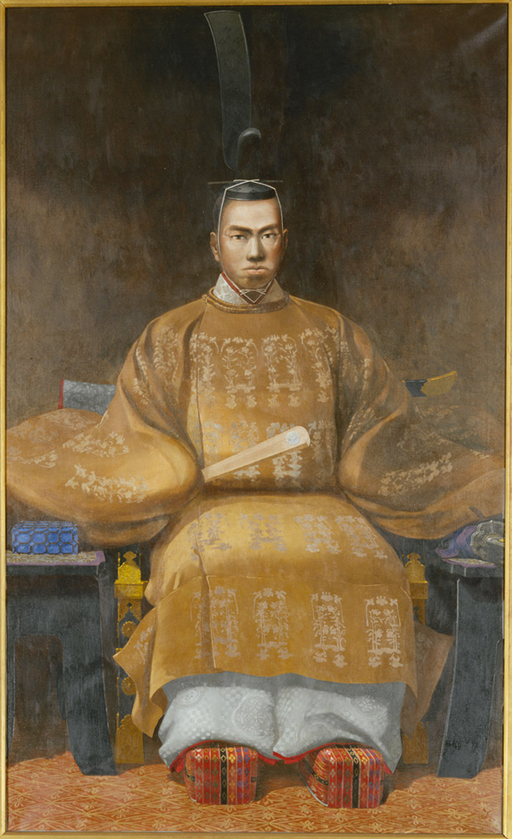
Portrait of Emperor Kōmei (1831–1867), the penultimate Emperor of pre-Meiji Japan, who died suddenly in January 1867 during the final months of the Tokugawa Bakufu (Shogunate).

[Portrait of Emperor Kōmei (1831–1867) by Koyama Shōtarō, 1902. Public domain via Wikimedia Commons.]

In the opening days of 1867, Emperor Kōmei of Japan died suddenly at the age of thirty-six. His death came only weeks after he had appointed Tokugawa Yoshinobu as shogun—an act that threatened the ambitions of the Satsuma and Chōshū domains to overthrow the shogunate and restore Imperial rule.

Twenty days before his sudden death, Emperor Komei had conferred upon Tokugawa Yoshinobu the title of shogun, placing him at the helm of the Bakufu, the teetering regime that had ruled Japan for over two and a half centuries. While the samurai clans of Satsuma and Chōshū, in collusion with the radical faction at the Imperial Court, were determined to eliminate Yoshinobu, overthrow the Bakufu, and restore Imperial rule, the Emperor had wanted nothing more than peace in his empire. But that peace had been threatened for over a decade by Western powers that had forced the formerly isolated country to conclude trade treaties against the Emperor’s wishes. The Imperial Court had not ruled in centuries, and so amid such dire straits the Emperor preferred to leave the governance of the country in the tried and true hands of the Bakufu. In fact, the Emperor was the greatest obstacle to Satsuma and Chōshū in their drive to make him the ruler of Japan. Komei’s son and heir, who would become the Emperor Meiji, was just a child who Satsuma and Chōshū expected would be more amenable to their plans to restore Imperial rule.

Komei was just thirty-six years old, robust, and in good health. In fact, the cause and circumstances of his death constitute a grim mystery of Japanese history—a mystery that has never been solved. But it seems certain that the cause of death was either smallpox or poisoning. Those who suspected assassination remained silent for nearly a century out of fear of imprisonment in pre-WWII Japan where the Emperor was worshipped as a god. Before WWII there was not even one document written in Japanese that openly stated that the great grandfather of the wartime Emperor Hirohito had been poisoned. I wrote in detail about the incident and the assassination theory in Samurai Revolution, Chapter 22: The Shōgun, the Emperor, and the Opposition at Court.


For more about my books in English, including Samurai Revolution, visit my Books at a Glance page. Read about my forthcoming Samurai Swordsmen here.

Follow me on Facebook | Amazon Author page

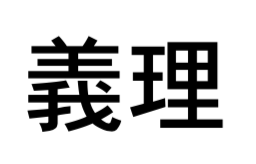
Giri: Is It Alive in Japanese Society Today?

義理

Giri, usually translated as “duty,” “obligation,” or “moral debt,” is one of the most misunderstood elements of Japanese ethics. In the Bakumatsu era it shaped the behavior of men like Takéchi Hanpeita, Katsu Kaishū, and Sakamoto Ryōma, and it raises an important question today: does giri still survive in modern Japan?

In Samurai Revolution (Chapter 5) I wrote the following: “Giri was integral to bushidō, the code of the samurai, a basic tenet of which was “strictness with superiors, and leniency with subordinates.” Based on loyalty to one’s feudal lord (i.e., obligation for favor received from one’s lord) and integrity founded on shame, giri, to a great extent, accounted for the harmony in samurai society, and it was an inherent element of both the aesthetics and the moral courage of the samurai caste.

unknown-2

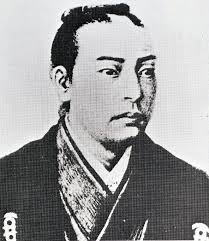
Takechi Hanpeita (武市半平太), leader of the Tosa Loyalist Party in the 1860s, wrote: “to be born a human being and not to have a sense of giri and gratitude is to be less than a beast.” (人と生まれて義理と恩とをしらざれハちくしょふにもおとり申し候)

 
Katsu_Kaishu
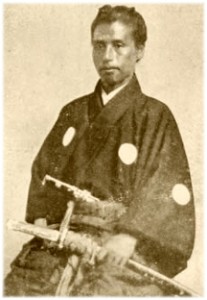
In Samurai Revolution (Chapter 5) I reported that Katsu Kaishū, in his history of the Japanese navy (海軍歴史), compared the Japanese navy to the navies of other countries. He implied that in the Japanese system severe punishment of sailors by commanding officers was probably unnecessary because, “We sustain the hearts and minds of our people only through obligation and justice, and integrity and shame.” (「皇国は属殊にして外国の風に似ず、ただ恩義と廉恥を以て衆心を維持」する)
Sakamoto Ryoma
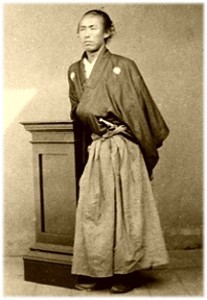
When Sakamoto Ryōma famously led a Chōshū warship against the Tokugawa Navy at Shimonoseki, more than the danger of battle he feared that he might encounter his former mentor, Katsu Kaishū, in command of the enemy fleet. “I could never fight against him,” he later told Tosa’s minister of justice, Sasaki Sanshirō (later Sasaki Takayuki).
 
Clearly giri was alive and powerful in the Bakumatsu years. Whether any of it survives in 21st-century Japan is another question entirely.
 
[For a fuller discussion of giri and its role in samurai ethics, see my Samurai Revolution, Samurai Assassins, and Samurai Swordsmen: The Definitive History of the Shinsengumi (forthcoming from Helion).]