A Note On Katsu Kaishū: A Samurai of the Highest Moral Character

Katsu Kaishū, “the shogun’s last samurai,” was not only an exceedingly interesting man but also one of the highest moral character – an attribute that seems to be sorely lacking among politicians and government officials today. By way of (partial) explanation, I offer the following edited excerpt from my Samurai Revolution:

In early 1868, Katsu Kaishū, as the commander of the forces of the fallen shogun’s regime, was prepared to take drastic measures rather than allow “millions of innocent people to die” in an imminent attack on the shogun’s capital of Edo, modern-day Tokyo, by the army of the new Imperial government. The drastic measures he had in mind were tied to the kenjutsu (Japanese swordsmanship) and Zen training of his youth. “Bushidō is found in dying,” asserts the key line of the memorable first chapter of Hagakure, the classic text of samurai values. Death was preferable to disgrace—there was “nothing particularly difficult” about it. Kaishū had reached that critical boundary line to which, it seems, the author of Hagakure had alluded a century and a half earlier. As ever, he wanted nothing more than peace; but, as ever, he would not have peace at any cost. Only a coward would choose life over death without achieving his objective—and Katsu Kaishū, for all his modern sensibilities, was a samurai through and through. Though his objective might be unachievable, he would never accept disgrace—for himself or for the Tokugawa.

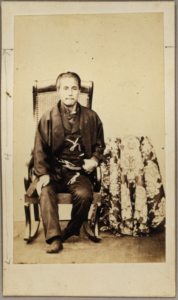
[The photo of Katsu Kaishū, taken just before surrender of Edo Castle in spring 1868, is used in Samurai Revolution courtesy of Yokohama Archives of History.]


Samurai Swordsmen: The Definitive History of the Shinsengumi (Helion, 2026) is now in production.
For professional guidance on Bakumatsu–Meiji Restoration history, see Historical Consulting.
Explore my books at Books at a Glance.

Katsu Kaishu’s Journal and Shinsengumi History

In writing Bakumatsu-Meiji Restoration history, Katsu Kaishu’s journal of the era is one of my most important sources. This applies to the Shinsengumi as well. For while Kaishu did not have much direct encounter with the Shinsengumi leaders, including Kondo Isami and Hijikata Toshizo, he documented the political landscape of the era to such an extent, and he captured its cultural and social essence so succinctly, that I find his journal indispensable in writing my in-depth history of the Shinsengumi.

[The above is a photo of my personal copy of Bakumatsu Nikki (“Bakumatsu Journal”), Vol. 1 of the 22-volume Kodansha edition of Katsu Kaishu Zenshu, the collected works of Katsu Kaishu, published in 1976.]

Follow Romulus Hillsborough on Facebook | Amazon Author page

A Note On “Hitokiri Izō”

The three most notorious assassins of the bloody Bakumatsu era (1853 – 1868)—Okada Izō, Tanaka Shimbé, and Kawakami Gensai—were from Tosa, Satsuma, and Kumamoto, respectively. All three bore the nom de guerre Hitokiri, literally “Man-Cutter”—which is really just another term for “murderer.” Izō was the chief hit man of Tosa Loyalist Party leader Takéchi Hanpeita, under whom he studied kenjutsu in Kochi (castle town of the Tosa daimyo) and also at the famed Momonoi Dōjō, one of the three most highly reputed kenjutsu schools in Edo, where Takéchi had served as head of students. As I wrote in Samurai Assassins,

The historical record of Okada Izō is scant. The historical novelist Shiba Ryōtarō writes of the “overly intense physical strength and stamina” with which “Hitokiri Izō” was naturally endowed. By age fifteen, perhaps even before studying under Takéchi, Izō had already started training on his own—not with a bamboo practice sword commonly used in the training hall but with a heavier and lethal oaken sword he had carved himself, “wielding it. . . from morning to night,” with such ferocity that his “body would be wasted,” thus developing extraordinarily powerful arms and the ability to handle a sword with great speed. As Shiba points out, the original purpose of a sword was to kill people. But “in the Tokugawa era it became a philosophy. Izō [however] . . .  taught himself fencing as a means of killing.” [end excerpt]

Izō was “intrepid by nature and fond of the martial arts,” wrote Tosa historian Teraishi Masamichi in 1928 (in Tosa Ijinden/“Biographies of Great Men of Tosa”). His sword “attack came swift, like a falcon, as was apparent in his nature—which was why [Takéchi] was so fond of him,” according to an early Takéchi biography published in 1912 (Ishin Tosa Kinnō-shi/“The History of Tosa Loyalism in the Meiji Restoration”).


Samurai Swordsmen: The Definitive History of the Shinsengumi (Helion, 2026) is now in production.
For professional guidance on Bakumatsu–Meiji Restoration history, see Historical Consulting.
Explore my books at Books at a Glance.
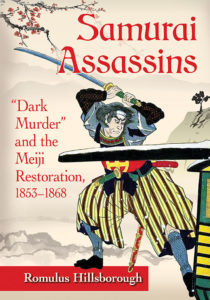
Note on “Samurai Assassins”

I have been studying Meiji Restoration history for more than thirty years, since I began research for my novel about Sakamoto Ryōma while living in Tokyo. In all of my books, I have explored the personalities of the leading actors in this history, presenting it as a human drama of epic proportion—thus bringing it to life.

Samurai Assassins was published in 2017. As I wrote in the Preface, the book is more than just a chronicle of “dark murder” [assassination] in the revolution [Meiji Restoration]. It is also an in-depth study of the ideology of the men behind the revolution, including bushidō, the code of the samurai, and the philosophy of Imperial Loyalism, which informed the revolution and would become the foundation of the Emperor-worship of World War II.

To the best of my knowledge, this is the first book in English to correlate bushidō and Imperial Loyalism in their respective indispensible roles in the Meiji Restoration. My previous book, Samurai Revolution, is a comprehensive history of the Meiji Restoration and the first ten years of Imperial rule. Samurai Assassins provides an in-depth overview of the Meiji Restoration, while focusing on significant men and events, and ideology, not expatiated in my previous book.

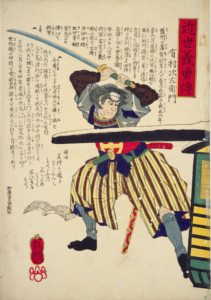
[The assassination of Ii Naosuke is the subject of Part I of Samurai Assassins. One of Ii’s assassins, Arimura Jizaemon of Satsuma, who delivered the coup de grâce, is depicted on the cover of the book. The image is part of a series entitled Kinseigiyuden (“Biographies of Loyal and Courageous Men”) by Ichieisai Yoshitsuya (1822 – 1866), originally published in a magazine called “Nishikie.”]

_____________

Recently I have been focusing on my forthcoming Samurai Swordsmen: The Definitive History of the Shinsengumi (1863–1869), scheduled for publication in fall 2026 with Helion. I also provide consulting on Bakumatsu–Meiji Restoration history and culture to authors, editors, publishers, documentarians, producers, screenwriters, translators, and other professionals who need expert guidance on the era.

See overviews of my other books at Books at a Glance.

Follow me on Facebook | Amazon Author page

Katsu Kaishū and Sakamoto Ryōma: A Meeting of the Minds

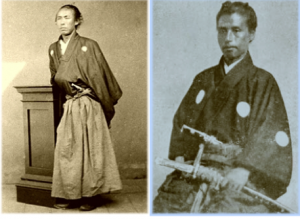
Composite image of Sakamoto Ryōma and Katsu Kaishū — created by Romulus Hillsborough to represent the mentor and disciple who helped shape Japan’s modern transformation.Few encounters in Japanese history carry as much weight as the first meeting between Katsu Kaishū, the shogunate’s forward-looking naval officer, and the outlaw samurai Sakamoto Ryōma. Kaishū, a man of discipline and vision, was committed to modernizing Japan through Western science and maritime strength. Ryōma, by contrast, was a restless revolutionary intent on overthrowing the Tokugawa shogunate. When these two men came together, what could easily have been a clash of swords became instead a meeting of minds—one that altered the course of Japan’s transition from feudal rule to modern nationhood.

How I wish I could have been present during their first meeting. Here is a slightly edited excerpt (without footnotes) from Samurai Revolution, Chapter 11: “The Commissioner and the Outlaw.”

Ryōma first visited Katsu Kaishū some time between the Tenth and Twelfth Months [of Bunkyū 2, Japanese year corresponding to 1862), though the date is unclear. In light of Ryōma’s Loyalist background and his antiforeign leanings, and the fact that he was outwardly anti-Bakufu, it is not unreasonable to assume that he might have visited Kaishū’s home with blood in his eyes. “Sakamoto Ryōma came to kill me,” Kaishū would say in a newspaper interview years later, on April 3, 1896. But Kaishū tended, on occasion, to exaggerate and embellish upon his past exploits—and, I contend, that tendency was at work during that particular newspaper interview. In fact, it is hard to believe that Ryōma intended to kill him. Ryōma, who hated bloodshed, is believed to have killed only once, and that in self-defense a few years later. Furthermore, with his naval aspirations, Ryōma stood to benefit through amicable relations with the man he would soon call “the greatest . . . in Japan.”

According to Kaishū, Ryōma was accompanied by Chiba Jūtarō on his first visit to Hikawa [Kaishū’s home]. Kaishū must have been forewarned by Shungaku. And it seems unlikely that the adept in Zen and kenjutsuwould have been taken off guard by the two younger and less experienced men. At any rate, Kaishū invited his visitors inside. Ryōma and Chiba would have had their two swords at their left hip. Ryōma, who according to a childhood friend “was of average height,” was much taller than Kaishū, who was only about five feet tall. And, of course, Kaishū would have been unarmed at home. “If you don’t like what I have to say, you should kill me,” he claimed to have told them. The two visitors, probably startled, followed Kaishū into the house. No doubt they were impressed by Kaishū’s pluck, although his tongue was certainly stuck in his cheek! According to Hirao, when the two swordsmen started to remove their swords as protocol demanded, Kaishū stopped them, perhaps to keep the upper hand. “It would be careless of you as samurai to take off your swords in these troubled times,” he reportedly said. Ryōma and Chiba were presently seated in the drawing room. “So, you’ve come to cut me down. Don’t try to hide it. I can see it in your eyes.”

Needless to say, Ryōma did not kill Kaishū. Instead, he listened closely as Kaishū discoursed on the state of the country and the world at large. Kaishū spoke of the futility of trying to defend against the foreign onslaught without a navy, for which Japan needed Western technology. He said that the navy must be a national effort, and not merely a force of the Tokugawa Bakufu. It must include capable young men from all the feudal domains, regardless of lineage, and not only the privileged sons of Tokugawa vassals. Such radical talk from the shōgun’s vice warship commissioner must have stunned the outlaw, who was captivated. Years later Kaishū wrote, “It was around midnight. After I had spoken incessantly about the reasons why we must have a [national] navy, [Ryōma], as if having understood, told me this: ‘I was resolved to kill you this evening, depending on what you had to say. But having heard you out, I am ashamed of myself.’” (It’s hard to believe that Ryōma actually spoke those words, and even if he did, that he meant them. But based on the fact that they were written down by Kaishū rather than reported in an interview, it is also hard to discount them. My only explanation is that Ryōma perhaps said those words to demonstrate to the Bakufu official, and even more importantly to his friend Chiba Jūtarō, his dedication to Imperial Loyalism.) “He told me that he wanted to become my student,” Kaishū wrote. Kaishū thought Ryōma to be “quite a man,” who “had a cool head, and a certain power about him that was hard to penetrate. He was a good man.” He readily accepted Ryōma’s request.

That Kaishū and Ryōma, men from opposing camps, not only set aside their differences but forged one of the most consequential alliances in Japanese history is a testament to both their characters. Kaishū’s pragmatism and Ryōma’s daring combined to pave the way for a relatively bloodless transition of power in 1868. It is no exaggeration to say that without this meeting, Japan’s path to modern nationhood might have been far more chaotic.


Samurai Swordsmen: The Definitive History of the Shinsengumi (Helion, 2026) is now in production.
For professional guidance on Bakumatsu–Meiji Restoration history, see Historical Consulting.
Explore my books at Books at a Glance.