Finished Writing “Ryoma” Over 30 Years Ago

Over thirty years ago I completed the draft manuscript of my first book, Ryoma: Life of a Renaissance Samurai, in my apartment on the Sumida River in Tokyo’s Asakusa district, just a few short blocks from where the statue of Katsu Kaishū stands today. At the time, I wasn’t even sure the book would ever see print—it would be another seven and a half years before publication.

Looking back, it’s remarkable to see the journey this book has taken. From those early days of writing in Tokyo to its place today in libraries and private collections, Ryōma has traveled far. One particularly special moment was seeing the book displayed at the private library of the Teradaya Inn in Fushimi, Kyoto, a location intimately tied to Ryōma’s own history.

These photos taken at Teradaya library capture a personal milestone: the moment my work joined the tangible history of the people and places it portrays. It’s a humbling reminder of how far the book has come and the enduring fascination with Ryōma, the “Renaissance Samurai.”

Reflecting on this milestone not only celebrates the book’s journey but also highlights the enduring relevance of Ryōma’s life and legacy in Japanese history. For anyone interested in exploring his story in depth, you can learn more about Ryoma: Life of a Renaissance Samurai here.

[The top photo was taken by my friend and fellow writer Phillip Jackson, as resident of Kyoto.]

Statue of Shinsengumi Vice-commander Hijikata Toshizō At Takahata Fudo Temple in Hino

Shinsengumi Commander Kondō Isami and Vice-commander Hijikata Toshizō were glorified as heroes upon their return to their native Tama in early 1868, shortly after the fall of the Bakufu. In death, not long thereafter, they were apotheosized. On the grounds of Takahata Fudō temple in Hino (in Tama), the stone Monument of the Two Heroes was completed in 1888, twenty years after Kondō’s execution, nineteen years after Hijikata fell in battle. Over a century later a bronze statue of Hijikata was erected near the monument. As I wrote in the closing of Shinsengumi: The Shogun’s Last Samurai Corps, “[t]he right hand grips a sword. The left fist is clenched. The eyes… the eyes battle-ready, are ever prepared for death, to meet Kondo underground.”

This post relates to my forthcoming book, Samurai Swordsmen: The Definitive History of the Shinsengumi (1863–1869). See the Shinsengumi Hub for additional essays and updates.

Follow me on Facebook | Amazon Author page

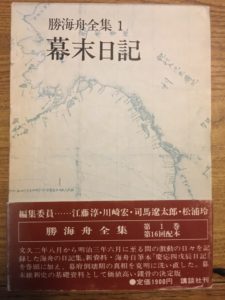
Katsu Kaishū’s “Notebook of Deceased Friends”

Katsu Kaishū, “the shogun’s last samurai” of Samurai Revolution, was a prolific writer. Recently I’ve been thinking about one of his books, Bōyūchō (“Notebook of Deceased Friends”), which he wrote in 1877 (at age fifty-seven), nine years after the Meiji Restoration, about ten important historical personages of that era. Following is an edited excerpt (without footnotes) from Samurai Revolution:
 

Though Katsu Kaishū had not mentioned Saigō Takamori’s death in his journal, shortly after Saigō died he produced a small book of late great men of the Meiji Restoration. It is clear that Saigō was foremost on his mind—but he could not explicitly dedicate the book to him. Bōyūchō (Notebook of Deceased Friends) is an annotated compilation of letters, poems, and paintings in the original calligraphic brushwork, which Kaishū personally had received from eight late friends “over my career of thirty years.” (The book actually covers ten men, but Kaishū possessed calligraphic works addressed to himself from only eight of them.) . . . . Included beside Saigō are (in order of appearance): Sakuma Shōzan, Yoshida Torajirō (Shōin), Shimazu Nariakira, Yamauchi Yōdō . . ., Katsura Kogorō, Komatsu Tatéwaki, Yokoi Shōnan, Hirosawa Hyōsuké, and Hatta Tomonori. Yokoi and Saigō are allotted the most space, with three works included from each of them. But Saigō alone is alluded to (if only implicitly) in the Introduction and it was with Saigō’s poem, Zangiku(“Chrysanthemums of Early Winter”), that Kaishū concluded the book.


Samurai Swordsmen: The Definitive History of the Shinsengumi (Helion, 2026) is now in production.
For professional guidance on Bakumatsu–Meiji Restoration history, see Historical Consulting.
Explore my books at Books at a Glance.
Mamoru Matsuoka: A Tribute to a Major Historian of the Meiji Restoration

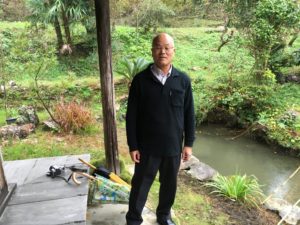
Students and writers of Meiji Restoration history lost an important teacher this week with the passing of historian Mamoru Matsuoka in Kochi, Japan, his hometown, and also the home of major Restoration figures such as Sakamoto Ryōma, Takechi Hanpeita, and Nakaoka Shintarō, on whom he wrote insightful and meticulously researched biographies.

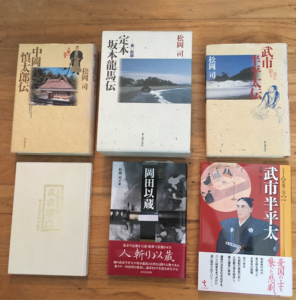
Of several fine biographies of Ryōma that I have read, Matsuoka-sensei’s Teihon Sakamoto Ryoma-den is the “authoritative edition,” as the title indicates. His works on Takechi and Nakaoka have been of particular value to me as a writer because of the dearth of reliable biographies about these two men.

Matsuoka-sensei was my friend. As a writer, I am greatly indebted to him. My deepest condolences to his family.

[The photo of Matsuoka-sensei was taken in the garden at the ancestral home of Takechi Hanpeita in Kochi, on November 13, 2015. These six of his books are, clockwise from upper left: “Nakaoka Shintaro-den” (biography of Nakaoka Shintaro); “Teihon Sakamoto Ryoma-den” (biography of Sakamoto Ryoma: authoritative edition); “Takechi Hanpeita-den” (biography of Takechi Hanpeita); “Takechi Hanpeita”; “Seiden Okada Izo” (authentic biography of Okada Izo); “Tosa Kinno-to Shuryo Takechi Zuizan: Mikokai Shiryo no Shokai” (Tosa Loyalist Party Leader Takechi Zuizan: A Presentation of Unpublished Materials)]

A Note On Ryoma, the Gunman

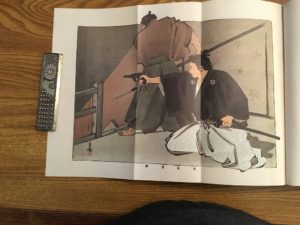
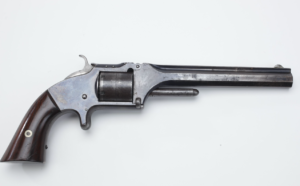
The other day I was interviewed by John Dolan, co-host of a very fine weekly podcast called “Radio War Nerd,” which covers a wide range of military topics. John had read my Shinsengumi and became interested in the “samurai revolution.” He mentioned that many men had been butchered with swords during those years, and asked why samurai did not also use guns against their enemies. In my reply, I failed to mention the incident at the Teradaya inn in the outskirts of Kyoto, in which Sakamoto Ryoma famously used a Smith and Wesson revolver to defend against an attack by a Bakufu police unit, as depicted in this print published in Chikami Kiyomi’s early biography (1914). In Samurai Revolution, I translated Ryoma’s own account of the incident, as reported in a letter to his family. Following is a brief excerpt: Thinking that the enemy was going to attack from the [left] side, I shifted my position to face left. Then I cocked my pistol and I fired a shot at [the man] on the far right of the line of ten enemy spearmen. But he moved back, so I shot at another one, but he also moved back. Meanwhile, [others of] the enemy were throwing spears, and also hibachi [charcoal braziers], fighting in all sorts of ways. . . . Needless to say, the fighting inside the house made quite a racket. Now I shot at another man, but didn’t know if I hit him.

Smith & Wesson No. 2 Army revolver, same model carried by Sakamoto Ryoma