
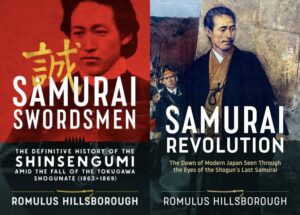
When I began writing Samurai Revolution, I had no intention of producing a trilogy. My purpose was to tell the story of the political, social, and cultural upheaval that transformed Japan during the final years of the Tokugawa shogunate and the early Meiji period from the perspective of one of the era’s most compelling figures, Katsu Kaishū, “the shogun’s last samurai.” The book was first published in 2014, after years of research and writing.
Since then, my work has continued to draw me back to the same extraordinary period of Japanese history. The more deeply I have examined the events and personalities of those years, the more apparent it has become that the revolution cannot be adequately understood from any single perspective.
My subsequent work on Samurai Swordsmen, a history of the Shinsengumi amid the fall of the Tokugawa shogunate, brought me into close contact with a very different group of men from those who dominate the narrative of Samurai Revolution. Whereas my earlier book on the Shinsengumi was an introductory study, Samurai Swordsmen is intended as a definitive history of the corps. Kondō Isami and Hijikata Toshizō, the two principal figures of the Shinsengumi, were born into peasant households. Yet, as I demonstrate in the book, both men, in their lives and deaths, embodied bushidō, the samurai code, rising to command a corps of swordsmen that became one of the most formidable defenders of the Tokugawa regime during its final years.
Writing their history required me to examine the revolution from the perspective of men whose fortunes were bound to the survival of an order that was rapidly disintegrating. It also meant returning to many of the events and personalities I had previously written about, but approaching them from another direction.
I am now writing The Last Shogun: The Fall of Tokugawa Yoshinobu in the Samurai Revolution. This third volume of the trilogy takes me back to the origins of the political crises that ultimately destroyed the shogunate, beginning with Yoshinobu’s father, Tokugawa Nariaki, the powerful and uncompromising daimyo of Mito. My subject is Yoshinobu himself: the circumstances that shaped him, his rise to power, and his role in the downfall of the government he came to lead.
One figure who appears throughout all three books is Katsu Kaishū. He occupies a central place in Samurai Revolution, but his involvement in the political and military affairs of the period also makes him an important presence in Samurai Swordsmen and The Last Shogun—a voice of reason amid an age overcome by chaos, tumult, and bloodshed. In that sense, Kaishū provides a thread running through all three historical narratives.
It was only after completing the first two volumes and beginning work on The Last Shogun that I came to think of them collectively as the Samurai Revolution Trilogy. The designation does not mean that the books form a continuous narrative, or that the second begins where the first ends. There is considerable chronological overlap, and many of the same historical figures appear in more than one volume. But the emphasis, the principal characters, and the questions that concern me differ from book to book. Each stands on its own and can be read without having read the others.
The first two volumes, Samurai Revolution: The Dawn of Modern Japan Seen Through the Eyes of the Shogun’s Last Samurai, in a revised and expanded edition, and Samurai Swordsmen: The Definitive History of the Shinsengumi amid the Fall of the Tokugawa Shogunate (1863–1869), are due for release by Helion & Company late in 2026 and the spring of 2027, respectively. The Last Shogun, also expected from Helion, remains a work in progress.
I have spent more than four decades studying and writing about this period of Japanese history, including sixteen years living in Japan, where I conducted research and visited many of the places associated with the people and events that figure in my books. Yet the work continues to lead me into unfamiliar territory.
Whether readers encounter these books individually or together, I hope the trilogy will help them understand the complexities of the samurai revolution and the men whose decisions, convictions, ambitions, and conflicts shaped its course and laid the foundation of modern Japan.