Self-portrait From Jail of Takéchi Hanpeita, Samurai Through and Through (2)

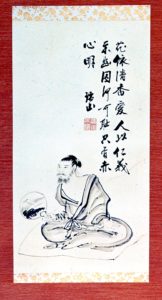
Below is a transcription of the poem on his self-portrait, followed by my English translation:

花依清香愛

人以仁義栄

幽囚何可恥

只有赤心明

A flower is cherished for its pure fragrance./A man glories in humanity and justice./Imprisonment brings no shame,/As long as one’s heart is sincere.

[Takéchi Hanpeita’s self-portrait appears in Samurai Assassins, courtesy of Kochi Prefectural Museum of History.]

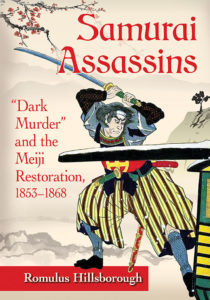
Takéchi Hanpeita is the focus of Part II of Samurai Assassins. Also see this recent post. 


hillsborough_978-1-4766-6880-2
widget_buy_amazon

On The 150th Anniversary of the Meiji Restoration (21) – The Final Installment

Wanted: International film professionals and investors with vision to produce a film about “Renaissance Samurai” Sakamoto Ryoma for worldwide audience

Meiji Restoration hero Sakamoto Ryoma is a national icon in Japan. When I “discovered” Ryoma over thirty years ago, I was so enthralled (I repeat “enthralled”) by his personality and history that I thought that people all over the world should know about him. Which was why I wrote Ryoma: Life of a Renaissance Samurai, the only English-language novel about this fascinating man.

While researching and writing the book, I often felt that Ryoma’s story would make for a great Hollywood film. And during the twenty years since the book was published, many people have expressed similar thoughts. I am not in the film industry; but I have been advised by industry experts that this could not happen without the support of a major Hollywood producer or director – and of course sponsors.

In this final installment of my series on the 150th Anniversary of the Meiji Restoration, I reach out to all “Ryoma fans” for their ideas to make this dream a reality.

Think big! Create! Persevere!
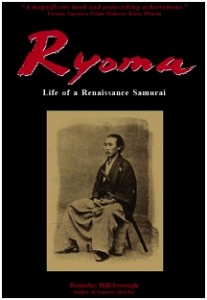

ryoma
widget_buy_amazon

Self-portrait From Jail of Takéchi Hanpeita, Samurai Through and Through

Takéchi Hanpeita is the focus of Part II of Samurai Assassins. Following is a slightly edited excerpt, without footnotes:

During the summer of 1864, Takéchi painted self-portraits, the bearded face haggard, cheeks hollow, body emaciated after nearly ten months in his squalid jail cell. In one portrait he is seated cross-legged, his chest exposed beneath an open kimono, a fan in his right hand, his left hand placed on his knee. Another depicts a similar pose, with an open book in hand instead of the fan. Pronounced in both is a stoic composure in face of impending doom, founded on an inner-strength developed through years of martial training and study, and manifested through his eyes. Above the image in the first painting he included a poem, beginning with the metaphor of a fragrant flower and rejecting any notion of shame in his imprisonment as long as he lived up to his bushidō-based values. In a letter to his wife and sister probably composed around the same time, he wrote with humor that when drawing his self-portrait he was struck by his own “excessive good looks”—then he suddenly turned serious: “when I look in the mirror [I see that] I am thinner and that my moustache has grown out and my cheeks are hollow.” But, he assured them, they need not worry because “my mind is strong.”

[Takéchi Hanpeita’s self-portrait appears in Samurai Assassins, courtesy of Kochi Prefectural Museum of History.]

For more on Takéchi Hanpeita:

Samurai Assassins Part II: Takéchi Hanpeita

Takechi Hanpeita: Samurai


hillsborough_978-1-4766-6880-2
widget_buy_amazon

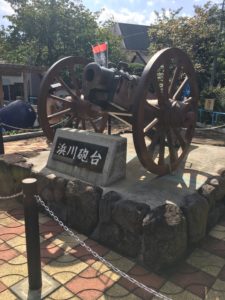
The Hamakawa Battery of Tosa Han, at Shinagawa – and my friend Kiyoharu Omino

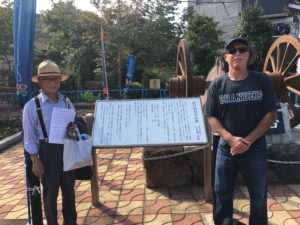
“Ryōma fans” at the annual gathering held in Tokyo last October visited Sakamoto Ryōma-related sites. Shinagawa was one of the destinations. Located there was Tosa’s residence at Samezu, where the retired daimyo of Tosa, Yamauchi Yōdō, had lived for a number of years; and where Ryōma and other Tosa samurai had been stationed.

Kiyoharu Omino, the distinguished writer and scholar of Bakumatsu history, gave talks at Yōdō’s alongside gravesite and at the reconstructed Hamakawa Battery of Tosa Han – whose eight guns would not have been able to hit Perry’s ships in Edo Bay in the summer of 19854 even if they had been fired. Ryōma, age twenty at the time, received gunnery training at the Hamakawa Battery as a student of Sakuma Shōzan, Mr. Omino wrote in the explanatory panel at the site.

_____________

Recently I have been focusing on my forthcoming Samurai Swordsmen: The Definitive History of the Shinsengumi (1863–1869), scheduled for publication in fall 2026 with Helion. I also provide consulting on Bakumatsu–Meiji Restoration history and culture to authors, editors, publishers, documentarians, producers, screenwriters, and other professionals who need expert guidance on the era.

To explore my books about Sakamoto Ryōma, Katsu Kaishū and others of the Meiji Restoration, see Books at a Glance.

Follow me on Facebook | Amazon Author page

Last Shogun Tokugawa Yoshinobu secluded himself in this room after the fall

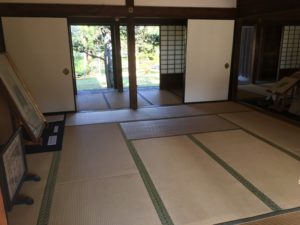
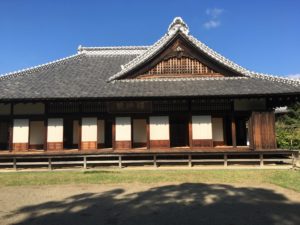
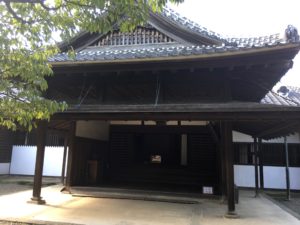
The last shogun, Tokugawa Yoshinobu, upon returning to his native Mito on the day his castle was surrendered in spring 1868, secluded himself in this room at the Kōdōkan, the official school of Mito, to demonstrate his loyalty to the new Imperial government. The room, named Shizendō (至善堂), is an Important Cultural Property, designated by the Japanese government. Its name means something like “Hall of Ultimate Virtue.”

Also see .