Katsu Kaishū and Sakamoto Ryōma: A Meeting of the Minds

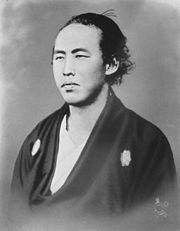
Composite image of Sakamoto Ryōma and Katsu Kaishū — created by Romulus Hillsborough to represent the mentor and disciple who helped shape Japan’s modern transformation.Few encounters in Japanese history carry as much weight as the first meeting between Katsu Kaishū, the shogunate’s forward-looking naval officer, and the outlaw samurai Sakamoto Ryōma. Kaishū, a man of discipline and vision, was committed to modernizing Japan through Western science and maritime strength. Ryōma, by contrast, was a restless revolutionary intent on overthrowing the Tokugawa shogunate. When these two men came together, what could easily have been a clash of swords became instead a meeting of minds—one that altered the course of Japan’s transition from feudal rule to modern nationhood.

How I wish I could have been present during their first meeting. Here is a slightly edited excerpt (without footnotes) from Samurai Revolution, Chapter 11: “The Commissioner and the Outlaw.”

Ryōma first visited Katsu Kaishū some time between the Tenth and Twelfth Months [of Bunkyū 2, Japanese year corresponding to 1862), though the date is unclear. In light of Ryōma’s Loyalist background and his antiforeign leanings, and the fact that he was outwardly anti-Bakufu, it is not unreasonable to assume that he might have visited Kaishū’s home with blood in his eyes. “Sakamoto Ryōma came to kill me,” Kaishū would say in a newspaper interview years later, on April 3, 1896. But Kaishū tended, on occasion, to exaggerate and embellish upon his past exploits—and, I contend, that tendency was at work during that particular newspaper interview. In fact, it is hard to believe that Ryōma intended to kill him. Ryōma, who hated bloodshed, is believed to have killed only once, and that in self-defense a few years later. Furthermore, with his naval aspirations, Ryōma stood to benefit through amicable relations with the man he would soon call “the greatest . . . in Japan.”

According to Kaishū, Ryōma was accompanied by Chiba Jūtarō on his first visit to Hikawa [Kaishū’s home]. Kaishū must have been forewarned by Shungaku. And it seems unlikely that the adept in Zen and kenjutsuwould have been taken off guard by the two younger and less experienced men. At any rate, Kaishū invited his visitors inside. Ryōma and Chiba would have had their two swords at their left hip. Ryōma, who according to a childhood friend “was of average height,” was much taller than Kaishū, who was only about five feet tall. And, of course, Kaishū would have been unarmed at home. “If you don’t like what I have to say, you should kill me,” he claimed to have told them. The two visitors, probably startled, followed Kaishū into the house. No doubt they were impressed by Kaishū’s pluck, although his tongue was certainly stuck in his cheek! According to Hirao, when the two swordsmen started to remove their swords as protocol demanded, Kaishū stopped them, perhaps to keep the upper hand. “It would be careless of you as samurai to take off your swords in these troubled times,” he reportedly said. Ryōma and Chiba were presently seated in the drawing room. “So, you’ve come to cut me down. Don’t try to hide it. I can see it in your eyes.”

Needless to say, Ryōma did not kill Kaishū. Instead, he listened closely as Kaishū discoursed on the state of the country and the world at large. Kaishū spoke of the futility of trying to defend against the foreign onslaught without a navy, for which Japan needed Western technology. He said that the navy must be a national effort, and not merely a force of the Tokugawa Bakufu. It must include capable young men from all the feudal domains, regardless of lineage, and not only the privileged sons of Tokugawa vassals. Such radical talk from the shōgun’s vice warship commissioner must have stunned the outlaw, who was captivated. Years later Kaishū wrote, “It was around midnight. After I had spoken incessantly about the reasons why we must have a [national] navy, [Ryōma], as if having understood, told me this: ‘I was resolved to kill you this evening, depending on what you had to say. But having heard you out, I am ashamed of myself.’” (It’s hard to believe that Ryōma actually spoke those words, and even if he did, that he meant them. But based on the fact that they were written down by Kaishū rather than reported in an interview, it is also hard to discount them. My only explanation is that Ryōma perhaps said those words to demonstrate to the Bakufu official, and even more importantly to his friend Chiba Jūtarō, his dedication to Imperial Loyalism.) “He told me that he wanted to become my student,” Kaishū wrote. Kaishū thought Ryōma to be “quite a man,” who “had a cool head, and a certain power about him that was hard to penetrate. He was a good man.” He readily accepted Ryōma’s request.

That Kaishū and Ryōma, men from opposing camps, not only set aside their differences but forged one of the most consequential alliances in Japanese history is a testament to both their characters. Kaishū’s pragmatism and Ryōma’s daring combined to pave the way for a relatively bloodless transition of power in 1868. It is no exaggeration to say that without this meeting, Japan’s path to modern nationhood might have been far more chaotic.


Samurai Swordsmen: The Definitive History of the Shinsengumi (Helion, 2026) is now in production.
For professional guidance on Bakumatsu–Meiji Restoration history, see Historical Consulting.
Explore my books at Books at a Glance.


“The heart of a samurai [must be] as solid as a rock.” Takechi Hanpeita

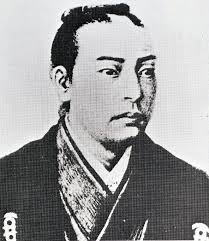
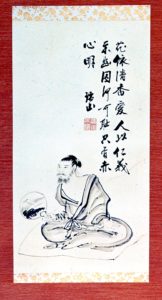
Takechi Hanpeita, the leader of the Tosa Loyalist Party who was determined to overthrow the Tokugawa Bakufu and restore Imperial rule, had languished in prison for nearly two years. On the 29th day of the Fifth Month of the Japanese year corresponding to 1865, he wrote to his wife from his squalid prison cell that “to lay down one’s life for one’s country or for one’s liege lord is true bushido.” Soon thereafter he was ordered to commit seppuku on the evening of the 11th day of the intercalary Fifth Month. Sentenced to die by his own hand based on trumped up charges of political crimes, he nonetheless took solace in the fact that he was at least given the honor of dying as a samurai, rather than be beheaded as a common criminal.“ [T]he heart of a samurai [must be] as solid as a rock,” he wrote. Now he would have the chance to live up to his words. His stunning seppuku, which he performed with such bravery that even his enemies witnessing the event “were left speechless,” is depicted in detail in Chapter 14 of Samurai Assassins.

[Takechi Hanpeita is the focus of Part II of Samurai Assassins. His self-portrait, which he produced in his prison cell, appears in Samurai Assassins courtesy of Kochi Prefectural Museum of History.]
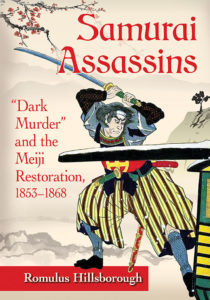

 

hillsborough_978-1-4766-6880-2
widget_buy_amazon

“Went up to the castle”

“Went up to the castle.” Katsu Kaishū, “the shogun’s last samurai,” repeated this phrase often in his journal, as vice commissioner and later commissioner of warships. He was, of course, recording his visits to the shogun’s castle, during the heady and dangerous years leading up to the revolution. “Went up to the castle” is the title of Samurai Revolution, Chapter 13, which opens as follows:

“ . . . I frequently encountered danger, which sometimes encouraged me. But sometimes it was difficult to endure the misery, and even when I hoped for death I survived only to suffer numerous more hardships.” (Katsu Kaishū)

The tide of revolution had been on the rise this past decade. The swirl began in Edo with the arrival of Perry’s “Black Ships” in 1853. Occasionally the tide ebbed, as during the reign of Ii Naosuké, only to surge again with the regent’s murder at the castle gate and the spree of assassinations of foreigners in Edo and Yokohama. As the Bakufu attempted in vain to stem the tide—through a union with the Imperial Court, consummated by the marriage between the young shogun and the Emperor’s sister—the architect of the marriage plan was nearly assassinated. Then sometime around the end of 1862 the tide suddenly turned, and the center stage of the gathering revolution shifted from the shogun’s stronghold at Edo to the Emperor’s capital at Kyoto.

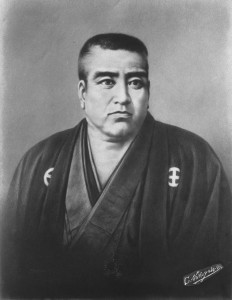
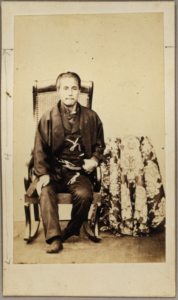
[The photo of Katsu Kaishū, taken just before surrender of Edo Castle, is used in Samurai Revolution, courtesy of Yokohama Archives of History.]

___________________

Katsu Kaishu is the “shogun’s last samurai” of Samurai Revolution, the only full-length biography of him in English.

The Quintessence of Samurai Morality

Like many Americans of conscience I am distressed over the current politics and society of our country. And so here are some words of wisdom from Saigō Takamori for these difficult times (slightly edited from Samurai Revolution, without footnotes):

Saigō Takamori, the quintessence of samurai morality, taught that “a great man,” unlike the average man, “never turns away from difficulty or pursues [his own] benefit.” He “takes the blame for mistakes upon himself and gives credit [for meritorious deeds] to others.” He “was physiologically unable to bear” even being suspected of any sort of underhandedness. He had a deep-seated repugnance of “love of self,” which, in his own words, he described as “the primary immorality. It precludes one’s ability to train oneself, perform one’s tasks, correct one’s mistakes,” and “it engenders arrogance and pride.” The ideal samurai “cares naught about his [own] life, nor reputation, nor official rank, nor money,” Saigō taught, even if such a man “is hard to control.”

[The image of Saigo is used in Samurai Revolution, courtesy of Japan’s National Diet Library.]


S644502_247397672083151_1209814990_n

widget_buy_amazon

Hanpeita and Ryōma

Recently I’ve been discussing Takéchi Hanpeita, while Sakamoto Ryōma has often been a subject of this blog. The two were distant relatives. Ryōma was among the first to seal his name in blood to the manifesto of the revolutionary Tosa Loyalist Party, established and led by Hanpeita. Following is an excerpt from Samurai Assassins:

Though Mito Loyalists triggered the revolution with the assassination of Ii Naosuké, as samurai of one of the Three Tokugawa Branch Houses they would never oppose the Bakufu. After the Incident Outside Sakurada-mon, the revolution was led by samurai who felt no allegiance to the Tokugawa. Most of them hailed from han in the west and southwest, ruled by outside lords, most notably Satsuma, Chōshū, and Tosa. Around this time in Tosa emerged two men who would inform the revolution—both charismatic swordsmen originally from the lower rungs of Tosa society. Takéchi Hanpeita, aka Zuizan, was a planner of assassinations and stoic adherent of Imperial Loyalism and bushidō, whose struggle to bring Tosa into the Imperial fold led to his downfall and death. Sakamoto Ryōma, one of the most farsighted thinkers of his time, had the guts to throw off the old and embrace the new as few men ever have—and for his courage, both moral and physical, he was assassinated on the eve of a revolution of his own design. But while Ryōma abandoned Tosa to bring the revolution to the national stage, Takéchi, remaining loyal to his daimyo, was determined to position Tosa as one of the three leaders of the revolution.

Takéchi Hanpeita is the focus of Part II of Samurai Assassins, while Part III focuses on Ryōma’s assassination.