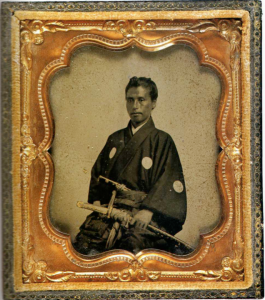
Sakamoto Ryoma, the Foreteller

“I’ll only die when big changes finally come. . . .” 私が死日 (シヌルヒ) ハ天下大変にて生ておりてもやくにたゝず

ryoma

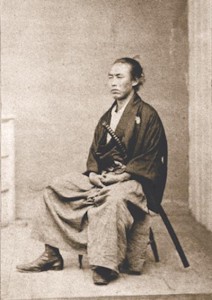
Sakamoto Ryoma was truly a Renaissance man: outlaw-samurai, pistol-bearing swordsman, gifted writer,* freedom fighter, pioneering naval commander, founder of Japan’s first modern trading company, and leader in the “samurai revolution at the dawn of modern Japan.” And, as it turned out, he also foretold the future.

“I don’t expect that I’ll be around too long. But I’m not about to die like any average person either. I’ll only die when big changes finally come, when even if I continue to live I’ll no longer be of any use to the country. Though I was born a mere potato digger in Tosa, a nobody, I’m destined to bring about great changes in the country.”

The above is from a letter Ryoma wrote to his sister in the summer of 1863. Less than four and a half years later, in the fall of 1867, the last shogun, Tokugawa Yoshinobu, announced his decision to abdicate and restore Imperial rule based on a peace plan from the “nobody” from Tosa. The next month, on his 32nd birthday, Ryoma was assassinated.

* [Shiba Ryotaro, the popular historical novelist who immortalized Sakamoto Ryoma in the psyche of the Japanese people, called Ryoma’s famous letter depicting the near fatal attack at the Teradaya inn, “the first piece of nonfiction literature” of the times. (Qtd. in Miyaji Saichiro. Ryoma Hyakuwa. Tokyo: Bungei Shunshu, 1997, p. 152)]

For updates about new content, connect with me on Facebook.


ryoma

Ryoma: Life of a Renaissance Samurai, the only biographical novel about Sakamoto Ryoma in English, is available on Amazon.com.

widget_buy_amazon


Takasugi Shinsaku: The Dynamic Leader of the Choshu Rebels

“Takasugi Shinsaku was young. The times being as they were, he didn’t have the chance to demonstrate his full potential. But he certainly was a dynamic man.”

Takasugi Shinsaku

The above words of Katsu Kaishu, the shogun’s last samurai in my Samurai Revolution, are complemented by biographer Kaoru Furukawa, who writes of Takasugi’s penchant to “think while on the run.”

To be sure, the leader of Choshu’s revolutionary forces had a wild reputation. He was an unruly swordsman who in a drunken rage reportedly cut a feral dog in two. He was a gifted poet whose boyish features were belied by piercing eyes. He was the founder and commander of Japan’s first modern army, who played on the three-stringed shamisen even as the war around him raged. He was a consumptive who kept his saké cup near the sickbed from where he laid his war plans—in bold defiance of the Tokugawa Bakufu and the disease that would finally kill him.

Takasugi “didn’t have the chance to demonstrate his full potential” because he died at age twenty-nine in 1867, around eight months before the fall of the Bakufu. Had he survived the “samurai revolution,” there can be little doubt he would have played a prominent role in the Imperial government after the Meiji Restoration. And it is certain that without him the restoration of Imperial rule would have been delayed by months if not years.

For updates about new content, connect with me on Facebook.


Takasugi Shinsaku features prominently in Samurai Revolution.

644502_247397672083151_1209814990_n

widget_buy_amazon

Sakamoto Ryōma’s Heroic Wife, Oryō

“It was only because of Ryo that I survived.”

After Sakamoto Ryōma  had overseen the conclusion of the military-political alliance between Satsuma and Chōshū in Kyoto in early 1866, thus hastening the fall of the Tokugawa Shogunate (Bakufu) less than two years later, his life was in danger. Though the Satusma-Chōshū Alliance was still secret, and so unknown to the Bakufu, the Tokugawa authorities in Kyoto had been after him for “going back and forth between Bakufu enemies Satsuma and Chōshū,” Ryōma wrote to his family later that year.

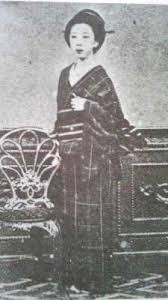
On the day after the alliance was concluded, Ryōma was attacked by Tokugawa police, at an inn called the Teradaya, in Fushimi just outside of Kyoto. He had arrived at the inn late at night. As he was about to sleep in an upstairs room, a young maid, Narasaki Ryō (better known simply as Oryō), whom Ryōma had met and married about a year and a half earlier, was downstairs soaking in a hot bath. Following is an excerpt from my Samurai Revolution:

Oryo as a young woman, according to a descendent of her second husband, whom she married after Ryoma’s death. (Miyaji Saichirō. Sakamoto Ryōma Shashinshū. Tōkyō: Shinjinbutsu Ōraisha, 1986).

Oryo as a young woman, according to a descendent of her second husband, whom she married after Ryoma’s death. (Miyaji Saichirō. Sakamoto Ryōma Shashinshū. Tōkyō: Shinjinbutsu Ōraisha, 1986).

The bathroom was located at the rear of the house, near a narrow corridor leading to the rear staircase. Oryō heard the assailants break in, and, as she recalled over thirty years later:

There was a thumping sound, and before I had much time to think about it, someone thrust a spear through the bathroom window, right by my shoulder. I grabbed the spear with one hand, and in an intentionally loud voice, so that I could be heard upstairs, yelled, “Don’t you know there’s a woman in the bath? You with the spear, who are you?” “Be quiet,” [a voice demanded], “or I’ll kill you.” “You can’t kill me,” I hollered back, jumped out of the bathtub into the garden [outside], and still wet and throwing on just a robe, with no time to even put on my sash, ran barefoot [to warn the two men upstairs]. [end excerpt]

Ryōma, with Miyoshi Shinzō, a samurai of Chōfu (branch house of Chōshū), assigned by the Chōshū men as Ryōma’s bodyguard, fought their way out of the inn and managed to escape, though Ryōma was wounded. The enemy, he reported in a separate letter to his sister, Otome, “cut the base of my right thumb, split open the knuckle of my left thumb, and hacked my left index finger to the knuckle bone.” “It was only because of Oryō that I survived.”

Sakamoto Ryōma and Nakaoka Shintarō: Very Different, Yet Very Similar

ryoma

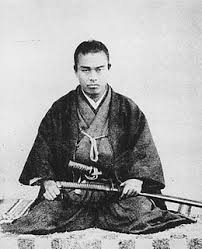
The alliance between Satsuma and Choshu, concluded in early 1866, was a turning point in the revolution. Sakamoto Ryoma’s biographers never fail to point out that the epochal event was brought about by a political outlaw who considered himself “a nobody.” While Ryoma receives so much of the historical limelight, it must not be forgotten that Nakaoka Shintaro, Ryoma’s cohort from Tosa, also played an indispensable role in bringing about the Satsuma-Choshu Alliance.

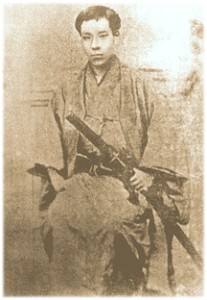
Nakaoka Shintaro

Nakaoka Shintaro

Until the alliance was concluded, Satsuma and Choshu were bitter enemies. But they embraced the same goal: to overthrow the Tokugawa Shogunate. Ryoma and Nakaoka worked for more than a year to persuade their connections in Satsuma and Choshu, namely Saigo Takamori and Katsura Kogoro, to meet. About a year and a half after the alliance was concluded, in the summer of 1867, Ryoma wrote to his sister Otome that Nakaoka “is just like me.” But in many ways they were quite different. Consider the following from Samurai Revolution:

The “man of the sea,” Sakamoto Ryōma, hailed from a “town-samurai” family in the central urban setting of Kōchi Castle Town, situated just inland from the bay that extends outward to the vast Pacific. The “man of the land,” Nakaoka Shintarō, came from the outlying mountains of eastern Tosa. If there is truth in the symbolic association of the wide-open sea with the flexibility of mind and freedom of spirit possessed by Ryōma, and that of the age-old tradition-steeped land with the stoic, rigid nature attributed to Nakaoka, why did Ryōma liken himself to his friend? [end excerpt]

Probably not because both were early members of the Tosa Loyalist Party with close connections to party leader Takechi Hanpeita. Nor because in the month after Ryoma wrote the above-mentioned letter Nakaoka would form and command a land auxiliary force (Rikuentai) in Kyōto, complementing the naval auxiliary force (Kaientai) that Ryoma had organized three months earlier. Nor could it have been because Nakaoka, who, with the leaders of Satsuma and Choshu, advocated the total destruction of the House of Tokugawa by military force, even while Ryoma, just days before writing the letter to his sister, had drafted a conciliatory plan to restore peace to the nation. Nor was it because less than five months after the above letter was sent, Ryoma and Nakaoka would be assassinated together in Kyoto on the eve of the revolution that they had fought so hard to achieve; nor because soon thereafter their graves would be set side by side in the cemetery of heroes on the east side of the city, where they remain to this day. No—Ryoma certainly had something else in mind in likening himself to Nakaoka.

Though Nakaoka, like Ryoma, was originally against opening the country to foreign trade, just before the conclusion of the Satsuma-Choshu Alliance, he wrote a famous letter to friends, in which he reported the changes in his anti-foreign stance in order to learn from foreign nations to develop a “rich nation and strong military.” Nakaoka’s words echo the ideas of Sakuma Shozan (one of the most farsighted thinkers of his time, who in 1850, three years before the arrival of Perry, realizing that isolationism was no longer possible, had advised the Bakufu to modernize in order to defend against Western imperialism) and Katsu Kaishu. Nakaoka had met directly with Sakuma. And though I don’t think he ever actually met Kaishu, he quoted him in the above-cited letter: “Military power depends on the clarity of moral principles, and not on military training or machinery,” Nakaoka informed his friends. “Without the right people, regulations and machines are useless.”

Sakuma was Kaishu’s teacher. Kaishu was Ryoma’s teacher. As such, Ryoma’s thinking was greatly influenced by both of them – as was Nakaoka’s. And therein lies the greatest and most enduring similarity between Ryoma and Nakaoka.


Samurai Swordsmen: The Definitive History of the Shinsengumi (Helion, 2026) is now in production.
For professional guidance on Bakumatsu–Meiji Restoration history, see Historical Consulting.
Explore my books at Books at a Glance.
Katsu Kaishū’s Lincolnian Dictum

Just as “a house in strife will fall, a country in strife will fall.” Katsu Kaishū

“A house divided against itself cannot stand.” Abraham Lincoln

The peaceful surrender of the fallen shogun’s castle at Edo (modern-day Tokyo), negotiated in the spring of 1868, one day before a scheduled general attack on the capital by forces of the new Imperial government, is “the most beautiful event in Japanese history,” according to Saigō Takamori’s biographer Kaionji Chōgorō. It was a result of amicable talks between the military leaders of the opposing sides: Katsu Kaishū representing the shogun, and Saigō, the de facto commander of the Imperial forces. Kaionji’s perceived “beauty” lay in the fact that a devastating civil war was thereby averted, sparing Edo’s population of well over a million from untold misery.

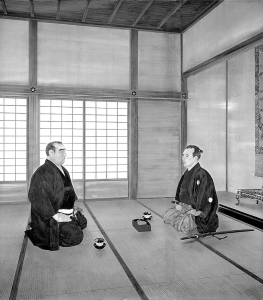
kaishu saigo peace talk

But even after the castle was surrendered, thousands of samurai in Edo refused to yield to draconian treatment by the Imperial government, including confiscation of their landholdings, which would leave them without a livelihood. With a final military showdown imminent, Kaishū sent a letter to Saigō warning him of the dire consequences of the unfair treatment. “Where do you expect them to vent their enmity?” But if the government would treat his people fairly, Kaishū assured Saigō, “the people would happily submit.” But, he ominously warned, just as “a house in strife will fall, a country in strife will fall”–and though Kaishū certainly admired Abraham Lincoln, it is unknown whether or not he was mindful of his famous dictum of a “house divided” uttered a decade earlier.

(Katsu Kaishū is the “shogun’s last samurai” of my Samurai Revolution. The image of Saigō and Kaishū negotiating the surrender of Edo Castle is used in my Samurai Tales, courtesy of Seitoku Kinen Kaigakan.)