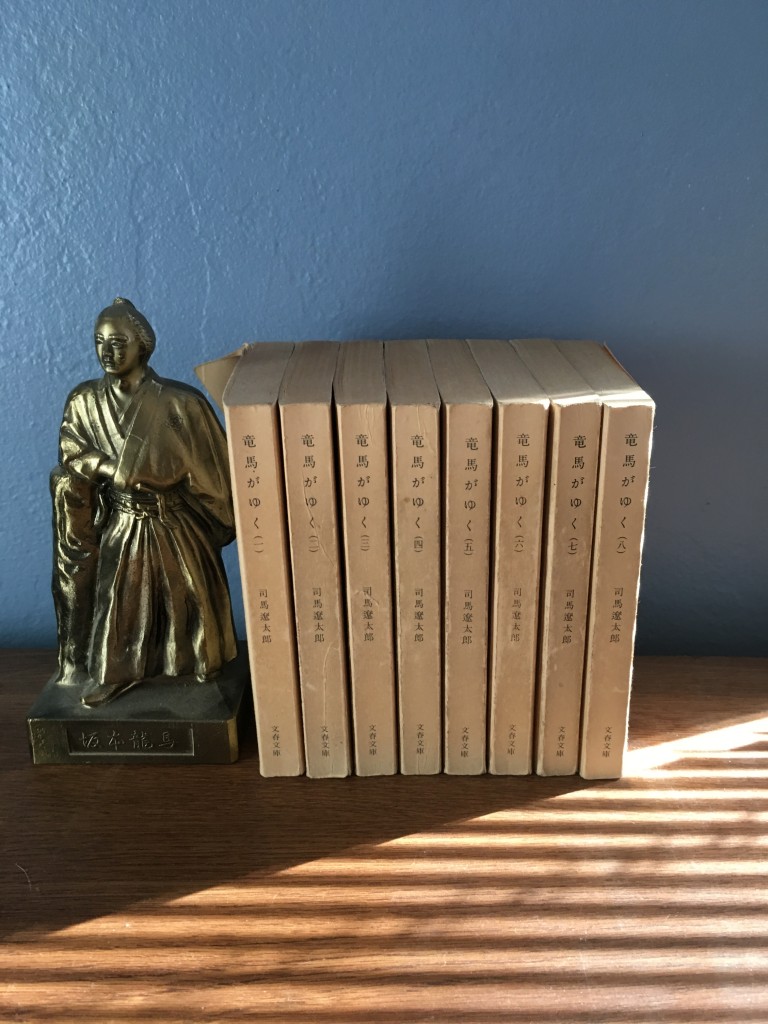
Among my favorite Japanese writers is the prolific historical novelist Shiba Ryōtarō (1923 – 1996), whose masterpiece Ryōma ga Yuku immortalized Sakamoto Ryōma in the psyche of the Japanese people. Originally published in serial form in the national newspaper Sankei Shimbun in 1962, this epic of the life and times of Sakamoto Ryōma comprises eight paperback volumes in its current printed form. My other favorite books by Shiba include Moeyo-ken, which focuses on Hijikata Toshizō, vice commander of the Shinsengumi; Yotte Sōrō, whose protagonist, Yamauchi Yōdō, the flamboyant daimyo of Ryōma’s native Tosa, played an important role in this history; Hitokiri Izō, the haunting portrait of the notorious assassin Okada Izō; and Saigō no Shōgun, about the life and times of the brilliant last shogun, Tokugawa Yoshinobu. Among these, Yotte Sōrō and Saigō no Shōgun have been published in English under the respective titles of Drunk as a Lord (Yōdō’s nom de plume was Geikaisuiko, “Drunken Lord of the Sea of Whales,” for the rich bounty of whales off the Tosa coast), and The Last Shogun: The Life of Tokugawa Yoshinobu.
I was introduced to Sakamoto Ryōma and the epic history of the Bakumatsu (i.e., the final fifteen years of the Tokugawa Shogunate: 1853 – 1868) through Ryōma ga Yuku, when a friend gave me a copy of Vol. 1, sometime around 1982. I owe my inspiration for my historical novel, Ryoma: Life of a Renaissance Samurai, to Shiba’s book.
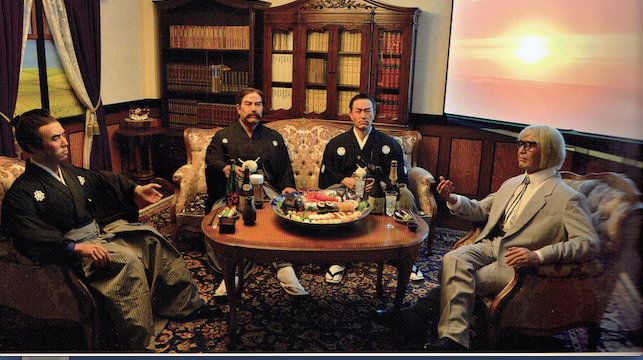
The above photo from Ryōma Rekishikan, a museum in Ryōma’s hometown of Kochi, shows one of 27 scenes of wax figures, some historical others personal, from Ryōma’s life. The fourth scene on the tour depicts Ryōma’s birth in Kochi in 1835. Scene 26 shows the gruesome assassinations of Ryōma and his friend and cohort in the revolution, Nakaoka Shintarō, in Kyoto in 1867. The final scene, number 27, depicts four immortals, perhaps discussing the state of Japan and the world today: Shiba Ryōtarō sits opposite Ryōma, joined by Mitsubishi founder Iwasaki Yatarō (left) and Nakaoka.
Below is a photo of my personal set of Ryōma ga Yuku, the jackets long since worn out.