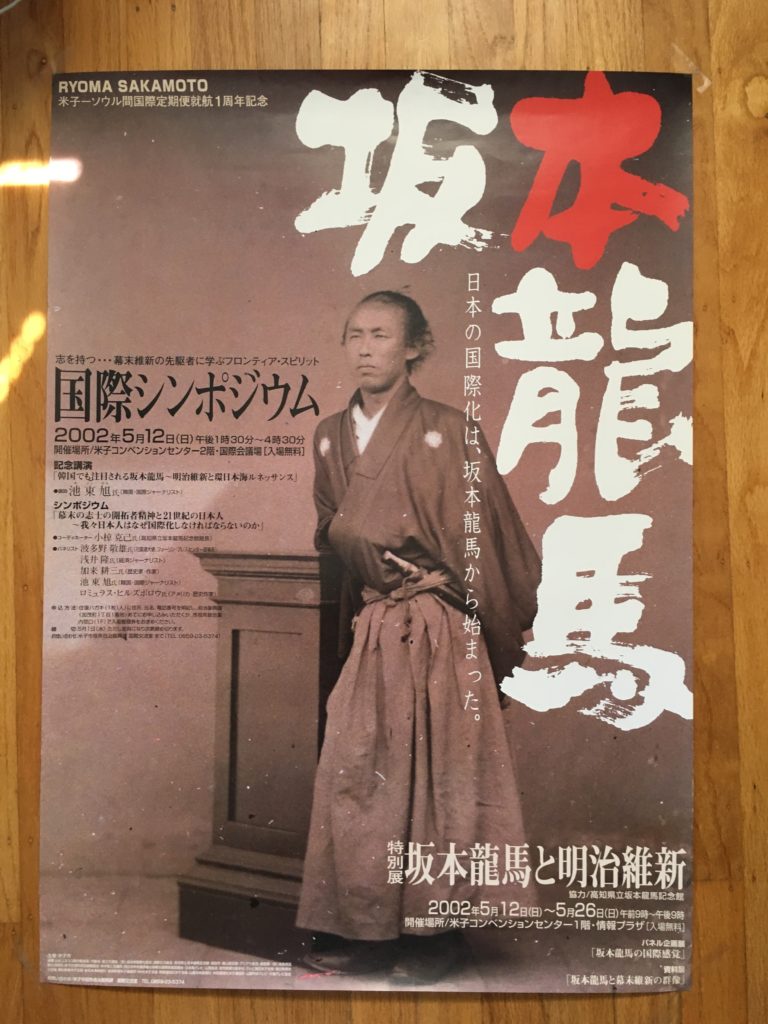
勇気ある2人 (Two Profiles In Courage)

09hillsborough-copyjfk-1

先日の「第28回全国龍馬ファンの集い in 九州」で「坂本龍馬とジョン・F・ケネディ: 「勇気ある2人 」」というタイトルで、この2人の案外な共通点について講演させていただきました。これについてこの数年間考えてきましたが、日本語による出版に向かって詳しく執筆中です。

Earlier this month I spoke at the 28th national convention of “Ryoma fans” in Fukuoka about some uncanny similarities between Sakamoto Ryoma and John F. Kennedy, which I have been thinking about for many years. Currently I am writing about this in greater detail toward publishing a book on this subject in Japanese. In the future I hope to write a book on the subject in English as well.


Read about the life and times of Sakamoto Ryoma in the only biographical novel of the great man in English:
ryoma
widget_buy_amazon

At Hikawa (氷川にて)

img_1359-1

Earlier this month my friends Minako Kohyama and Michio Tsuda and I visited the Hikawa Shrine in Tokyo’s Akasaka district, near the site of Katsu Kaishū’s residence. (Ms. Kohyama is a great great grandchild of Katsu Kaishū. Mr. Tsuda is a direct descendent of Katsu Kaishū’s friend, Tsuda Sen.) We had the special opportunity to view these hanging scrolls with calligraphy written by Katsu Kaishū, Yamaoka Tesshū and Takahashi Deishū – “Bakumatsu no Sanshū.”
unknown-1

It’s common knowledge that Ryōma knew Kaishū. But until I had read a recent book by my good friend Kiyoharu Omino, “Ryōma no Yuigon,” I did not know that Ryōma had actually met Tesshu and Deishu.

From the shrine we walked to the nearby statue of Katsu Kaishū and Sakamoto Ryōma, unveiled last month at the site of Kaishū’s residence. (Ms. Kohyama is in the photo below.)
img_136814713704_1097987676957531_9140689117727583012_n

I wrote about “Bakumatsu no Sanshu” in Samurai Assassins.

Read about Kaishū’s relationship with Ryōma in my Samurai Revolution, the only full-length biography of Kaishū in English.

“Pessimism of the intellect, optimism of the will” — and an “optimistic” call for revolution

noam_chomsky_2004Kaishu

I just caught the last part of an interview with Noam Chomsky, on NHK World. He mentioned the horror he felt when as a teenager in the United States, he heard the news about the atomic bombing of Hiroshima. He also said that he had been appalled by the “reaction” to the news among most people: they went on with whatever they were doing, no matter how trivial, and didn’t really seem to care very much that tens of thousand had just been incinerated, except that it might help end the war. One of the greatest thinkers of our time concluded this interview with the above quote from Antonio Gramsci, paraphrasing: we should be pessimistic about the way things are in this world, but we should be optimistic about perhaps being able to make them better.

This brings to mind the following quote from another great thinker, Katsu Kaishu, of nineteenth-century Japan, the “shogun’s last samurai” of my book Samurai Revolution: “If the Bakufu [shogun’s government] truly has the best interest of the country at heart, it must willingly fall.” So that the reader may better understand this bold and important pronouncement from a leading Bakufu official, I excerpt the following from Samurai Revolution (from first few pages of Chapter 20):

[begin excerpt] Katsu Kaishū had spent the past year and a half to no avail, he wrote to Yokoi Shōnan on Keiō 2/4/23 (1866). But “I will not be discouraged.” To evade the enmity of the Edo authorities, he would carry on with his “leisurely existence of reading and writing, although it is difficult to forget my anxiety over the fate of the country.” Even as the political and social scene of Japan underwent a sea change of historical proportion, this man of thought and action remained inert, during a seemingly endless intermission backstage—awaiting the cue to reenter.

. . . Kaishū had been informed of “popular unrest” around Ōsaka and Kyōto over rising prices of rice, and as a result, of other commodities. While large quantities of rice were purchased to supply the troops in the impending war, various feudal domains restricted the sale of rice beyond their borders. Unscrupulous merchants cornered the market, driving up rice prices even further. In less than one year rice prices had risen by more than fifty percent. As a result, townspeople in the cities and peasants in rural areas suffered. Early in the Fifth Month rioting broke out at Nishinomiya (about halfway between Kōbé and Ōsaka), soon spreading to Hyōgo (Kōbé) and by mid-month to Ōsaka, where the shōgun was present at his castle. On 5/23, Kaishū wrote of a visit by Sugi Kōji, who informed him that in Hyōgo and Ōsaka mobs attacked and destroyed wealthy merchant houses. Troops fired on the rioters in both cities. Many were killed.

On 5/8 Kaishū noted in his journal that Satsuma “absolutely refused” to fight against Chōshū. On the fourteenth of the previous month, Ōkubo Ichizō had met with Senior Councilor Itakura Katsukiyo at Ōsaka Castle, presenting a letter stating Satsuma’s refusal to send troops. Seizing the high moral ground, Satsuma admonished the Bakufu “not to fight our own countrymen.” It was the shōgun’s duty to preserve the peace in the Imperial Country, not to disturb it. And so to attack Chōshū would be “against the rule of Heaven.” As Kaishū wryly put it at Hikawa, “Itakura was perplexed.”

. . . On the night of 5/27, Kaishū received a letter from Senior Councilor Mizuno, summoning him to Edo Castle on the following morning. “Went up to the castle,” he wrote in his journal on 5/28. Reinstated as commissioner of warships, he was ordered to proceed to Ōsaka immediately. Noting the extraordinary manner in which he had been reinstated, he questioned Mizuno as to the nature of his assignment. “Direct orders from the shōgun,” Mizuno replied. “I had nothing else to say,” Kaishū later wrote. At Hikawa, he recalled that he was “hard pressed for money. So on the next day they gave me three thousand ryō,” about two years’ worth of his salary as warships commissioner. “It was the first time in my life that I got three thousand ryō all at once.”

Before leaving the castle, Kaishū encountered Finance Commissioner Oguri Tadamasu and two others of the French clique. He noted that his political enemies “were surprised” by his sudden comeback. Since he had been out of the loop for a year and a half, they thought that they should fill him in on their secret project—i.e., their scheme to set up a Tokugawa autocracy through French aid. They understood that he was going to Ōsaka, they said. “As you know, the Bakufu is in trouble. It’s going to obtain warships from France. As soon as the ships arrive, we’ll attack Chōshū. Then we’ll hit Satsuma. Once Chōshū and Satsuma are taken care of, there will be no one left in Japan who can challenge us. Then we’ll move forward, subduing all of the other feudal lords. We’ll reduce their landholdings and set up a prefectural system.” Certainly their colleague . . ., they assumed, would agree with their plan. They could not have been more mistaken! “Realizing that it would be a waste of time to argue with them,” Kaishū later wrote, “I kept quiet and listened.”

. . . On the next day, 6/22, Kaishū reported to Senior Councilor Itakura at the castle. This time he held no punches, even pounding his fist as he spoke. “What they have decided in Edo is very wrong,” he told Itakura. If Japan intends to take its place among the nations of the world, it must set up a prefectural system—i.e., feudalism must be abolished and a unified national government established. But, Kaishū admonished, the Tokugawa must not take away the lands of the feudal lords and rule the nation autocratically, claiming to do so for the welfare of the country. “If the Bakufu truly has the best interest of the country at heart,” he said, “it must willingly fall.” [end excerpt]

In other words, Katsu Kaishu was pessimistic about the government which he loyally served, but optimistic about the way his country might be. As we approach the presidential election in the United States, the above ideas of Gramsci and Kaishu are particularly relevant — and I fear for our country. Whichever of the two candidates wins, we will be stuck with perhaps the worst president in our history. So the optimistic question is: how can we fix things?


Read more about Katsu Kaishu in Samurai Revolution, the only full-length biography of the great man in English.

644502_247397672083151_1209814990_n

widget_buy_amazon

The Ryōma Phenomenon (9) – My Five Favorite Books About Ryōma

shelf

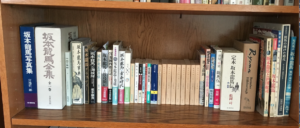
There are lots of books about Sakamoto Ryōma.* There are more than thirty volumes in one of the bookshelves in my personal library. And there are a lot more to be found in bookstores, and public and university libraries. During the thirty years that I’ve been researching and writing about Ryōma, my favorite books about him are the five mentioned below. I have chosen them for their originality, scholarship, and overall readability, and also for their great value to me as a writer.

zenshu
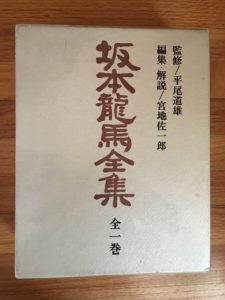
Miyaji Saichiro, ed. Sakamoto Ryoma Zenshu. Tokyo: Kofusha, 1982: The collection of Ryōma-related documents, including letters written and received by him, letters written by others concerning him, other documents either written by or attributed to him, and much, much more, all of which is meticulously annotated. A must for all researchers and students of the life and times of Sakamoto Ryōma, compiled, edited and annotated by my revered late mentor and friend.
matsuoka
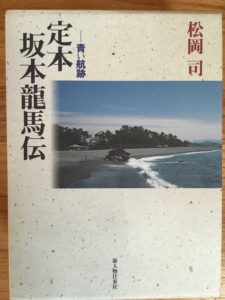
Matsuoka Mamoru. Teihon Sakamoto Ryoma-den. Tokyo: Shinjinbutsu Oraisha, 2003: Of the many biographies I have read or referred to, this fairly recent one is the most comprehensive and perhaps most painstaking. As indicated by its title, it is the definitive biography, and a truly remarkable work of scholarship and writing by a Tosa historian whom I am proud to call a personal friend.
omino
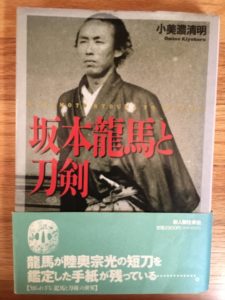
Omino Kiyoharu. Sakamoto Ryōma to Token. Tokyo: Shinjinbutsu Oraisha, 1995: A scholarly collection of extremely interesting essays focusing on the significance of the Japanese sword in Ryōma’s life. As with other works by this fine author and Ryōma scholar, who is also an accomplished sword appraiser and polisher, this penetrating study of Ryōma is exceptionally original, and written in concise, easy-to-read language. I am proud to call Mr. Omino a personal friend.
hirao
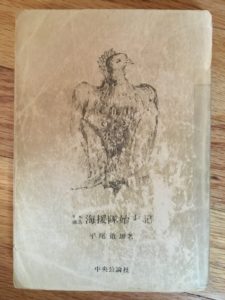
Hirao Michio. Sakamoto Ryōma: Kaientai Shimatsuki. Tokyo: Chuokoronsha, 1976: This exceptional biography is standard reading for all students of the life and times of Sakamoto Ryōma. It must be one of the most widely read books by an important and prolific writer who might be called the “godfather” of Tosa historians during the twentieth century.
IMG_0510

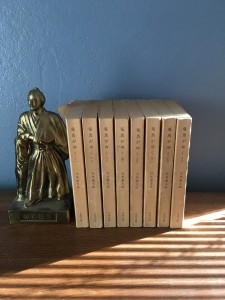
Shiba Ryōtarō. Ryōma ga Yuku (vols 1-8). Tokyo: Bungei Shunshu, 1975: This masterpiece by a prolific historical novelist immortalized Sakamoto Ryōma in the psyche of the Japanese people. Originally published in serial form in the national newspaper Sankei Shimbun in 1962, this epic of the life and times of Sakamoto Ryōma comprises eight paperback volumes in its current printed form.

Almost all books about Sakamoto Ryoma are in Japanese. The only two that I know of which are not are my novel, Ryoma Life of a Renaissance Samurai, and Marius B. Jansen’s biography, Sakamoto Ryōma and the Meiji Restoration.

Samurai Assassins: A Brief Synopsis

hillsborough_978-1-4766-6880-2

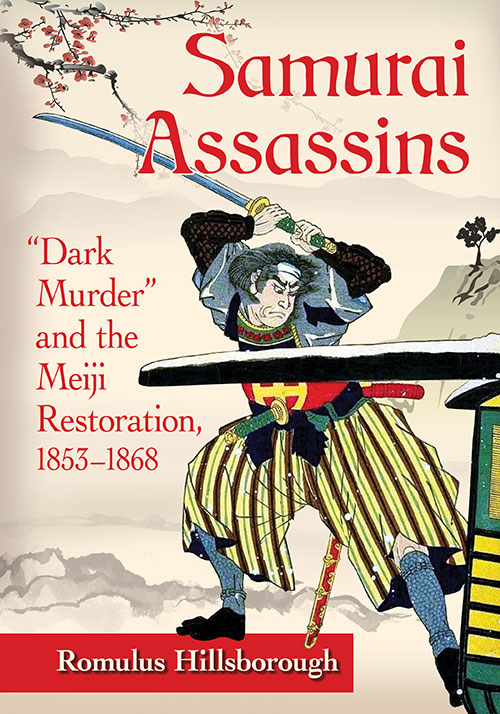
With my forthcoming Samurai Assassins: “Dark Murder” and the Meiji Restoration, 1853 – 1868 expected to be published sometime between spring and summer, 2017, I thought readers would benefit from the following brief synopsis:

The Japanese word for assassination is ansatsu, “dark murder,” and its significance in the samurai-led revolution which was the “dawn of modern Japan”—when the shogun’s military government was abolished and Imperial rule restored—forms the substance of Samurai Assassins.

For all the impact of “dark murder” on the revolution, most of the assassinations covered in Samurai Assassins have thus far received only cursory, if any, attention by Western writers, though the assassins and their deeds are an indelible part of the popular Japanese literary genre that focuses on the final years of the shogun’s government.

The shogun’s government, known as the Tokugawa Bakufu (or simply Bakufu), was controlled by the Tokugawa family, whose head held the title of seiitaishogun—commander in chief of the expeditionary forces against the barbarians (“shogun” for short)—conferred by the Emperor. The shogun ruled the isolated island nation peacefully for two and a half centuries on the Emperor’s behalf from his castle at Edo (modern-day Tokyo) in the east, while the powerless Emperor was sequestered in his palace at Kyoto in the west. But the era of peace ended when the Bakufu could no longer enforce isolationism against the industrial and technological advances of Europe and America. While Hong Kong was ceded to Great Britain in 1842, the specter of Western imperialism reared its ugly head off Japanese shores. When a squadron of warships commanded by Matthew Perry of the United States Navy entered the bay near Edo in the summer of 1853, that specter hit home. The modern era had reached Japan. It was the onset of fifteen years of chaos and turmoil and violence, which would not subside until the collapse of the Bakufu and the restoration of Imperial rule—the series of events collectively called the Meiji Restoration.

During the decade after Perry’s arrival Japan was divided into two schools of thought. “Revere the Emperor and Expel the Barbarians” was embraced by samurai who called themselves “Imperial Loyalists” (“Loyalists,” for short). Meanwhile, the Bakufu and its allies advocated “Open the Country.” The Loyalists rejected the shogun as the legitimate ruler of Japan because he had failed in his most fundamental purpose of keeping the foreigners out, while the Bakufu and its allies believed that expelling the foreigners would be impossible without first modernizing the country militarily and industrially, which required opening up to foreign trade, technology, and ideas.

The Emperor had been a powerless figurehead for centuries until the early 1860s, when Loyalists from samurai clans of western Japan, most notably Satsuma, Choshu, and Tosa, gathered in Kyoto to rally around the Imperial Court. Those samurai colluded with noblemen of the Court to orchestrate a renaissance of Imperial power, while the Bakufu and its allies believed that the reins of government must remain with the tried-and-true military regime at Edo. Restoring rule to the politically inept Court, they said, would jeopardize the sovereignty of the country. The two sides headed toward a final showdown, while the most farsighted among them realized the imperative for the samurai clans to unite as one powerful nation to fend off Western imperialism.

Samurai Assassins will be the only thorough presentation and analysis in English of “dark murder” and the assassins who committed it, without which the Meiji Restoration as we know it could not have happened. On a deeper level, the book is a study of the ideology behind the revolution. My previous book, Samurai Revolution (Tuttle 2014), is a comprehensive history of the Meiji Restoration and the first ten years of Imperial rule. Samurai Assassins provides an in-depth overview of the Meiji Restoration while focusing on significant men and events, and ideology, not expatiated in my previous book. The following breakdown does not include the twenty-two chapters, or the front or back matter:

• Introduction: On “Dark Murder”—and the Existential Crisis and Rediscovered Purpose of the Samurai Class

• Part I: The Assassination of Ii Naosuke and the Beginning of the End of the Tokugawa Bakufu

• Part II: The Rise and Fall of Takechi Hanpeita and the Tosa Loyalist Party

• Part III: The Assassination of Sakamoto Ryoma

• Epilogue: The Second Existential Crisis of the Samurai Class

Samurai Assassins is based mostly on primary sources and definitive secondary sources in Japanese. Among the primary sources are letters from Takechi Hanpeita, the stoic samurai par excellence who is the focus of Part II. Takechi composed the letters in his squalid prison cell, to converse with his wife and sisters, and to communicate with his cohorts on the outside who had been able to avoid arrest. His letters to his cohorts, written in formal language and tone befitting a samurai, provide an insight into his thinking, including his stoic philosophy, which is not seen in any other documents. His letters to his wife and sisters, on the other hand, overflow with the tender feelings of a husband and brother, and include self-effacing humor, complaints, despondency, and melancholy absent in the other letters. To the best of my knowledge, Takechi’s letters have rarely, if ever, been used by non-Japanese writers.

I will report more in this blog on Samurai Assassins as the publication date approaches. Look for updates, including publication date, on Facebook.

hillsborough_978-1-4766-6880-2
widget_buy_amazon