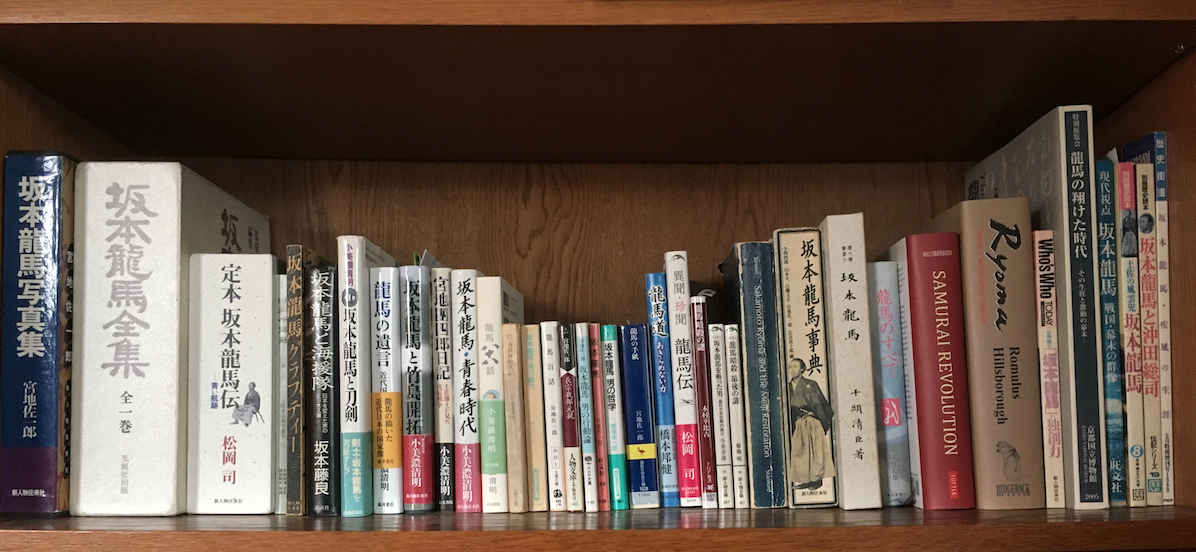
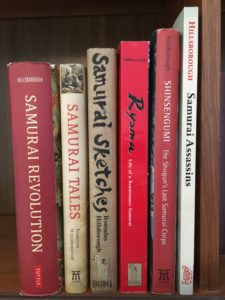
Included on this shelf are some of the most important books about Sakamoto Ryōma that I’ve referred to in my writing over the years.
For readers interested in how I’ve drawn on these sources in my own books, see Books at a Glance.

Included on this shelf are some of the most important books about Sakamoto Ryōma that I’ve referred to in my writing over the years.
For readers interested in how I’ve drawn on these sources in my own books, see Books at a Glance.
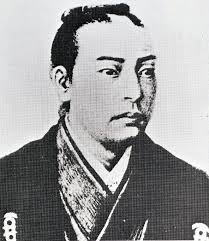
Part II of Samurai Assassins is the first in-depth biographical treatment in English of Takéchi Hanpeita, charismatic leader of the Tosa Loyalist Party and mastermind of “divine punishment,” which wreaked terror on the streets of Kyōtō. Takéchi’s important role in the “samurai revolution” is covered in detail, including his meteoric rise to power and his sudden arrest and imprisonment. I referred to Takéchi’s journals, contained in an early biography published in 1912; and more heavily to his letters from jail to his wife and cohorts on the outside. To the best of my knowledge, Takéchi’s letters have rarely, if ever, been used by Western writers. Following is an excerpt:
At the end of the Second Month, Takéchi wrote home about his new cellmate, a samurai named Itō Reihei, whom he referred to as “shit bug” (kuso mushi). Itō had been arrested for seducing a woman and attempting to run away with her, behavior which Takéchi would not condone. But from Takéchi’s letters home it seems that the two men became unlikely friends during the next few months, which they spent together in the same cell, with Itō, perhaps starstruck by the famous Loyalist Party leader, regularly fixing Takéchi’s hair. And so “I don’t have to get my hands dirty,” which was “the only good” thing about the “shit bug.”
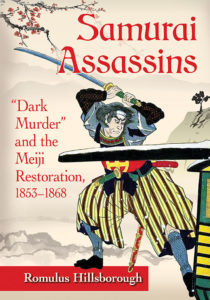

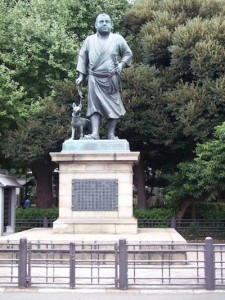
The following anecdote (cited from Samurai Assassins, Chapter 16, without footnotes) involving Saigō Takamori and Sakamoto Ryōma provides insight into the magnanimity of the former:
Hirao relays an anecdote that goes a long way to illustrate Saigō’s affection and even reverence for Ryōma. In Keiō 1/5 (1865) Ryōma traveled to Saigō’s native Kagoshima to lay the groundwork for the Satsuma-Chōshū Alliance, during which time Ryōma stayed at Saigō’s home. According to the story, which Hirao heard directly from Saigō’s sister-in-law, one day Ryōma asked Saigō’s wife, Itoko, if he could borrow Saigō’s “oldest loincloth,” i.e., underwear. As Hirao interjects, Ryōma, a rōnin without a source of income, probably didn’t have the money to buy such things. So Itoko gave Ryōma exactly what he asked for; and when her husband returned home and she told him about it, he was angered: “Don’t you know that he’s ready to die for the country?” he said, and instructed her to change the “old loincloth for the newest one” he had. Recalling the story years later, Itoko said that it was the only time she had ever seen her husband so angry.
…on August 14, 1895 (Meiji 28), at age seventy-three, Count Katsu Awa gave an interview to the Kokumin Shimbun newspaper, in which he alluded to his title. “I’m naturally a bad person, which is why I put a market price on society,” he said in his signature mock self-deprecatory tone, which he was apt to quickly change to self-praise underpinned by the truth.
“I know that when the price goes up, it’ll eventually go back down. When the price goes down, it’ll eventually go back up. And it never takes more than ten years for the market price to rise and fall. So, if I see that the price for me is down, all I need do is hunker down and wait a while—and sure enough it’ll rise again. The former villain and traitor Katsu Rintarō is now Count Katsu Awa. But even if I act as if I’m important now, after a while I’ll only grow old and senile, and nobody will even bother to spit on me then. So anyway, that’s the way the market price of society is. A person who has the patience to wait out those ten years of rising and falling is a great man. And actually I’m one of them.”
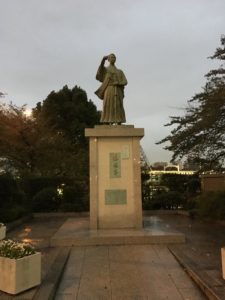
[The above is excerpted from Samurai Revolution: The Dawn of Modern Japan Seen Through the Eyes of the Shogun’s Last Samurai. Katsu Kaishū (aka Katsu Awa and Katsu Rintarō) is the “Shōgun’s Last Samurai.” The statue stands at Asakusa, Tokyo, near the Sumidagawa river, pointing out at the Pacific Ocean.]