Two Masterpieces of Shinsengumi History and Lore

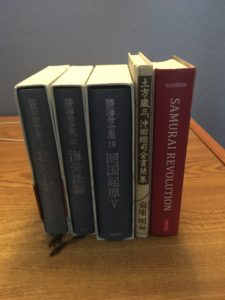
Shimosawa Kan’s Shinsengumi Shimatsuki and Hirao Michio’s Shinsengumi Shiroku 

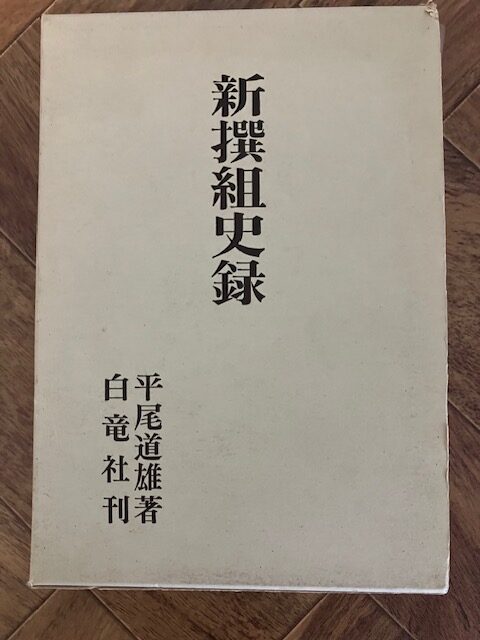
Hirao Michio’s Shinsengumi Shiroku (新撰組史緑)

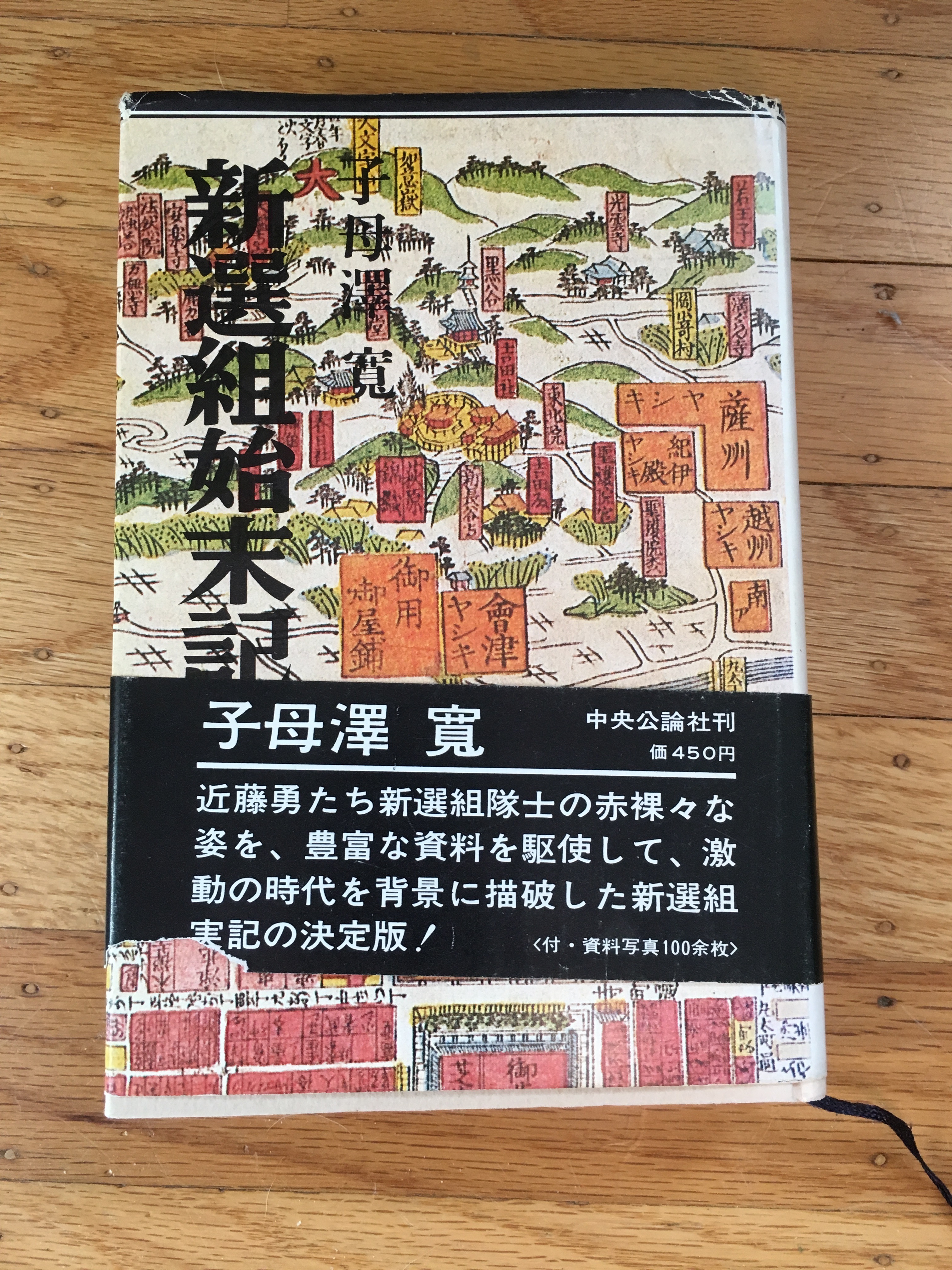
Shimosawa Kan’s Shinsengumi Shimatsuki (新撰組始末記)

Shimosawa’s Shinsengumi Shimatsuki is an early account of the Shinsengumi. It was first published in 1928, just before Hirao’s groundbreaking history Shinsengumi Shiroku (original title, Shinsengumishi). Shimosawa’s book is partially based on interviews with former corpsmen and other people who had direct contact with the Shinsengumi. But he was first and foremost a novelist. He began the preface of his book by stating, “It is not my intention to write history.” Some of his information has been repudiated by more recent studies, whose authors have enjoyed the benefits of nearly a century of subsequent scholarship unavailable to Shimosawa. Accordingly, like other early histories of the Shinsengumi, Shimosawa’s book should best be taken for what it’s worth, and relished for its portrayal of the spirit of the men of Shinsengumi rather than a faithful history.

Hirao, on the other hand, was an historian, widely known for his writings about Tosa history, including biographies of Sakamoto Ryōma, Nakaoka Shintarō, and Yamauchi Yodō. Therefore, his historical narrative is more reliable than Shimozawa’s book, which reads more like a novel than a history—though, as Meiji Restoration historian Matsuura Rei observes, Hirao often does not cite sources and contains occasional errors.

I have many books about the Shinsengumi in my private library. Both of the above editions, two of my prize possessions, were published in 1967. I found them in used bookstores in Tokyo’s Kanda district years ago.

I refer to both books in my forthcoming Samurai Swordsmen: The Definitive History of the Shinsengumi, scheduled for publication in fall 2026 with Helion.

Reflections on Writing about a Different Time, Place, and Culture

In my forthcoming book Samurai Swordsmen: The Definitive History of the Shinsengumi (1863–1869), I wrote about Shinsengumi Vice-Commander Hijikata Toshizō’s anticipation of a war in Kyoto between Aizu and Satsuma based on the latter’s refusal to support the Bakufu in the imminent war against Chōshū in 1866. Katsu Kaishū, “the shogun’s last samurai” of my Samurai Revolution, was tasked with mediating between the two to resolve the problem peacefully.

Okay so I wrote about that. But as is sometimes the case after spending the day (or week or month or year or even decade) writing about this history, which was played out by men of a completely different time, place and culture than my own, I am struck by a sense of awe at the heaviness of my work—especially given that many of my main sources are in antiquated Japanese written by the men who made this history.

Main sources include three works from Katsu Kaishū, a book of letters by Hijikata Toshizō and Okita Sōji (annotated by Kikuchi Akira), and my own Samurai Revolution.

For more about my forthcoming book Samurai Swordsmen, see the Shinsengumi Hub.

To explore my other books, see Books at a Glance.

Kaishū and Ryōma: The Indispensable Relationship (Part 5)


Sakamoto Ryoma & Katsu Kaishu

Sakamoto Ryoma & Katsu Kaishu

In Part 4 of this series, I quoted Sakamoto Ryōma’s assessment of Katsu Kaishū as “the greatest man in Japan.” The respect between the two men was clearly mutual. During the months after the two had first met, Kaishū mentioned Ryōma numerous times in his journal, including in an entry dated Bunkyu 3/5/16 (16th day of the Fifth Month of the Japanese year corresponding to 1863), when Kaishū, then-vice-commissioner of warships, wrote that he would send Ryōma to Fukui, the feudal domain of his political ally and friend Matsudaira Shungaku, to solicit financial support for the private school in Kobe that Kaishū was about to establish for Ryōma and other “outlaw samurai” (rōnin) who had enlisted to study under him.

In all of these journal entries Kaishū refers to Ryōma, who was twelve years younger than him, as “Ryōma-shi.” The character for “shi” (子), which when pronounced “ko” means “child,” is in this sense used as an honorary, indicating that Kaishū perceived in Ryōma an element of greatness or at least extraordinary ability, as Matsuura Rei explains in his biography of Katsu Kaishū.

Three decades after Ryōma’s death, Kaishū had nothing but praise for him. In an interview with the national newspaper Yomiuri Shinbun, given on April 3, 1896, Kaishū said that Ryōma “had a cool head, and a certain power about him that was hard to penetrate. He was a good man.”


Samurai Swordsmen: The Definitive History of the Shinsengumi (Helion, 2026) is now in production.
For professional guidance on Bakumatsu–Meiji Restoration history, see Historical Consulting.
Explore my books at Books at a Glance.

Kaishū and Ryōma: The Indispensable Relationship (Part 4)

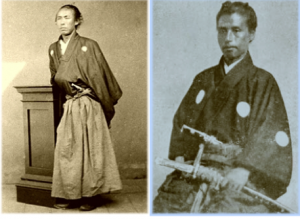
Composite image of Sakamoto Ryōma and Katsu Kaishū — created by Romulus Hillsborough to represent the mentor and disciple who helped shape Japan’s modern transformation.

Sakamoto Ryoma & Katsu Kaishu

Sakamoto Ryōma first met Katsu Kaishū, a high-ranking officer of the shogun’s nascent navy, some time during the final months of 1862. In the following spring, while Kaishū moved forward with plans to establish an official Naval Training Center at Kobe, Ryōma, as Kaishū’s right-hand man, recruited his friends from Tosa and elsewhere—most of them “outlaw samurai” (i.e., rōnin) like himself—to study under Kaishū. Following is a slightly edited excerpt from my historical novel, Ryoma: Life of a Renaissance Samurai:

While Kaishū used his close relationship with the seventeen-year-old shogun, Tokugawa Iemochi, to gain permission to establish an official Naval Training Center in Kobe, Ryōma used his influence among the Imperial Loyalists in Kyoto to recruit nearly one hundred of them for Kaishū’s private school. The Bakufu’s institution and the private school would share the costly facilities supplied by the Edo government. Under Kaishū, Ryōma, at age twenty-seven, was on the verge of realizing his dream of establishing a navy. [end excerpt]

In a letter to his older sister, Otome, dated Bunkyū 3/3/20 (May 7, 1863), Ryōma drolly expressed his excitement over his “disciple-teacher” relationship with the Bakufu’s vice-commissioner of warships: “Well, well! In the first place, life sure is strange. There are some men who are so unlucky that they die by breaking their balls just trying to climb out of a bathtub. Compared to that I’m extremely lucky: here I was on the verge of death [after fleeing Tosa and becoming an outlaw], but I didn’t die. Even if I tried to die I couldn’t, because there are too many things which compel me to live. I have now become the disciple of Katsu Rintarō [his given name, ‘Kaishū,’ being a pseudonym], the greatest man in Japan [italics mine], and I am spending every day on things I have always dreamed about. I don’t intend to return home until I’m around forty.” [translation from my novel Ryoma]

In the last lines before the postscript to the letter, Ryōma expressed his joy that their older brother, the Sakamoto family patriarch, had “forgiven” his transgression of fleeing Tosa, and conveyed his intention to “do my utmost for the country [Tosa] and the nation [greater Japan]”—which, for an “outlaw samurai,” required the unwavering support of the influential vice-commissioner of warships.

[Read Part 5 of this series here.]


Samurai Swordsmen: The Definitive History of the Shinsengumi (Helion, 2026) is now in production.
For professional guidance on Bakumatsu–Meiji Restoration history, see Historical Consulting.
Explore my books at Books at a Glance.
Kaishu and Ryoma: The Indispensable Relationship (Part 3)

Sakamoto Ryoma & Katsu Kaishu

Sakamoto Ryoma & Katsu Kaishu

The outlaw samurai Sakamoto Ryōma first met the shogun’s vice commissioner of warships, Katsu Kaishū, some time between the Tenth and Twelfth Months of the Japanese year corresponding to 1862. In light of Ryōma’s background as a leader of Takechi Hanpeita‘s seditious Tosa Loyalist Party, whose members had been assassinating officials and sympathizers of the shogun’s government over the past several months, it would not be unreasonable to assume that Ryōma had at least entertained the notion of killing Kaishū. “Sakamoto Ryōma came to kill me,” Kaishū recalled in 1896, more than thirty years later. But Kaishū tended to exaggerate and embellish past exploits; and anyway, based on Ryōma’s behavior during those bloody times (he is known to have killed only once, in self-defense), it is hard to believe that he intended to kill Kaishū.

Far from it. In fact, Ryōma became a devoted student of Katsu Kaishū, who in essence headed up the shogun’s nascent navy. Kaishū taught Ryōma the naval arts and sciences, most significantly how to operate and navigate a state-of-the-art steamship toward developing a modern Japanese navy. It was only natural, then, for Ryōma to be protective of his teacher. Which was why a few months after their first meeting, Ryōma recruited one of the most notorious assassins of the time, fellow Tosa samurai Okada Izō, who bore the nom de guerre “Hito-kiri” (literally, “Man-Cutter”), to protect Kaishū on the dangerous streets of Kyoto, the Imperial capital. Following is a slightly edited excerpt from my Samurai Revolution (without footnotes):

“The situation at that time was extremely dangerous,” Kaishū later wrote. “I had arrived [to the region] by ship, and come to Kyoto. It was a bad time to travel because all the inns [in the city] were completely full.” Okada Izō accompanied him that night, probably assigned to bodyguard duty by Ryōma. Kaishū and Izō were each armed with the two swords. As they walked down the street called Teramachi-dōri, running north and south just below the east side of the Imperial Palace, “three samurai suddenly appeared. Without uttering a word, they came at me with swords drawn. I was startled. Okada Izō of Tosa, walking beside me, drew his long sword and immediately jumped in and cut one of them in two. ‘Coward,’ Izō screamed. ‘What do you think you’re doing?’ The other two, completely surprised, fled without looking back. I was amazed by his [Izō’s] technique and lightening speed.

But Kaishū was bothered by Izō’s attitude after the incident. “‘You shouldn’t take pleasure in killing people,’ I told him. ‘Bloodshed is extremely bad. You’d best mend your ways.’ He acknowledged my words, then faintly murmured, ‘If I hadn’t been with you the other day, Sensei, you would have lost your head.’ He stood there smiling. There wasn’t a thing I could say.”

Katsu Kaishū survived the assassination attempt, as he would numerous others, to move forward with a grand scheme to build a modern national navy, to which Sakamoto Ryōma was dedicated. During the first months of 1863, the political outlaw recruited men from Tosa, many from Takechi’s Tosa Loyalist Party, to join him under the leader of the enemy’s navy.

[Read Part 4 of this series here.]


Samurai Swordsmen: The Definitive History of the Shinsengumi (Helion, 2026) is now in production.
For professional guidance on Bakumatsu–Meiji Restoration history, see Historical Consulting.
Explore my books at Books at a Glance.