Katsu Kaishū’s Wife Tami, and Daughters

This undated photo, from the family photo archive of the American Descendants of Katsu Kaishū, is posted on their Facebook page, which is “For all descendants, relatives, and friends of the 6 children of Clara Whitney and Umetaro Kaji.” Umetaro Kaji was Kaishū’s son. Clara Whitney was Umetaro’s American wife. If you look at the Descendants’ Facebook page (@WhitneyKajiDescendants), you will see a recent photo of the Descendants: at front center is my good friend Douglas Stiffler, Katsu Kaishū’s great-great-grandson.
[Backside of above photo]
 
See also my post on Tokugawa Yoshinobu’s family, photographed two decades after the fall of the Bakufu.
 

The Quintessence of Samurai Morality

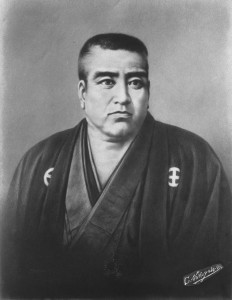
Like many Americans of conscience I am distressed over the current politics and society of our country. And so here are some words of wisdom from Saigō Takamori for these difficult times (slightly edited from Samurai Revolution, without footnotes):

Saigō Takamori, the quintessence of samurai morality, taught that “a great man,” unlike the average man, “never turns away from difficulty or pursues [his own] benefit.” He “takes the blame for mistakes upon himself and gives credit [for meritorious deeds] to others.” He “was physiologically unable to bear” even being suspected of any sort of underhandedness. He had a deep-seated repugnance of “love of self,” which, in his own words, he described as “the primary immorality. It precludes one’s ability to train oneself, perform one’s tasks, correct one’s mistakes,” and “it engenders arrogance and pride.” The ideal samurai “cares naught about his [own] life, nor reputation, nor official rank, nor money,” Saigō taught, even if such a man “is hard to control.”

[The image of Saigo is used in Samurai Revolution, courtesy of Japan’s National Diet Library.]


S644502_247397672083151_1209814990_n
widget_buy_amazon

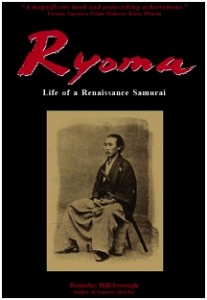
“Ryoma: Life of a Renaissance Samurai”: The 20th Anniversary (9)

There is no way to understand modern Japan without knowledge of Bakumatsu-Meiji Restoration history, and the men who made that history. Which is why I’ve spent the past 30 years or so writing about this subject.

When I decided to write Ryoma, my first book, in late 1986, I had no idea that I would continue with this endeavor for so long.

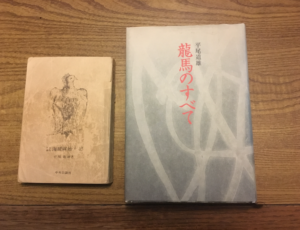
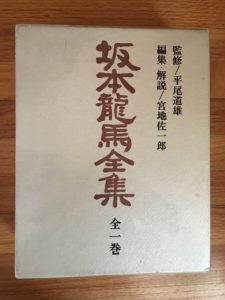
Among the first nonfiction Bakumatsu history books that I read and studied are these two classics of the life and times of Sakamoto Ryoma, both by Tosa historian Hirao Michio: Sakamoto Ryoma: Kaientai Shimatsuki (坂本龍馬  海援隊始末記) AND Ryoma no Subete (坂本龍馬のすべて).

The copy of Shimatsuki shown here is the original copy that I have read and re-read many times. The copy of Subete I bought at a bookstore in Kochi in 1999. (I had lost my first copy during my move from Tokyo to San Francisco some years before that.)


ryoma
widget_buy_amazon