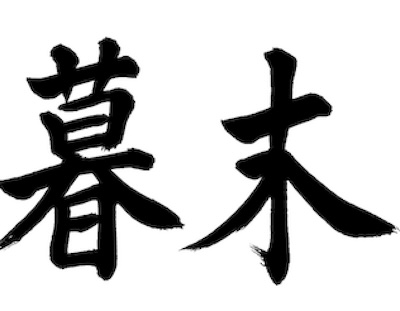
Bakumatsu literally means “end of the Bakufu,” the military regime of fifteen generations of heads of the House of Tokugawa, each one holding the title of shogun. Their hegemony over Japan began in 1603 and lasted more than two and a half centuries. The first character of Bakumatsu, also pronounced maku, signifies a curtain or tent, recalling the field headquarters of medieval commanders. The second character, matsu, simply means “end.” So Bakumatsu signified not a political program or ideology, but a historical reality: the final years of Tokugawa rule.
Most historians date the Bakumatsu from Perry’s arrival in 1853 to the Restoration of Imperial Rule in early 1868 — the coup that ended Tokugawa rule. The reasoning is that Perry’s arrival is widely construed to have sparked the “beginning of the end” of the Tokugawa Bakufu—though three consecutive shoguns would cling to power for another fourteen and a half years before the final fall. Bakumatsu is a relatively recent term, which was not used by people who lived through those years. The term came into common use only after the Meiji government had consolidated power and historians could look back on the collapse of the Bakufu as a distinct era. An early example of its use is from one of the most celebrated and important men of the era, Katsu Kaishū, in an interview with the magazine Tenchijin in October 1898, just a few months before his death. “Although it has only been thirty years since the Bakufu fell, there isn’t one person who has written a perfect history of the Bakumatsu,” Kaishū said. (Quoted in Hikawa Seiwa, Katsu Kaishū Zenshū 21 (Tokyo: Kodansha, 1973), p. 293)
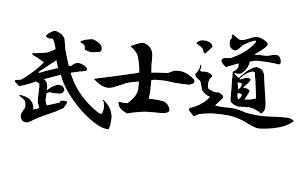
The emotional weight of the word is powerful. It evokes not only political upheaval but also the moral exhaustion of a system that had preserved peace for two and a half centuries. It was a time when loyal retainers faced impossible choices between serving their daimyo—or the shogun, as in the case of Katsu Kaishū and tens of thousands of other Bakufu samurai—and the emerging concept of a unified nation under the Emperor. It was also an age of extraordinary creativity, when Japan’s brightest minds grappled with how to reconcile the old way of life, based in no small measure on the samurai code of bushido.
When I use the term “Samurai Revolution,” I mean precisely this: the transformation of Japan that began with the Bakumatsu, and encompassed the Meiji Restoration and the subsequent civil war (Boshin War) that continued until May 1869.
Samurai Swordsmen: The Definitive History of the Shinsengumi (Helion, 2026) is now in production.
For professional guidance on Bakumatsu–Meiji Restoration history, see Historical Consulting.
Explore my books at Books at a Glance.