
[Sakamoto Ryōma (standing portrait), taken in Nagasaki, ca. 1866 — one of the most iconic images of the Bakumatsu reformer]
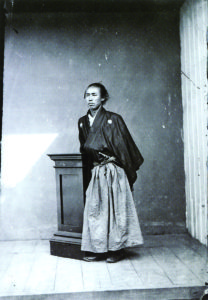
Sakamoto Ryōma (1836–1867) stands among the most influential figures of the Bakumatsu era, a visionary swordsman, and political reformer whose ideas helped shape Japan’s transition from Tokugawa rule to the modern nation-state. A native of the Tosa domain, Ryōma deserted his clan at a time of intense political upheaval and became one of the era’s most dynamic activists, advocating national unity, modernization, maritime strength, and peaceful political reform.
Ryōma famously vowed to “clean up Japan once and for all.” By “cleaning up” his country, he meant eliminating the corrupt and antiquated Tokugawa Bakufu, which had ruled Japan for 260 years, and replacing it with a modern democratic system modeled on Western institutions.
Among Ryōma’s greatest achievements was brokering the crucial alliance between Satsuma and Chōshū. Their combined strength made possible the January 3, 1868 takeover of the government, which brought down the Tokugawa Bakufu and restored Imperial rule.
Ryōma’s life and work were cut short with his assassination in Kyoto in late 1867, but his legacy endures as one of Japan’s most beloved historical heroes.
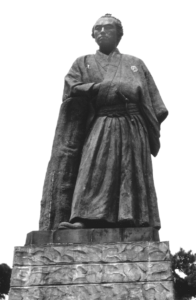
[Sakamoto Ryōma statue at Katsurahama, Kochi. Photo by the author.]
Ryōma and Katsu Kaishū
Ryōma’s association with the Bakufu naval officer Katsu Kaishū profoundly shaped his political thinking and strategic worldview. Their relationship became one of the most consequential alliances of the Bakumatsu era. For more about the Ryōma-Kaishū relationship see here.
Ryōma’s Greatest Achievements
Ryōma’s greatest achievements are outlined in the concluding lines of this edited passage from Samurai Assassins:
Though Ryōma was the author of the plan for the peaceful restoration of Imperial rule, he was also a leading proponent of Tōbaku, “Down with the Bakufu.” These two seemingly contradictory stances underlie the tragedy of his assassination. In a letter to Ryōma shortly before his death, the Chōshū leader Katsura Kogorō likened Tōbaku to a “Great Drama,” the final act of which was getting under way in Kyoto, as Satsuma and Chōshū, in collaboration with Court nobleman Iwakura Tomomi, prepared to destroy the Bakufu. With Ryōma’s assassination around two months later, on the eve of a peaceful revolution of his own design, that drama turned tragic.
Ryōma’s murder by multiple sword wounds to the body and a blow to the head from which his brains reportedly protruded even as he was still able to move around and speak, was as horrible as it was tragic. To fully understand the scale of Ryōma’s tragedy, we must realize that he was a visionary and a genius—if genius means to conceive of original ideas and to have the courage and audacity to bring them to fruition. The German philosopher Friedrich Nietzsche, Ryōma’s contemporary, alluded to genius, I think, with the following statement: “When a human being resists his whole age and stops it at the gate to demand an accounting, this must have influence.” Based on his determined resistance to the social iniquities and restraints under the Tokugawa Bakufu and its archaic feudal system, Sakamoto Ryōma influenced “his whole age” through a series of unparalleled historical achievements: Japan’s first trading company, the Satsuma-Chōshū Alliance, and his great plan for peaceful restoration of Imperial rule.
My Work on Sakamoto Ryōma
I have written extensively on Ryōma for more than four decades, including the full-length biographical novel Ryoma: Life of a Renaissance Samurai. My research draws from Ryōma’s surviving letters, personal documents, and definitive Japanese sources, including the annotated Sakamoto Ryoma Zenshū compiled by Miyaji Saichirō.
Other books featuring Ryōma:
• Samurai Revolution: The Dawn of Modern Japan Seen Through the Eyes of the Shogun’s Last Samurai
• Samurai Assassins: “Dark Murder” and the Meiji Restoration, 1853–1868
––––––––––––––––––––––
Kaishū–Ryōma Relationship: How Their Alliance Shaped the Restoration
Further Reading
• Ryoma: Life of a Renaissance Samurai
• “Ryoma: Life of a Renaissance Samurai”: The 20th Anniversary (2)
• “Ryoma: Life of a Renaissance Samurai”: The 20th Anniversary (3)
• “Ryoma: Life of a Renaissance Samurai”: The 20th Anniversary (4)
• “Ryoma: Life of a Renaissance Samurai”: The 20th Anniversary (5)
• “Ryoma: Life of a Renaissance Samurai”: The 20th Anniversary (6)
• “Ryoma: Life of a Renaissance Samurai”: The 20th Anniversary (7)
• “Ryoma: Life of a Renaissance Samurai”: The 20th Anniversary (8)
• “Ryoma: Life of a Renaissance Samurai”: The 20th Anniversary (12): “Ryoma never repaid the money, so I guess he still owes us.”
• Hanpeita and Ryōma
• “A man of consequence”
• Sakamoto Ryōma and Nakaoka Shintarō
• Saigō’s Magnanimity and Ryōma’s Underwear
• Ryōma and the Satsuma–Chōshū Alliance
• A Note On Ryōma, the Gunman
• Sakamoto Ryōma’s Heroic Wife, Oryō
• Oryō, a Woman Who Changed Japanese History
• Sakamoto Ryōma and International Law
• Did Sakamoto Ryōma Hold the Rank of Kaiden? A Historical Reassessment of His Swordsmanship
• Ryōma: Ten Often Overlooked Facts (1)
• Ryōma: Ten Often Overlooked Facts (2)
• Ryōma: Ten Often Overlooked Facts (3)
• Ryōma’s Eerie Foresight
• Prophetic Words in Sakamoto Ryōma’s Final Letter
• Ryōma’s Assassination and His Peace Plan
• Assassination of Sakamoto Ryōma: Shinsengumi Suspected
• An Indispensable Document for Knowing the Facts Regarding Ryōma’s Assassination
• The Ryōma Phenomenon (1) – How Japan’s “Renaissance Samurai” Became a Legend
• The Ryōma Phenomenon (2) – Find Out Why Ryōma Still Captivates Japan
• The Ryōma Phenomenon (3) – The Statue at Katsurahama
• The Ryōma Phenomenon (4) – A Nation Still Inspired
• The Ryōma Phenomenon (5): “You Gotta Have Big Dreams!”
• The Ryōma Phenomenon (9): My Five Favorite Books About Ryōma
Samurai Swordsmen: The Definitive History of the Shinsengumi (Helion, 2026) is now in production.
For professional guidance on Bakumatsu–Meiji Restoration history, see Historical Consulting.
Explore my books at Books at a Glance.