In Third Month of the Japanese year corresponding to 1868, around three months after the fall of the Tokugawa Bakufu (Shogunate), the forces of the new Imperial government were set to launch a general attack on the shogun’s capital of Edo (modern-day Tokyo). Meanwhile, Katsu Kaishū, commander-in-chief of the fallen shogun’s military, appealed to Saigō Takamori of Satsuma, the commander of the Imperial forces, to call off the attack, which would have resulted in a bloodbath in that city of well over one million people. Kaishū asked Saigō to meet to discuss terms for a peaceful surrender of Edo and its mighty castle that would be acceptable to both sides. The two commanders met twice, once each on the 13th and 14th of that month.
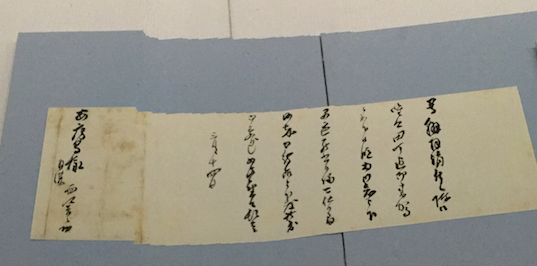
This letter from Saigō to Kaishū, dated 3/14, was in reply to a letter from Kaishū informing Saigō that he was waiting to meet him a second time at Satsuma’s warehouse facility (kurayashiki) in the Tamachi district of Edo. Replying that he would arrive shortly, Saigō asked Kaishū to wait for him. Saigō arrived as promised, and as a result of the ensuing “Meeting of the Two Heroes” the attack was called off.
[The letter from Saigō to Kaishu is exhibited in the Edo-Tokyo Museum in Tokyo, Japan.]
Katsu Kaishū is the “shogun’s last samurai” of Samurai Revolution, in which I wrote in detail (Chapters 27-30) about his role in averting civil war, including his talks with Saigō.