
“I don’t know about difficult things such as affairs of state.” Saigō Takamori
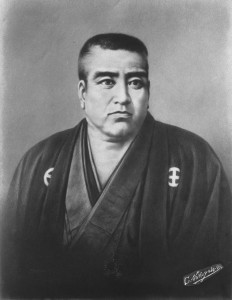
Katsu Kaishu told an anecdote illustrating Saigō’s kindness and gentility—and his modesty. It has to do with a man named Hitomi Yasushi, who had been among those in the Bakufu opposing Shogun Tokugawa Yoshinobu’s abdication. Hitomi had fought against the Satsuma troops at the outbreak of civil war at Toba-Fushimi in Keio 4/1 (1868), and later against the forces of the Imperial government at Hokodate. Not long after the Meiji Restoration of 1868, Hitomi visited Kaishu at his home. Saying that he wanted to meet Saigō, he asked for a letter of introduction. “But it seemed that he intended to kill Saigō,” Kaishu recalled:
“I wrote the letter for Hitomi, but included the following warning: ‘This man intends to kill you. But please meet with him anyway.’ So Hitomi went down to [Saigō’s home in] Satsuma. The first person he met there was Kirino [Toshiaki]. Kirino . . . had a discerning eye. . . . So when he opened and read my letter to Saigō, he understood the situation. Even the fearless Kirino was a little startled—and immediately informed Saigō. But Saigō remained absolutely calm. ‘If he’s got an introduction from Katsu, I’ll meet him,’ he said. So on the next day Hitomi visited Saigo’s home. ‘My name is Hitomi Yasushi,’ he announced. ‘I’ve come to talk to you.’ Saigō was lying down near the front door. Hearing Hitomi’s voice, he calmly got up and said, ‘…I don’t know about difficult things such as affairs of state. Just listen to this. The other day I took a trip. . . . Along the way I got very hungry. So I bought some potatoes and ate them. Certainly you can’t expect a guy like me, who can satisfy his hunger [with just potatoes], to know about the state of things in our country.’ Then he opened his mouth wide and burst out laughing. The impetuous Hitomi was caught off-guard by the sudden words. Far from killing Saigo, he left without saying so much as ‘goodbye.’ He was struck with admiration, and when he got back told me, ‘Saigō is truly a great man.'”
Hikawa Seika (Kodansha, vol. 21, p. 56)
Read more about Saigō Takamori’s philosophy in “Revere Heaven, Love Mankind” (敬天愛人)“
For more about my books in English, including Samurai Revolution, visit my Books at a Glance page.
Follow me on Facebook | Amazon Author page