
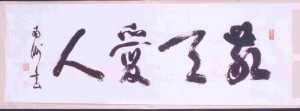
敬天愛人 — “Revere Heaven, love mankind” — was Saigō Takamori’s cherished motto. In Samurai Revolution, I wrote the following:
“Revere Heaven, love mankind” represents a Confucian ethic that dictates the relationship between the people, the government, and the Emperor—in a universe ruled by Heaven. But Heaven cannot feasibly watch over each and every person, assuring peace and harmony in human society. That role, then, is allotted to the Emperor, the Son of Heaven. Assisting the Emperor in his holy obligation are the feudal lords. Assisting each feudal lord in assuring peace and harmony for the people in his domain are the government officials, selected from among the lord’s samurai vassals.
Heavy is the responsibility of the officials who oversee the everyday affairs of the feudal domains. Since they directly control the fate of the people, one blunder by just one official can mean catastrophe for a great number. As a leader of the people, a government official must win the hearts and minds of the people. To do so, he must put aside self-interest for the benefit of the people, who have no choice but to obey him. [end excerpt]
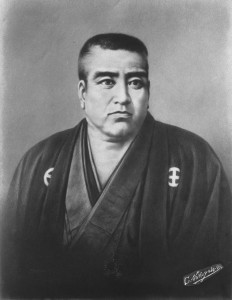
Saigō’s philosophy is timeless. It expresses an enduring moral vision rooted in compassion, duty, and leadership. More than a political maxim, “Revere Heaven, love mankind” embodies the moral foundation of his life and actions—a teaching that continues to illuminate Japan’s transformation in the Bakumatsu–Meiji era.
[The image of Saigō’s calligraphy is from the website of Kagoshima Prefectural Library (鹿児島県立図書館). The image of Saigo is used in Samurai Revolution, courtesy of Japan’s National Diet Library.]
___________________
Read more about Saigō Takamori’s character in Saigō Takamori’s ‘gentility, kindness, and modesty’.
For a full account of Saigō Takamori’s life and philosophy, see Samurai Revolution.