In my forthcoming book Samurai Swordsmen: The Definitive History of the Shinsengumi (1863–1869), I wrote about Shinsengumi Vice-Commander Hijikata Toshizō’s anticipation of a war in Kyoto between Aizu and Satsuma based on the latter’s refusal to support the Bakufu in the imminent war against Chōshū in 1866. Katsu Kaishū, “the shogun’s last samurai” of my Samurai Revolution, was tasked with mediating between the two to resolve the problem peacefully.
Okay so I wrote about that. But as is sometimes the case after spending the day (or week or month or year or even decade) writing about this history, which was played out by men of a completely different time, place and culture than my own, I am struck by a sense of awe at the heaviness of my work—especially given that many of my main sources are in antiquated Japanese written by the men who made this history.
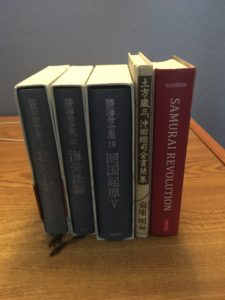
Main sources include three works from Katsu Kaishū, a book of letters by Hijikata Toshizō and Okita Sōji (annotated by Kikuchi Akira), and my own Samurai Revolution.
For more about my forthcoming book Samurai Swordsmen, see the Shinsengumi Hub.
To explore my other books, see Books at a Glance.