
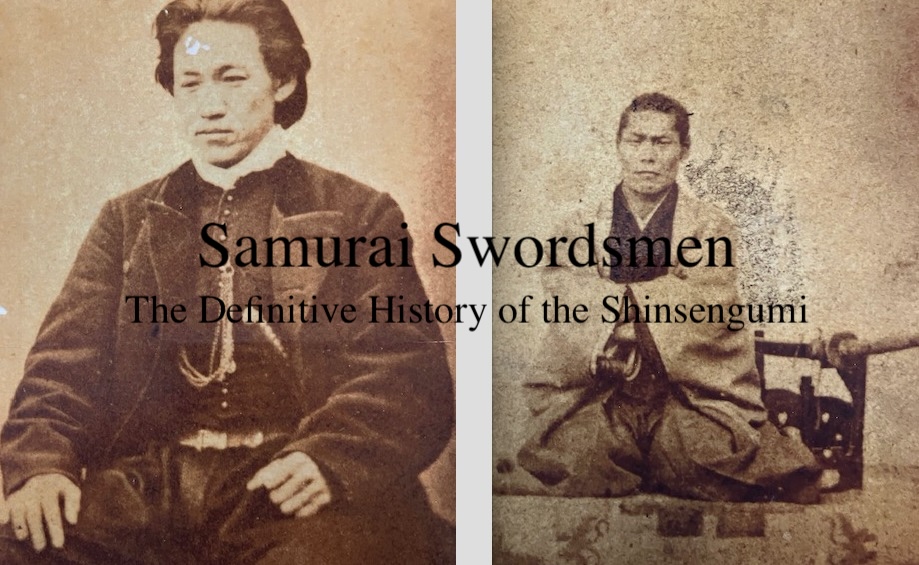
This page serves as the hub for my Shinsengumi writing — a central place for my research, essays, and ongoing work on the corps and their history. Here you’ll find essays, background notes, and related posts, along with new articles in my ongoing Shinsengumi series leading up to the fall 2026 publication of Samurai Swordsmen: The Definitive History of the Shinsengumi amid the Fall of the Tokugawa Shogunate (1863–1869).
The Shinsengumi
The Shinsengumi — the shogun’s last samurai corps — were a unique and formidable band of warriors who stood at the center of Japan’s turbulent final years under Tokugawa rule. The Shinsengumi lived and died by the samurai code of bushido, and their story has fascinated me for decades.
From My First Book to the Definitive History
Years ago, I published The Shogun’s Last Samurai Corps: The Bloody Battles and Intrigues of the Shinsengumi, an introductory history that made the group’s dramatic rise and fall accessible to general readers. I have recently completed a comprehensive new history of the Shinsengumi, which builds on my earlier research and expands it into what I intend to be the definitive history of the Shinsengumi in English.
Samurai Swordsmen: The Definitive History of the Shinsengumi amid the Fall of the Tokugawa Shogunate (1863–1869) is scheduled for publication in fall 2026 with Helion.
Publisher information:
Samurai Swordsmen — forthcoming from Helion & Company
View the book on the Helion website
_______________
SHINSENGUMI ARTICLES
Two Masterpieces of Shinsengumi History and Lore
Posted November 16, 2016 — A comparison of two foundational works on the Shinsengumi: Shimosawa Kan’s Shinsengumi Shimatsuki, a vivid narrative drawn from first-hand accounts, and Hirao Michio’s Shinsengumi Shiroku, a more disciplined historical study of the corps. The essay reflects on their contrasting methods and lasting importance in Shinsengumi historiography.
Reflections on Writing from a Different Time, Place, and Culture
Posted November 16, 2025 — A short meditation on the challenge of writing Shinsengumi history drawn from nineteenth-century Japanese sources. Romulus reflects on the weight of interpreting a world defined by different assumptions, values, and language—through the words of Katsu Kaishū, Hijikata Toshizō, Okita Sōji, and other key figures whose documents inform Samurai Swordsmen and his broader work.
The Shinsengumi in English: Separating Myth from History
Posted October 23, 2025 — A reflection on the growth of English-language writing about the Shinsengumi, much of it drawn from myth and popular fiction. The article introduces Samurai Swordsmen: The Definitive History of the Shinsengumi amid the Fall of the Tokugawa Shogunate (1863–1869), forthcoming from Helion, which sets the historical record straight.
Katsu Kaishū’s Journals and Shinsengumi History
Posted October 18, 2025 — An introduction to Katsu Kaishū’s Bakumatsu Nikki and its importance as a primary source for Samurai Swordsmen: The Definitive History of the Shinsengumi amid the Fall of the Tokugawa Shogunate (1863–1869). Kaishū’s journals capture the political and cultural world that produced the Shinsengumi.
The Assassination of Sakamoto Ryōma: The Shinsengumi Suspected
Posted August 1, 2025 — Examines the longstanding theory implicating the Shinsengumi in the assassination of Sakamoto Ryōma, while the actual assassins were almost certainly the Mimawarigumi, another of the shogunate’s elite security corps active in Kyoto during the same turbulent years.
Matsudaira Katamori: Master of the Shinsengumi
Posted July 6, 2025 — A profile of Aizu daimyo Matsudaira Katamori, protector of Kyoto (1862–1867) and ultimate commander of the Shinsengumi. Draws on Yamakawa Hiroshi’s 1911 history Kyoto Shugoshoku Shimatsu.
The Assassination of Sakamoto Ryōma: The Shinsengumi Suspected
Posted August 1, 2025 — Examines the longstanding theory implicating the Shinsengumi in the assassination of Sakamoto Ryōma, while the actual assassins were almost certainly the Mimawarigumi, another of the shogunate’s elite security corps active in Kyoto during the same turbulent years.
Who Was Serizawa Kamo?
Posted June 24, 2025 — Examines the violent and enigmatic Serizawa Kamo, co-founder and early leader of the Shinsengumi, with an original photograph of his grave at Mibu Temple in Kyoto.
Statue of Shinsengumi Vice-Commander Hijikata Toshizō at Takahata Fudō Temple in Hino
Posted August 19, 2020 — Describes the monument and bronze statue honoring Kondō Isami and Hijikata Toshizō at Takahata Fudō Temple in their native Hino.
National Diet Library’s Online Database (2)
Posted January 3, 2019 — A brief note on Japan’s National Diet Library online database as an invaluable source for Bakumatsu–Meiji primary documents. Hillsborough highlights Kabuto Kuninori Jirekifu, the autobiography of a Kuwana samurai linked to the Matsudaira brothers of Aizu and Kuwana, underscoring its value in his continuing Shinsengumi research.
National Diet Library’s Online Database (1)
Posted December 3, 2018 — A brief note introducing Japan’s National Diet Library online database as an essential repository of Bakumatsu–Meiji Restoration documents. Hillsborough highlights Tamamushi Yoshishigé’s Kanbu Tsūki (官武通紀), a record of events from 1862–64 that has contributed to his continuing research on the Shinsengumi.
Hijikata Toshizō, Vice Commander of the Shinsengumi
Posted August 19, 2018 — A glimpse into Hijikata’s life through recollections from his hometown, revealing the contrast between his gentle youth and fearsome reputation in Kyoto.
A History of the Shinsengumi’s Master
Posted January 28, 2018 — A look at Yamakawa Hiroshi’s 1911 chronicle Kyoto Shugoshoku Shimatsu, written by a former minister to Aizu daimyo Matsudaira Katamori, the Shinsengumi’s commander. The book offers a rare insider’s view of Aizu’s role in Kyoto and serves as a key source for Samurai Swordsmen: The Definitive History of the Shinsengumi amid the Fall of the Tokugawa Shogunate (1863–1869).
Bushidō: A Universal Code for the 21st Century
Posted February 10, 2017 — A reflection on the Shinsengumi’s emblematic virtue makoto (“sincerity”) and its relation to the core tenets of bushidō: sincerity, loyalty, and courage. Hillsborough considers how these principles guided Kondō Isami and his men — and how the moral code of the samurai endures as a universal ethic beyond Japan’s nineteenth century.
Read more about my background and work here.
To explore my books see Books at a Glance.