
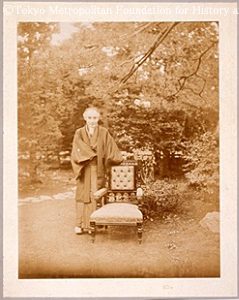
 While reviewing my material for Samurai Revolution, I was reminded of one of my favorite comments from Katsu Kaishū in his old age. The setting was the formal surrender of Edo Castle to the new Imperial government in spring 1868, four months after the abolition of the Tokugawa Bakufu by the new Imperial government – i.e., The Restoration of Imperial Rule of Old. The ceremony took place in the interior of the citadel, attended by samurai of various feudal domains including Satsuma and Choshū. As I wrote in Samurai Revolution (excluding footnotes):
Kaishū did not attend the ceremony in which the castle was officially surrendered. Rather, he went to navy headquarters on the bay, where he had some of his men climb to the rooftop to watch and listen for gunshots coming from the direction of the castle. If anything happened, he wrote, he was prepared to report to the Imperial Army and accept the responsibility by taking his own life. “Fortunately, nothing happened”—the ceremony was concluded without incident.
But there was a “praiseworthy anecdote” which Kaishū heard from [his friend] Ōkubo Ichiō. Saigō, it seems, remained typically placid throughout the ceremony:
“…[w]hat was truly amazing was that when the formalities began for surrendering the castle, Saigō dozed off. Then when the ceremony was finished and the other representatives were leaving, he just sat there calmly. Ichiō, who was near him, couldn’t stand it. “Saigō-san, Saigō-san,” he said, waking him up, “the ceremony is over and everyone’s leaving.” At which Saigō, a bit startled, rubbed his sleepy face then calmly left. Ichiō was struck with admiration. What an audacious fellow! Exhausted after dozens of days, he took the opportunity to doze off while the castle was being surrendered—truly unbelievable!”
“And so,” Kaishū concluded the above account, told in January 1896, “that’s why he’s at the top of the list of the great men of the Restoration.” (p. 500)
[The photo of Katsu Kaishū was taken in the garden at his Hikawa estate during the final years of his life.]
Katsu Kaishū is the “shogun’s last samurai” of Samurai Revolution,the only biography in English.