
Just as “a house in strife will fall, a country in strife will fall.” Katsu Kaishū
“A house divided against itself cannot stand.” Abraham Lincoln
The peaceful surrender of the fallen shogun’s castle at Edo (modern-day Tokyo), negotiated in the spring of 1868, one day before a scheduled general attack on the capital by forces of the new Imperial government, is “the most beautiful event in Japanese history,” according to Saigō Takamori’s biographer Kaionji Chōgorō. It was a result of amicable talks between the military leaders of the opposing sides: Katsu Kaishū representing the shogun, and Saigō, the de facto commander of the Imperial forces. Kaionji’s perceived “beauty” lay in the fact that a devastating civil war was thereby averted, sparing Edo’s population of well over a million from untold misery.
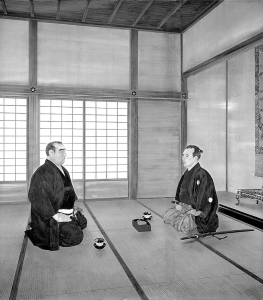
But even after the castle was surrendered, thousands of samurai in Edo refused to yield to draconian treatment by the Imperial government, including confiscation of their landholdings, which would leave them without a livelihood. With a final military showdown imminent, Kaishū sent a letter to Saigō warning him of the dire consequences of the unfair treatment. “Where do you expect them to vent their enmity?” But if the government would treat his people fairly, Kaishū assured Saigō, “the people would happily submit.” But, he ominously warned, just as “a house in strife will fall, a country in strife will fall”–and though Kaishū certainly admired Abraham Lincoln, it is unknown whether or not he was mindful of his famous dictum of a “house divided” uttered a decade earlier.
(Katsu Kaishū is the “shogun’s last samurai” of my Samurai Revolution. The image of Saigō and Kaishū negotiating the surrender of Edo Castle is used in my Samurai Tales, courtesy of Seitoku Kinen Kaigakan.)