
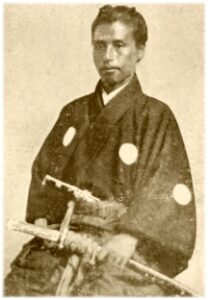
 Katsu Kaishū (1823–1899) was one of the most remarkable leaders during the final years of the Tokugawa Bakufu—a founder of the Japanese navy, statesman, reformer, and one of the first Japanese officials to advocate modernization through maritime strength and engagement with the Western world. His vision for a unified, modern Japan placed him at the center of the political transformation that led to the Meiji Restoration.
Kaishū’s most celebrated achievement occurred in the spring of 1868, when, as commander-in-chief of the deposed shogun’s military, he negotiated directly with Saigō Takamori, the de facto military leader of the new Imperial government, to surrender Edo Castle without bloodshed—an act that spared the shogun’s capital of Edo (modern-day Tokyo) and its more than one million inhabitants from destruction.
Kaishū and Ryōma
Kaishū played a crucial mentoring role in the life of Sakamoto Ryōma, who entered his service after becoming a political outlaw. Their relationship helped shape Ryōma’s political evolution and contributed to the ideological foundations of the Meiji Restoration.
Who was Katsu Kaishū?
Kaishū’s multifaceted personality is briefly described in this edited passage from the Prologue of Samurai Revolution:
In spring 1868, Katsu Kaishū, who had risen through the ranks by force of character and a keen and creative mind, was in command of the Tokugawa military. He had at his disposal a fleet of ships and thousands of troops raring to attack the enemy. But just who was this multifaceted, enigmatic man upon whom the deposed shōgun rested his life and the fate of his family and indeed the entire country? Unlike [Shōgun Tokugawa] Yoshinobu’s other advisors, he hailed neither from a noble house of feudal lords charged for generations with the Bakufu’s highest offices, nor from the privileged families of Tokugawa samurai whose sons traditionally filled the most important magistracies and commissionerships. Born to the humblest of samurai families in service of the shōgun, he was at once the consummate samurai and streetwise denizen of downtown Edo; an expert swordsman who refused to draw his sword even in self-defense; a statesman who commanded the respect of allies and foes alike; an inviolable outsider within the shōgun’s regime; an iconoclast, historian, prolific writer, and creator of the Japanese navy. And though his loyalty to the Tokugawa was unsurpassed, he was nevertheless a friend and ally of men who had overthrown the government.
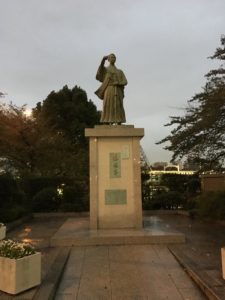
[Statue of Katsu Kaishū on the Sumida River in Asakusa. Photo by the author.]
My Work on Katsu Kaishū
The biography:
Samurai Revolution: The Dawn of Modern Japan Seen Through the Eyes of the Shogun’s Last Samurai — A comprehensive history of the Bakumatsu–Meiji Restoration and the only full-length English-language biography of Katsu Kaishū. It draws extensively on Kaishū’s own Bakumatsu Nikki (Bakumatsu Journal), his memoirs and letters, and a wide range of Japanese archival material. I have also published numerous essays on this website examining Kaishū’s political strategy, naval career, and influence on the next generation of Bakumatsu reformers.
Other books featuring Kaishū:
• Samurai Swordsmen: The Definitive History of the Shinsengumi (1863–1869) (forthcoming in fall 2026)
• Ryoma: Life of a Renaissance Samurai
––––––––––––––––––––––
Kaishū–Ryōma Relationship: How Their Alliance Shaped the Restoration
Further Reading
• Katsu Kaishū’s Journals and Shinsengumi History
• Clark’s Biography of Katsu Kaishū
• Katsu Kaishū’s “Notebook of Deceased Friends”
• A Note On Katsu Kaishū: A Samurai of the Highest Moral Character
• Katsu Kaishū and Sakamoto Ryōma: A Meeting of the Minds
• “The sword is in the man” (剣は人なり) and Katsu Kaishū
• Katsu Kaishū’s Mock-Self-Deprecation: The 1895 Interview
• Katsu Kaishū’s Portrait by US Navy Sailor Edward Kern
• Katsu Kaishū on Perseverance and “Ki”
• Saigō’s Letter to Kaishū
• Katsu Kaishū’s Early Hardships and the Friend Who Changed His Life
• Katsu Kaishū’s Lincolnian Dictum
• Katsu Kaishū’s “Heartrending Narrative”
• Katsu Kaishū’s Martial Arts Teachers
• The Samurai, the Ship, and the Golden Gate
• “Went up to the castle”
• Calligraphy from the last Shogun to His “Last Samurai”
• Words of Wisdom from the “Shogun’s Last Samurai”
• On The 150th Anniversary of the Meiji Restoration (19): Katsu Kaishū on “dangerous times”
• On The 150th Anniversary of the Meiji Restoration (10): Timeless Words of Wisdom from “the Shogun’s Last Samurai”
Samurai Swordsmen: The Definitive History of the Shinsengumi (Helion, 2026) is now in production.
For professional guidance on Bakumatsu–Meiji Restoration history, see Historical Consulting.
Explore my books at Books at a Glance.