
This page offers a clear, authoritative overview of the historical relationship between Katsu Kaishū and Sakamoto Ryōma—one of the most consequential personal alliances of the Bakumatsu period, and a central theme in my long study of Japan’s transformation from Tokugawa rule to the modern nation-state.
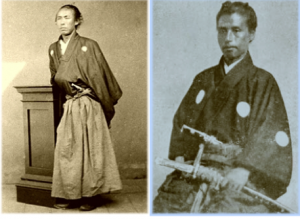
[Composite image of Sakamoto Ryōma and Katsu Kaishū—created by Romulus Hillsborough to represent the mentor and disciple who helped shape Japan’s modern transformation.]
Introduction
Few encounters in Japanese history had consequences as far-reaching as the meeting between Katsu Kaishū (1823–1899), the visionary naval officer and statesman of the Tokugawa Bakufu, and Sakamoto Ryōma (1836–1867), the outlaw samurai from Tosa who would become one of the Meiji Restoration’s pivotal figures. Their brief but intense association from 1862 to 1864 helped set into motion political, military, and ideological developments that reshaped Japan.
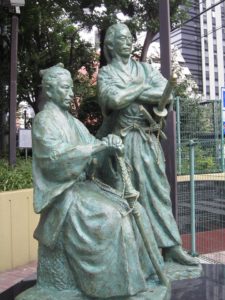
[Statue of Katsu Kaishū and Sakamoto Ryōma at Hikawa, commemorating the meeting that helped shape Japan’s path to the Meiji Restoration]
The First Meeting
Ryōma’s first meeting with Kaishū, at the latter’s home in Edo (modern-day Tokyo), occurred sometime in the last three months of Bunkyū 3, the Japanese calendrical year corresponding to 1862—a time of violent anti-Bakufu, anti-foreign activism in Kyoto and Edo. Having deserted the Tosa domain, Ryōma had aligned himself with anti-Bakufu patriots and embraced the idea of overthrowing the Bakufu. Kaishū, by contrast, was a senior naval official advocating modernization, Western technology, and diplomatic engagement.
Since Ryōma was a founding member of Takechi Hanpeita’s radical Tosa Loyalist Party, which stood for Sonnō-Jōi—Revere the Emperor and Expel the Barbarians—and “overthrowing the Bakufu,” it would not be unreasonable to assume that he had visited Kaishū’s home with intention to kill the prominent Bakufu naval officer who advocated “opening the country.” Indeed, this assumption came to be treated as fact in later accounts. A dramatic legend, rooted largely in Kaishū’s interviews and reminiscences from his later years and popularized by Shiba Ryōtarō’s widely read novel Ryōma ga Yuku, claims that Ryōma entered the meeting intending to assassinate him.
However, nothing in the contemporary record supports this. Ryōma, like Kaishū himself, hated bloodshed and is believed to have killed once, and then in self-defense. Moreover, even before his first meeting with the founder of Japan’s modern navy, Ryōma had already embraced aspirations of developing a navy to defend and enrich the country in face of the foreign threat. Far from drawing his sword on Kaishū, Ryōma was quickly won over by the senior naval officer’s vision for a national navy and a modernized Japan.
Kaishū, for his part, quickly recognized Ryōma’s intelligence and fearlessness and took him under his wing. He supported the young political outlaw’s initiatives, including his efforts to promote maritime strength, encourage modernization, and move the country toward peaceful unification. Their alliance became one of the most consequential partnerships of the Bakumatsu era.
Mentor and Disciple
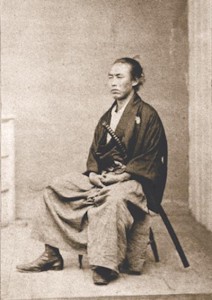
[Seated portrait of Sakamoto Ryōma, ca. 1866—taken during his most active years as a political reformer and advocate of maritime modernization]
 Kaishū provided Ryōma with far more than naval instruction. He offered a strategic worldview informed by his voyage as captain of the Kanrin Maru, on the historic first Pacific crossing—to San Francisco in 1860. Kaishū’s engagement with Western governments and his years confronting the limitations of the Tokugawa system from within served as powerful lessons for the younger man, who would go on to establish Japan’s first modern maritime trading company, Kameyama Shachū, at the open port of Nagasaki, which would later become the more famous Kaientai—Naval Auxiliary Corps.
Ryōma, in turn, became a conduit for Kaishū’s ideas, carrying them into the radical political networks of Tosa, Satsuma, and Chōshū. Through Kaishū, Ryōma learned:
• The strategic necessity of maritime strength.
• The futility of trying to expel foreign powers without modernization.
• The need for a unified national government.
• The value of peaceful transition over violent upheaval.
These principles became the foundations of Ryōma’s later political achievements, including Senchū Hassaku, his eight-point plan to bring the Bakufu down peacefully.
The Satsuma–Chōshū Alliance and Ryōma’s Political Role
One of Ryōma’s greatest political accomplishments—brokering the Satsuma-Chōshū Alliance—was shaped by concepts he absorbed from Kaishū. Both men saw Japan’s fragmentation as untenable—and dangerous in the face of the threat of Western imperialism—and they believed in the necessity of coordinated national action.
The Satsuma–Chōshū Alliance, formed in early 1866, provided the military and political foundation for overthrowing the Bakufu and establishing a new central government under the Emperor. This achievement would not have been possible without Ryōma’s unique ability to move between domains and political factions, and without the intellectual framework and personal connections—particularly with Saigō Takamori, the de facto leader of Satsuma—that he had acquired from Kaishū.
Kaishū’s Preservation of Edo and the Peaceful Transition of Power
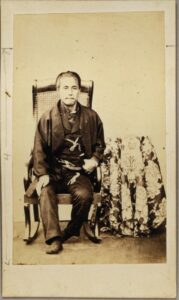
[Portrait of Katsu Kaishū, late Tokugawa period]
 While Ryōma was assassinated in late 1867—shortly after his peace plan was accepted, however insincerely, by the last shogun, Tokugawa Yoshinobu—Kaishū lived to see the full collapse of the Tokugawa regime and played a decisive role in preventing the destruction of Edo during the Boshin War. His negotiation with Saigō in the spring of 1868 ensured the peaceful surrender of Edo Castle, sparing the lives of more than one million inhabitants of the shogun’s capital. This act, which Kaishū himself regarded as the culmination of his career, mirrored the principles he had taught Ryōma: modernization, unity, and the avoidance of unnecessary bloodshed.
Why Their Relationship Matters
The association between Kaishū and Ryōma provides a window into the broader transformation of Japan:
• The decline of feudalism.
• The rise of a modern navy.
• The emergence of national rather than domain-based identity.
• The ideological shifts that propelled the Meiji Restoration.
Their brief but formative relationship stands at the center of this transition.
Further Reading
For a more detailed examination of their association, including Kaishū’s journals and Ryōma’s letters, see:
• Samurai Revolution: The Dawn of Modern Japan Seen Through the Eyes of the Shogun’s Last Samurai
• Ryoma: Life of a Renaissance Samurai
• Kaishū and Ryōma: The Indispensable Relationship (Parts 1–5)
• Katsu Kaishū and Sakamoto Ryōma: A Meeting of the Minds
• The Ryoma Phenomenon (6): The Meeting That Changed Japan
Samurai Swordsmen: The Definitive History of the Shinsengumi (Helion, 2026) is now in production.
For professional guidance on Bakumatsu–Meiji Restoration history, see Historical Consulting.
Explore my books at Books at a Glance.