
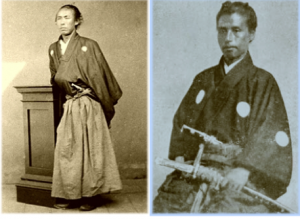
Sakamoto Ryoma & Katsu Kaishu
It is well known that Katsu Kaishū and Sakamoto Ryōma had a very close relationship for a couple of years. But their relationship abruptly ended with the dismissal of Kaishū as the shogun’s commissioner of warships and his subsequent house arrest near the end of 1864, for harboring the likes of Ryōma and other known renegades intent on overthrowing the shogun’s government. And though the two men would never meet again, neither could have accomplished his greatest task without the other.
Kaishū taught Ryōma how to navigate a steamship, state-of-the-art technology that enabled him to establish and operate his merchant marine (Kaientai=Naval Auxiliary Corps), by which he ran guns for the revolution after his break with Kaishū. All of that was essential to Ryōma’s greater achievement of brokering an alliance between Satsuma and Chōshū against the shogunate in early 1866. Satsuma was led by Saigō Takamori, to whom Kaishū had introduced Ryōma just before his dismissal from the government – and it is doubtful that without his Kaishū connection Ryōma would have been in the position to even talk to Saigō. Without the Satsuma-Chōshū Alliance, of course, it is highly unlikely that the Meiji Restoration would have happened as and when it did – that is to say, it is doubtful that it would have been led by Satsuma and Chōshū between the end of 1867 and early 1868.
The shogunate was abolished and the Imperial government was established at the end of the Twelfth Month of the year Keiō 3 – January 3, 1868. Saigō represented the Imperial government in the talks with Kaishū to avert all-out civil war in Edo (modern-day Tokyo) in the spring of 1868. Kaishū, as commander of the military forces of the fallen shogun, agreed to surrender the shogun’s castle in Edo to avoid war. But he later remarked that had anyone but Saigō represented the Imperial government, “the talks would have broken down immediately.” Catastrophe would have followed, undoubtedly changing the course of history – and Katsu Kaishū would not have gone down in history as the man who saved the great city of Edo from the ravages of civil war.
[Read Part 2 of this series here.]
Samurai Swordsmen: The Definitive History of the Shinsengumi (Helion, 2026) is now in production.
For professional guidance on Bakumatsu–Meiji Restoration history, see Historical Consulting.
Explore my books at Books at a Glance.