
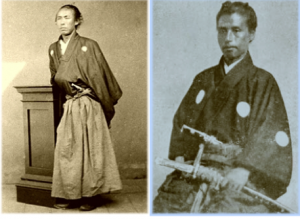
Sakamoto Ryoma & Katsu Kaishu
In Part 4 of this series, I quoted Sakamoto Ryōma’s assessment of Katsu Kaishū as “the greatest man in Japan.” The respect between the two men was clearly mutual. During the months after the two had first met, Kaishū mentioned Ryōma numerous times in his journal, including in an entry dated Bunkyu 3/5/16 (16th day of the Fifth Month of the Japanese year corresponding to 1863), when Kaishū, then-vice-commissioner of warships, wrote that he would send Ryōma to Fukui, the feudal domain of his political ally and friend Matsudaira Shungaku, to solicit financial support for the private school in Kobe that Kaishū was about to establish for Ryōma and other “outlaw samurai” (rōnin) who had enlisted to study under him.
In all of these journal entries Kaishū refers to Ryōma, who was twelve years younger than him, as “Ryōma-shi.” The character for “shi” (子), which when pronounced “ko” means “child,” is in this sense used as an honorary, indicating that Kaishū perceived in Ryōma an element of greatness or at least extraordinary ability, as Matsuura Rei explains in his biography of Katsu Kaishū.
Three decades after Ryōma’s death, Kaishū had nothing but praise for him. In an interview with the national newspaper Yomiuri Shinbun, given on April 3, 1896, Kaishū said that Ryōma “had a cool head, and a certain power about him that was hard to penetrate. He was a good man.”
Samurai Swordsmen: The Definitive History of the Shinsengumi (Helion, 2026) is now in production.
For professional guidance on Bakumatsu–Meiji Restoration history, see Historical Consulting.
Explore my books at Books at a Glance.