
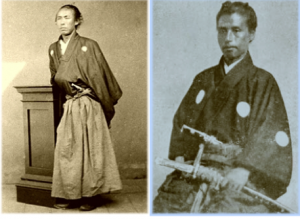
Sakamoto Ryoma & Katsu Kaishu
Sakamoto Ryōma first met Katsu Kaishū, a high-ranking officer of the shogun’s nascent navy, some time during the final months of 1862. In the following spring, while Kaishū moved forward with plans to establish an official Naval Training Center at Kobe, Ryōma, as Kaishū’s right-hand man, recruited his friends from Tosa and elsewhere—most of them “outlaw samurai” (i.e., rōnin) like himself—to study under Kaishū. Following is a slightly edited excerpt from my historical novel, Ryoma: Life of a Renaissance Samurai:
While Kaishū used his close relationship with the seventeen-year-old shogun, Tokugawa Iemochi, to gain permission to establish an official Naval Training Center in Kobe, Ryōma used his influence among the Imperial Loyalists in Kyoto to recruit nearly one hundred of them for Kaishū’s private school. The Bakufu’s institution and the private school would share the costly facilities supplied by the Edo government. Under Kaishū, Ryōma, at age twenty-seven, was on the verge of realizing his dream of establishing a navy. [end excerpt]
In a letter to his older sister, Otome, dated Bunkyū 3/3/20 (May 7, 1863), Ryōma drolly expressed his excitement over his “disciple-teacher” relationship with the Bakufu’s vice-commissioner of warships: “Well, well! In the first place, life sure is strange. There are some men who are so unlucky that they die by breaking their balls just trying to climb out of a bathtub. Compared to that I’m extremely lucky: here I was on the verge of death [after fleeing Tosa and becoming an outlaw], but I didn’t die. Even if I tried to die I couldn’t, because there are too many things which compel me to live. I have now become the disciple of Katsu Rintarō [his given name, ‘Kaishū,’ being a pseudonym], the greatest man in Japan [italics mine], and I am spending every day on things I have always dreamed about. I don’t intend to return home until I’m around forty.” [translation from my novel Ryoma]
In the last lines before the postscript to the letter, Ryōma expressed his joy that their older brother, the Sakamoto family patriarch, had “forgiven” his transgression of fleeing Tosa, and conveyed his intention to “do my utmost for the country [Tosa] and the nation [greater Japan]”—which, for an “outlaw samurai,” required the unwavering support of the influential vice-commissioner of warships.
[Read Part 5 of this series here.]
Samurai Swordsmen: The Definitive History of the Shinsengumi (Helion, 2026) is now in production.
For professional guidance on Bakumatsu–Meiji Restoration history, see Historical Consulting.
Explore my books at Books at a Glance.