
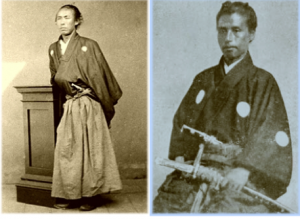
Sakamoto Ryoma & Katsu Kaishu
Sakamoto Ryōma became a political outlaw upon fleeing his native domain of Tosa on a rainy night in the spring of 1862, amid unprecedented social and political upheaval. Following is a slightly edited excerpt from my Samurai Revolution, Chapter 11 (without footnotes):
The crime of fleeing one’s han (i.e., feudal domain) was among the most serious in samurai society. It not only entailed forsaking one’s feudal lord and clan, but also abandoning one’s family—cardinal sins in a society based on Confucian morals. But Ryōma, an extremely independent sort, was unlike most men of his time. He was an iconoclast who would prove to be an enigma to many of his confederates in Tosa and other clans. Few if any of his fellow Imperial Loyalists, for all their avowed loyalty to the Emperor (and indeed readiness to die for their cause), had the audacity to throw off their loyalty to their han. But Ryōma did. In fleeing, it seems, he demonstrated his dissatisfaction with feudalism, including feudal lord and clan, and intended to break the feudal bonds forever.
His dissatisfaction had sprung from a gnawing resentment of the iniquities in feudal society (particularly Tosa), and more recently from his rejection of the violence perpetrated by his fellow Tosa Loyalists. While many of his friends were ready and willing to kill men of the Bakufu (i.e., Tokugawa Shogunate) and their supporters, Ryōma, an original member of the Tosa Loyalist Party, would ultimately turn peacemaker, bristling at unnecessary bloodshed even as he opposed the Bakufu to the bitter end. And while other “patriots of high aspiration” clamored to expel the barbarians and overthrow the Bakufu, they were jealous of the position of one another’s han in a post-Tokugawa Japan. Few, however, had a viable plan for the future. But Ryōma did—based on an uncanny foresight by which he saw beyond the boundaries of the feudal domains toward a unified Japanese nation. And it was another famous outsider, Katsu Kaishū, who would nurture that vision in Ryōma’s very supple mind. [end excerpt]
Ryōma’s ultimate objective was the bloodless overthrow of the Bakufu to usher in the modern age, preserving national sovereignty against Western imperialism. His greatest obstacle, as he saw it, was the outdated system of Tokugawa feudalism, with its hundreds of domains and suppressive class structure, which Katsu Kaishū, and three other farsighted and high-ranking samurai within the Tokugawa power structure—whom I have elsewhere dubbed the “Group of Four”—meant to replace with a representative form of government based on Western models. Among the Group of Four were Matsudaira Shungaku, retired daimyo of Fukui and one-time political director of the Bakufu; Ōkubo Ichiō, Kaishū’s fellow Tokugawa samurai who had recruited him into government service; and Yokoi Shōnan, Shungaku’s chief advisor—and the political outlaw Sakamoto Ryōma had direct access to them all.
Ryōma, like many others of Tosa, had studied gunnery under another leading mind of the era, Sakuma Shōzan. Sakuma was Katsu Kaishū’s brother-in-law, who bestowed on him his own pseudonym, “Kaishū” — written with the characters for “ocean” and “ship” — because he believed Katsu would play a pivotal role in building Japan’s future navy. If Kaishū’s most important protégé had learned from Sakuma the impossibility of “expelling the barbarians,” upon fleeing Tosa he would be schooled by the Group of Four on the dire necessity of adopting Western political models. Based on the free-class society that, as he envisioned, would be the natural result of the political and cultural revolution, he intended to engage in free international trade to “enrich the nation and strengthen the military.”
Sometime in the fall of 1862, several months after fleeing Tosa, the outlaw samurai would meet the man who would not only change his life but in so doing alter the history of modern Japan.
[Read Part 3 of this series here.]
Samurai Swordsmen: The Definitive History of the Shinsengumi (Helion, 2026) is now in production.
For professional guidance on Bakumatsu–Meiji Restoration history, see Historical Consulting.
Explore my books at Books at a Glance.