Writing on samurai history and Japanese culture, focusing on the samurai revolution, meiji restoration, sakamoto ryoma, katsu kaishu, yoshida shoin, saigo takamori, takasugi shinsaku, shinsengumi, shogun, Tokugawa, bakufu, bushido, seppuku, sword
Samurai Swordsmen: The Definitive History of the Shinsengumi amid the Fall of the Tokugawa Shogunate (1863–1869) is now listed on the website of its publisher, Helion & Company. The book is scheduled for publication in fall 2026.
The listing marks the formal public cataloging of the volume, which represents the culmination of many years of research into the history of the Shinsengumi and the political world of late Tokugawa Japan. The book builds on my earlier work while incorporating extensive primary-source material not previously available in English.
Further updates will be posted here as publication approaches.
English language-based popularization of the Shinsengumi seems to keep on growing, as a quick Google search reveals. Unfortunately, most of this information is distorted, or simply wrong. Twenty or thirty years ago, almost nothing serious on the Shinsengumi existed in English. Today, the internet is filled with articles, videos, and discussions—most of them recycling the same half-remembered stories and television myths, mixed with manga- and anime-base fantasy.
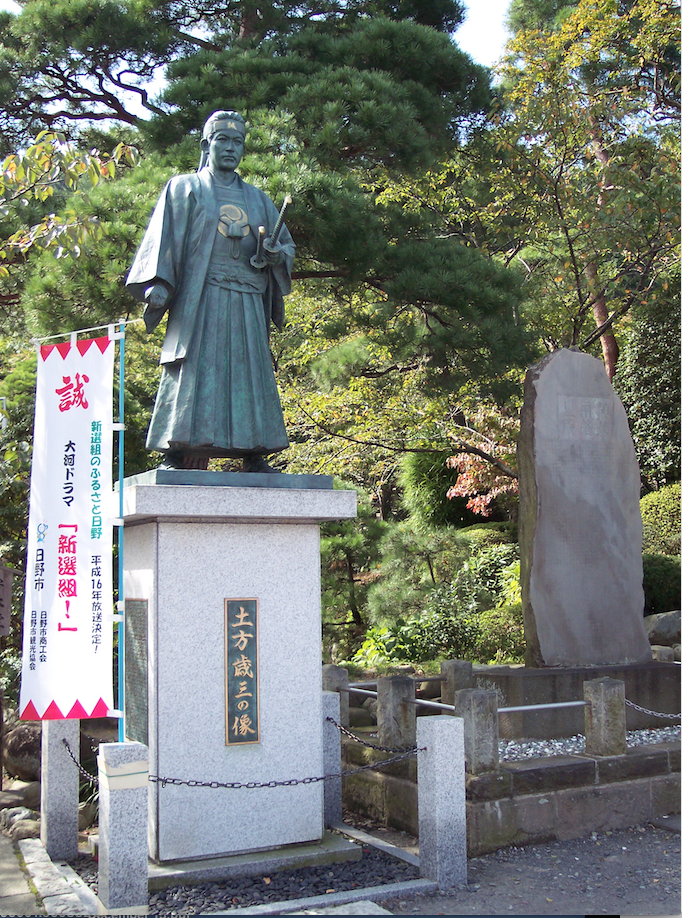
(The photo of the statue of Shinsengumi Vice-commander Hijikata Toshizō at the Takahata Fudō Temple in Hino was taken by the author.)
The only credible book in English about the Shinsengumi is my own, published by Tuttle in 2005. But it’s an introductory volume on the “shogun’s last samurai corps,” which is why in July 2017 I began writing my forthcoming Samurai Swordsmen: The Definitive History of the Shinsengumi amid the Fall of the Tokugawa Shogunate (1863–1869), to be published by Helion in fall 2026.
As the title indicates, I believe it will be both the definitive history of the Shinsengumi and a comprehensive history of the Bakumatsu–Meiji Restoration era, from the perspective of the losing side of the upheaval. In that sense, it is the perfect companion volume to my previous comprehensive history of the era, Samurai Revolution, which focuses on the victors, “through the eyes of the shogun’s last samurai.”
Updates and background materials related to Samurai Swordsmen: The Definitive History of the Shinsengumi amid the Fall of the Tokugawa Shogunate (1863–1869) will appear on the Shinsengumi Hub.
Over the past week I’ve updated the Shinsengumi Hub, linking together essays and research notes written over the past decade—from early reflections in 2016 to recent studies leading toward my forthcoming Samurai Swordsmen: The Definitive History of the Shinsengumi (1863–1869). The Hub now serves as a single access point for readers following my ongoing work on the Shinsengumi and the era that shaped them.
Many of these posts—some written years apart—are newly interlinked and arranged chronologically, tracing the evolution of my research and writing as Samurai Swordsmen has taken shape. Together they form a record of how this project has grown over time, from early source notes to full historical essays.
My forthcoming book, Samurai Swordsmen: The Definitive History of the Shinsengumi, is scheduled for publication in fall 2026 with Helion. Katsu Kaishū’s journals of the era, BakumatsuNikki, are among my most important sources. Though Kaishū did not have much direct encounter with the Shinsengumi leaders, Kondō Isami and Hijikata Toshizō, he captured the zeitgeist of the era to such an extent—astutely documenting its politics, culture, and society—that his journals were indispensable in writing this in-depth history of the Shinsengumi.
The journals were kept separately, though entries occasionally overlap. The regular journal, covering the final years of the Bakufu and the Meiji Restoration, was kept from Bunkyū 2/intercalary 8/17 (October 10, 1862)—upon the author’s appointment to the high post of vice commissioner of warships—until Meiji 3/6/4 (June 4, 1870), about a year after the end of the Boshin War. The Keiō 4 Boshin Nikki—Boshin being the Chinese zodiac cycle corresponding to the Japanese calendrical year Keiō 4 (1868 on the Western calendar)—covers the heady months from Keiō 3/10/22 (November 17, 1867), eight days after the fifteenth shogun, Tokugawa Yoshinobu, officially announced his intention to abdicate and restore Imperial rule, until Keiō 4/5/15 (1868), the day the Imperial Army defeated the Shōgitai, “Corps of Clear Loyalty,” in the hills of Ueno northeast of the castle, essentially eliminating the resistance in Edo among diehard vassals of the former shogun. Both journals contain copies of important letters to and from Katsu Kaishū.
[The above is a photo of my personal copy of Bakumatsu Nikki, vol. 1, of the 22-volume Kodansha edition of Katsu Kaishū Zenshū, the collected works of Katsu Kaishū, published in 1976.]
Aizu samurai Yamakawa Hiroshi’s Kyōto Shugoshoku Shimatsu, a history of the office of the protector of Kyoto, was published in 1911. The office of the protector of Kyoto, which lasted for more than five years (1862 – 1867), was held by Matsudaira Katamori, daimyo of Aizu. As the protector of Kyoto, he was the master of the Shinsengumi.