Did Sakamoto Ryōma Hold the Rank of Kaiden? A Historical Reassessment of His Swordsmanship

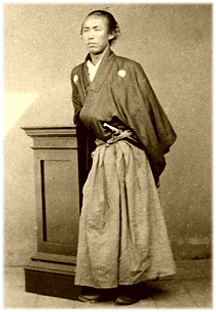
Sakamoto Ryōma’s level of expertise with a sword has long been a topic of debate among historians, writers, filmmakers, and so-called “Ryōma fans” throughout Japan. That he was an accomplished swordsman has never been questioned. He practiced the Hokushin-Itto style of kenjutsu at Chiba Sadakichi’s school in Edo for several years, receiving the respectable rank of mokuroku. But he famously used a pistol to defend himself during an attack by Tokugawa police at the Teradaya inn in Fushimi in early 1866. And less than two years later, he was assassinated at his hideout in Kyoto. If he was an expert swordsman, some ask, why did he use his pistol instead of his sword at the Teradaya? And why wasn’t he able to defend himself at Kyoto?

list of Ryoma certifiicates

The mokuroku is the only extant certificate that Ryōma received from Chiba. But notably it was for the halberd (naginata) and not the sword. Nor was it for the rank of kaiden, awarded to a swordsman who had mastered the style. And so, some argue, Ryōma wasn’t such a skilled swordsman after all. But as reported by Yomiuri Shinbun on October 14, 2015, a recently revealed handwritten list of certificates in the Hokushin-Itto style that Ryōma had supposedly received includes certificates of heiho kaiden (“expert in the art of warfare”) for the halberd and the sword, along with a mokuroku for the sword. The scrolled certificates were reportedly kept at the Hokkaido home of a Sakamoto family descendent, which was destroyed in a fire in the early part of the twentieth century.

The late Meiji Restoration historian Mamoru Matsuoka offered a cautious view at the time. In a 2015 note on Facebook, he observed that while the list includes the mokuroku certificate for the sword, it omits the intervening ranks that would normally precede kaiden. Therefore, he considered the “kaiden” entry a copying error for mokuroku.

The Mysterious Death of a Japanese Emperor: Was It Deicide?

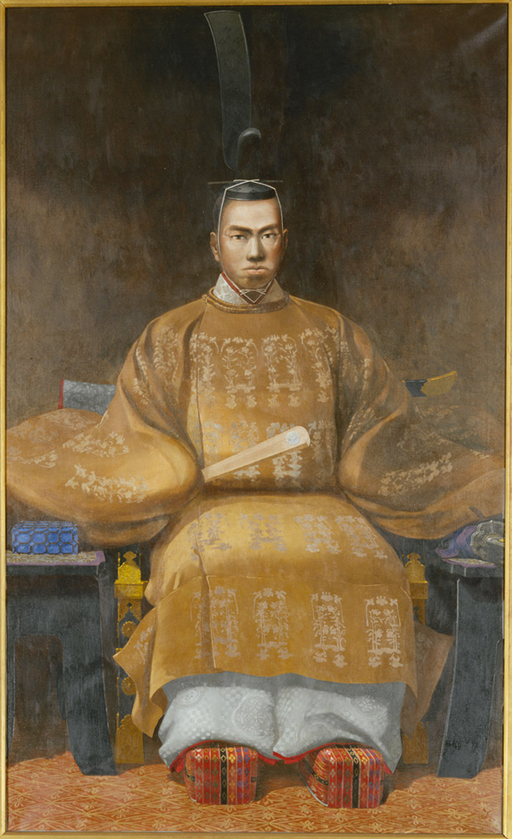
Portrait of Emperor Kōmei (1831–1867), the penultimate Emperor of pre-Meiji Japan, who died suddenly in January 1867 during the final months of the Tokugawa Bakufu (Shogunate).

[Portrait of Emperor Kōmei (1831–1867) by Koyama Shōtarō, 1902. Public domain via Wikimedia Commons.]

In the opening days of 1867, Emperor Kōmei of Japan died suddenly at the age of thirty-six. His death came only weeks after he had appointed Tokugawa Yoshinobu as shogun—an act that threatened the ambitions of the Satsuma and Chōshū domains to overthrow the shogunate and restore Imperial rule.

Twenty days before his sudden death, Emperor Komei had conferred upon Tokugawa Yoshinobu the title of shogun, placing him at the helm of the Bakufu, the teetering regime that had ruled Japan for over two and a half centuries. While the samurai clans of Satsuma and Chōshū, in collusion with the radical faction at the Imperial Court, were determined to eliminate Yoshinobu, overthrow the Bakufu, and restore Imperial rule, the Emperor had wanted nothing more than peace in his empire. But that peace had been threatened for over a decade by Western powers that had forced the formerly isolated country to conclude trade treaties against the Emperor’s wishes. The Imperial Court had not ruled in centuries, and so amid such dire straits the Emperor preferred to leave the governance of the country in the tried and true hands of the Bakufu. In fact, the Emperor was the greatest obstacle to Satsuma and Chōshū in their drive to make him the ruler of Japan. Komei’s son and heir, who would become the Emperor Meiji, was just a child who Satsuma and Chōshū expected would be more amenable to their plans to restore Imperial rule.

Komei was just thirty-six years old, robust, and in good health. In fact, the cause and circumstances of his death constitute a grim mystery of Japanese history—a mystery that has never been solved. But it seems certain that the cause of death was either smallpox or poisoning. Those who suspected assassination remained silent for nearly a century out of fear of imprisonment in pre-WWII Japan where the Emperor was worshipped as a god. Before WWII there was not even one document written in Japanese that openly stated that the great grandfather of the wartime Emperor Hirohito had been poisoned. I wrote in detail about the incident and the assassination theory in Samurai Revolution, Chapter 22: The Shōgun, the Emperor, and the Opposition at Court.


For more about my books in English, including Samurai Revolution, visit my Books at a Glance page. Read about my forthcoming Samurai Swordsmen here.

Follow me on Facebook | Amazon Author page

Samurai Revolution in Chinese: 武士革命

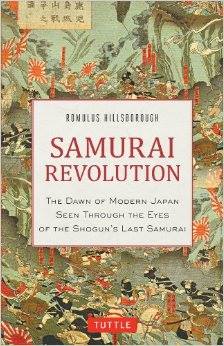
It is a pleasure to share that my book Samurai Revolution: The Dawn of Modern Japan Seen Through the Eyes of the Shogun’s Last Samurai has been translated into Chinese under the title 武士革命 (Samurai Revolution). This translation was published in China by 光明日报出版社 (Guangming Daily Publishing House), and translated by 袁皓天. The Chinese subtitle, 明治维新与近代日本的崛起, means The Meiji Restoration and the Rise of Modern Japan.

A Warm Reception in the Chinese-speaking World

The appearance of 武士革命 has not gone unnoticed. It has been:

  • Catalogued on Douban — China’s influential book database and reading community, where readers can rate, review, and discuss books. The listing includes full details on the Chinese edition and its translator.
  • Reviewed in major media — The respected Chinese outlet The Paper (澎湃新闻) published a review on April 12, 2023, under the title 书评 |《武士革命》——美国当代尽的幕末新史著作 (Book Review | Samurai Revolution — A Comprehensive Contemporary American Work on the Bakumatsu and Meiji Restoration). The review discusses the themes and depth of the book, underscoring its significance for readers interested in Japan’s 19th-century transformation.
  • Discussed by readers — On Douban, Chinese readers have written reviews such as 海舟眼中的幕末 (The Bakumatsu Through the Eyes of Katsu Kaishū), reflecting on the narrative and its characters.
  • Referenced on Zhihu — A major knowledge-sharing platform in China, where readers recommend 武士革命 alongside other works on the Bakumatsu and Meiji Restoration.
  • Shared on social media — Facebook and other platforms carry posts and comments from Chinese-speaking readers comparing the translation with the original edition.

What the Reviewers Say

The Paper review states: “A major hallmark of Samurai Revolution is its comprehensive documentation, with nearly 130 pages devoted to detailed references, annotations, and citations. Each chapter begins with a quotation from Katsu Kaishū’s writings, another unique feature of the book. The author also cites the perspectives of numerous other historians to supplement his arguments, particularly those of Matsuura Rei. He also presents diverse perspectives on the same historical facts and boldly offers speculation on matters not found in historical sources.”

Douban, meanwhile, describes the book as, “A clear and complete chronicle of the Meiji Restoration, [which] clearly outlines the key events from the end of the shogunate to the Meiji Restoration, with a fluent and engaging narrative.”


What It Means to Me as the Author

Seeing Samurai Revolution cross into another language and culture is deeply rewarding. It confirms that the story of the samurai revolution — Japan’s turbulent transition from the Tokugawa Shogunate to the modern Meiji state — speaks not only to readers in the West, but also to those in East Asia, where this history is part of the shared past of the region. For me, 武士革命 is more than a translation: it is evidence that the themes of change, revolution, and modernization resonate universally.

It is also gratifying given the importance of Chinese culture in samurai society. Educated men during the Edo period — not only samurai but also merchants and peasants — were steeped in the Chinese classics, and often wrote in Japanized Chinese (kanbun). In this sense, the appearance of Samurai Revolution in Chinese closes a historical circle, linking past and present across languages and cultures.


For more about my books in English, including Samurai Revolution, visit my Books at a Glance page. Read about my forthcoming Samurai Swordsmen here.

Follow me on Facebook | Amazon Author page
Prophetic Words in Sakamoto Ryōma’s Final Letter

Amid the national upheaval of the Samurai Revolution of the 1860s, Sakamoto Ryōma left behind prophetic words in his final letter—speaking not only to the Japan of his time but also to the timeless struggle for meaning and direction in times of change.

At the height of the tumult of the revolution, and less than one month since the last shogun, Tokugawa Yoshinobu, had announced his intention to abdicate and restore Imperial rule based on an historic peace plan, the author of that plan was engrossed in yet another plan to send men to Ezo (modern-day Hokkaido) in the far north of Japan to settle and exploit that mineral-rich wilderness, train them in the naval sciences, and save them from dying in the revolution.

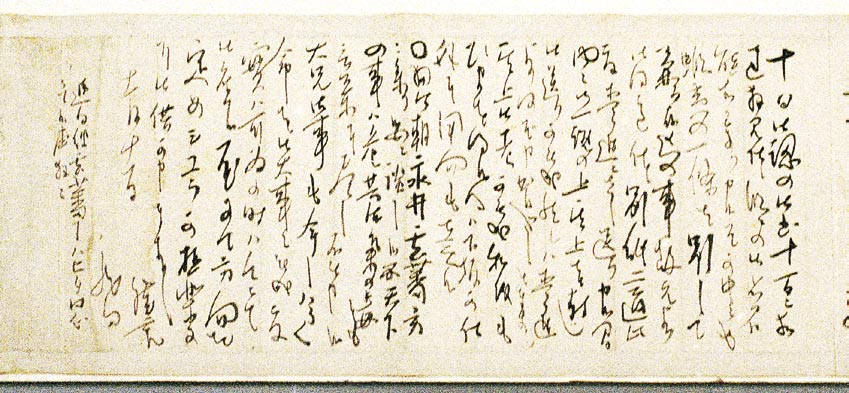
Ryōma was working on the plan with Hayashi Kenzō, a Hiroshima samurai in the employ of Satsuma. In the eerily prophetic closing to a letter to Hayashi, Ryōma, just four days before his assassination, advised his friend to be very careful for his life, then wrote, “Now is the time for us to act. Soon we must decide on our direction, whether it lead to pandemonium or paradise” (my translation).

Early in the morning five days later, Hayashi, summoned by Ryōma from “an urgent discussion” at his hideout in Kyoto, encountered the aftermath of that pandemonium. Entering the house Hayashi saw “bloody footprints here and there”; then “dashing up the stairway to see if Sakamoto was okay,” he found Ryōma’s corpse, “his sword drawn, lying in a pool of blood.”

[Sakamoto Ryōma’s letter written days before his assassination (dated the 11th day of the 11th month of Keiō 3 (December 1, 1867). Source: Sakamoto Ryōma Memorial Museum.]


Samurai Swordsmen: The Definitive History of the Shinsengumi (Helion, 2026) is now in production.
For professional guidance on Bakumatsu–Meiji Restoration history, see Historical Consulting.
Explore my books at Books at a Glance.

Samurai Revolution: A New Edition Coming

I’m pleased to share an important update about my book Samurai Revolution: The Dawn of Modern Japan Seen Through the Eyes of the Shogun’s Last Samurai.

First published by Tuttle in 2014, Samurai Revolution received strong reviews and has maintained a steady readership for more than a decade. The book has been an important part of my life for many years—during the 10 years I was writing it and since it was published—and I’ve been gratified by the interest it has generated among readers around the world.

As of this month, the publishing rights have reverted to me. This means the original edition is no longer in print—but it also opens the door for a fresh new edition. I’m planning for Samurai Revolution to be republished in the near future, likely in 2026, with updates that reflect on Katsu Kaishū’s enduring legacy and the extraordinary era he helped shape.

I’ll be sharing more details as they come together. For now, I simply want to thank my readers for your continued support, and to let you know that Samurai Revolution will return in a new edition before long.

Stay updated here.