A Fortuneteller’s Prophesy About Katsu Kaishū

Kaishu

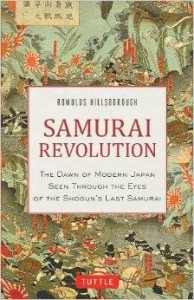
Katsu Kaishū is the “shogun’s last samurai” of my Samurai Revolution. His given name was Rintaro. Kaishū is a pseudonym, consisting of the Chinese characters for “ocean” and “boat.” It was given him by his teacher Sakuma Shōzan, a celebrated military scientist and designer of big guns. In giving his student his own pseudonym, perhaps Sakuma foresaw in him an element of greatness, correctly anticipating that Katsu would play a leading role in developing a modern Japanese navy. Katsu Kaishu’s biographer Katsube Mitake reports a much earlier prophesy by a fortuneteller in Edo regarding a young Katsu Rintaro. “This is a handsome child, with girlish features,” the fortuneteller supposedly told the boy’s father, Katsu Kokichi. “But he has . . . flashing eyes—and there is something extraordinary about him. When he grows up, if he is evil he will cause chaos throughout the land. If he is good he will save the world from chaos.” (This is reported in Vol. 1 of Katsube’s 2-volume biography published by PHP in 1992.)


Samurai Revolution is the only biography of Katsu Kaishu in English.

Samurai Entourage in San Francisco, 1860

In early 1860 the Tokugawa Bakufu (i.e., the Japanese government) dispatched a delegation of seventy-seven samurai to Washington to ratify a trade treaty with the United States concluded in Japan in the summer of 1858. The Japanese delegation sailed aboard an American naval ship, the Powhatan, while the Bakufu sent the warship Kanrin Maru to San Francisco, as an auxiliary vessel to the delegation. The Kanrin arrived in San Francisco on March 17, as the first Japanese vessel to reach the United States. The captain, Katsu Kaishu, is the “shogun’s last samurai” in my book Samurai Revolution. I gave a whole chapter to the stay of the Japanese in San Francisco, which was closely covered by the local press. Upon landing at Vallejo Street Wharf, the press reported, the officers of the Kanrin, including its captain, took carriages to the International Hotel. The following is from Samurai Revolution (pp. 119, without footnotes):
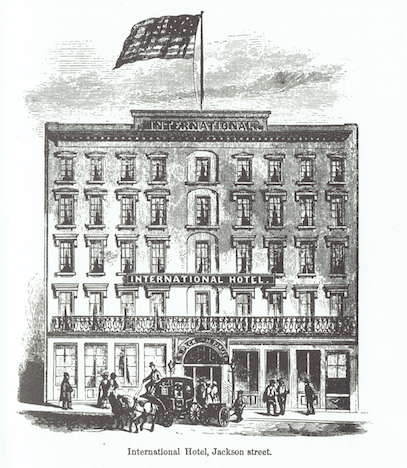
International Hotel, from "The Annals of San Francisco," by Frank Soule, et al, originally published in 1854

International Hotel, from “The Annals of San Francisco,” by Frank Soule, et al, originally published in 1854

The International Hotel stood on the corner of Jackson and Kearney Streets in the center of the city. When the samurai alighted in front of the lobby, their strange appearance attracted crowds of spectators, who must have watched their every move. “One wore a light blue gown and trowsers the colors of the sky at sunset, spangled, starred and barred with gold and crimson,” reported the Daily Evening Bulletin on March 20. Each man displayed on his jacket his family crest in white “circular, oval or square patches,” which were “of an import quite unknown to us.” And each wore his long and short swords in the polished scabbards at his left hip, “almost horizontally.” One of them “carried a fan [in his right hand], in his left a walking cane. . . . Almost every man wore sandals generally of grass.” [end excerpt]

As the local people admired the grand spectacle of the samurai entourage, the samurai entourage admired the International Hotel, the likes of which they had never before seen. It was “a beautiful redbrick building four stories high,” Kaishu noted in his journal. Passing through the lobby, they ascended the staircase to a spacious parlor, furnished with “a huge glass mirror, chairs and a harp. The floor was covered by a thick woolen carpet of a floral pattern.” They must have been mesmerized by the sumptuous and spacious parlor illuminated by an enormous gaslight chandelier. Picture them traversing the luxurious carpet to seat themselves awkwardly upon the couches and chairs upholstered with fine woven fabric, and sipping French champagne, as their hosts spoke to them in a language they could not understand. And what would they have thought of the likely spectacle of mustachioed and bearded men sporting Victorian frockcoats, ruffled shirts, neckties, top hats and long black boots, and smoking fat cigars, as they promenaded hand in hand with hoop-skirted ladies? Certainly the samurai would have found it odd that American gentlemen were unarmed and tipped their hats in an uncomely gesture as they passed by.

To be sure, both the Americans and the Japanese experienced culture shock. Kaishu, for example, noted his astonishment that “a man accompanied by his wife [in town] will always hold her hand as he walks. Or he will let his wife walk before him, remaining behind her.” (I wish I could have seen him watching this.)

Nonetheless, unlike most of their countrymen, the ship’s captain, along with the official interpreter, Nakahama Manjiro (aka John Manjiro), who had been educated in the United States, had previous experience with foreign cultures. Years later Kaishu commented that during his training at the Bakufu’s naval academy in Nagasaki in the late 1850s, “I met everyone who came [there] from foreign countries”—including ship captains “with whom I spoke candidly about anything and everything.” That Kaishū had (at Nagasaki and through his extensive reading of foreign books) familiarized himself with Western dress and furnishings, and even cigars and champagne (though he rarely drank alcohol), while certain others at the naval academy had not, denotes the flexibility of his very open mind. That he did not blindly follow standards of dress but rather wore his thick black hair tied in a loose topknot, so that, as the Bulletin reported on March 23, “he looked as if he knew nothing of pomatum and gloried in its frizzled, shaggy look,” reveals his outsider’s nature. That he seemed, in the Bulletin’s words, to be “acquainted with the [English] language, and to appearances every inch a gentleman,” bespeaks his self-possession, because Captain Katsu, like the rest of his company except Manjiro, did not understand English.

For updates about new content, connect with me on Facebook.


Read more about the San Francisco experience of Katsu Kaishu in Samurai Revolution, the only biography of the man in English.
644502_247397672083151_1209814990_n

widget_buy_amazon

Katsu Kaishū’s “praiseworthy anecdote” during the ceremony of the surrender of Edo Castle

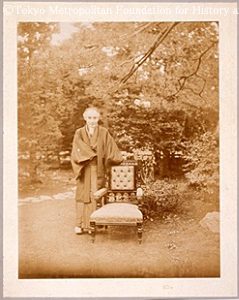
Katsu Kaishū standing beside a chair in the garden of his Hikawa estate in Tokyo, photographed late in his life.While reviewing my material for Samurai Revolution, I was reminded of one of my favorite comments from Katsu Kaishū in his old age. The setting was the formal surrender of Edo Castle to the new Imperial government in spring 1868, four months after the abolition of the Tokugawa Bakufu by the new Imperial government – i.e., The Restoration of Imperial Rule of Old. The ceremony took place in the interior of the citadel, attended by samurai of various feudal domains including Satsuma and Choshū. As I wrote in Samurai Revolution (excluding footnotes):

Kaishū did not attend the ceremony in which the castle was officially surrendered. Rather, he went to navy headquarters on the bay, where he had some of his men climb to the rooftop to watch and listen for gunshots coming from the direction of the castle. If anything happened, he wrote, he was prepared to report to the Imperial Army and accept the responsibility by taking his own life. “Fortunately, nothing happened”—the ceremony was concluded without incident.

But there was a “praiseworthy anecdote” which Kaishū heard from [his friend] Ōkubo Ichiō. Saigō, it seems, remained typically placid throughout the ceremony:

“…[w]hat was truly amazing was that when the formalities began for surrendering the castle, Saigō dozed off. Then when the ceremony was finished and the other representatives were leaving, he just sat there calmly. Ichiō, who was near him, couldn’t stand it. “Saigō-san, Saigō-san,” he said, waking him up, “the ceremony is over and everyone’s leaving.” At which Saigō, a bit startled, rubbed his sleepy face then calmly left. Ichiō was struck with admiration. What an audacious fellow! Exhausted after dozens of days, he took the opportunity to doze off while the castle was being surrendered—truly unbelievable!”

“And so,” Kaishū concluded the above account, told in January 1896, “that’s why he’s at the top of the list of the great men of the Restoration.” (p. 500)

[The photo of Katsu Kaishū was taken in the garden at his Hikawa estate during the final years of his life.]


Katsu Kaishū is the “shogun’s last samurai” of Samurai Revolution,the only biography in English.

Saigo Takamori’s Statue

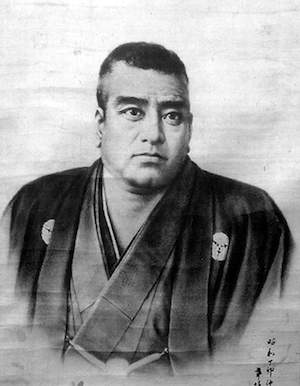
Saigo portrait

Saigo Takamori, the most powerful driving force behind the Meiji Restoration, died in disgrace ten years later as the leader of the Satsuma Rebellion of 1877. Saigo was a close friend of Katsu Kaishu, “the shogun’s last samurai” of my Samurai Revolution. Kaishu remained loyal to his friend even during the years of Saigo’s posthumous ignominy. I wrote extensively about Saigo, including his relationship with Kaishu, in Samurai Revolution.

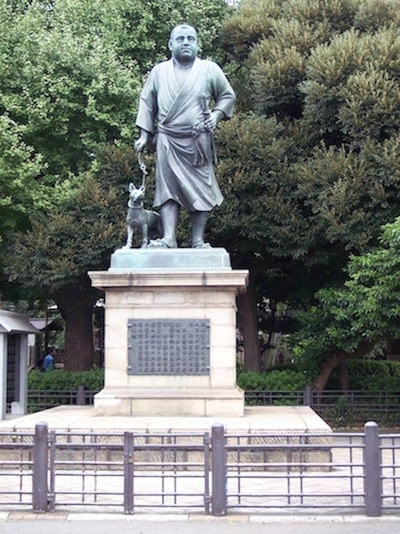
One of my favorite places in Tokyo during the many years I lived there was Ueno Park, a treasure trove of history and culture. And one of my favorite spots in the park is the statue of Saigo.

saigostatueueno

Following is an excerpt from my Samurai Tales regarding the statue (footnotes excluded):

*                     *                     *

On February 11, 1889, the Meiji Constitution was promulgated, marking the beginning of representative government in Japan. On the same day, Saigo was exonerated and redecorated with the senior third rank for his achievements during the Restoration years. Two years later it was decided that a great statue would be erected to his memory at Ueno Park in downtown Tokyo. “So what if they’ve erected a statue to Saigo!” Katsu said just days before the unveiling ceremony on December 18, 1898, a month before his death. “Is the statue going to say ‘thank you very much’ [to Saigo]?” he asked. “That’s strange! Statues don’t talk.” Having thus vented his disgust for the past harsh treatment of his friend, he added, probably tongue in cheek (but certainly not without an element of sincerity), “Saigo was only Saigo because of me.” When invited to give a speech at the unveiling ceremony, Katsu, who was ailing, at first refused because it was “ridiculous,” and anyway “I don’t know how to give a speech. . . . [Besides], it’s too cold for me to be dragged out to Ueno. And everyone there will be putting on airs as if they’re so very important.” The event organizers would not accept Katsu’s refusal, and he eventually agreed to attend the unveiling. Katsu recited several short poems that he had written in Saigo’s memory. Regarding the famed statue: “It’s poorly made,” he said.

The weathered bronze statue, always covered with pigeon droppings, is situated on a height overlooking the bustling streets and train station of Ueno. It is a symbol of the Japanese capital and favorite photo spot among tourists from the provinces. Over the past century it has become part of the landscape of the park, like any of the venerable old cherry trees that line the walkways of the spacious precincts and under whose gossamer blossoms people have been celebrating the arrival of spring since the days of the Tokugawa Bakufu. I have visited the statue more times than I remember, and each time I pause before the monument—out of sheer admiration for the great warrior and humanist.

Saigo’s statue, set atop a high pedestal, lacks the pomp and glory of statues erected for military heroes in countries throughout the world. Saigo is neither mounted atop a war steed, nor attired in military dress, nor decorated with medals, nor armed with anything but a simple short sword. His head is bare, his hair cropped; he is dressed plainly in a loose-fitting, short-sleeved kimono and straw sandals. With his left hand he grasps his sword, stuck through his sash at his left hip. His dog is with him, whose leash he holds in his right hand, as if out hunting rabbit in the rugged mountains of his beloved Satsuma. The large round eyes are penetrating; the heavy, firm jaw resolute; the limbs and body stout and stalwart—and this statue of the humanist whose cherished slogan was “Revere Heaven, love mankind,” of the warrior whose spiritual and physical magnanimity earned him the epithet “Saigo the Great” and the adoration of an entire nation, of the stoic who considered love of oneself a crime, is truly a monument for the people.

Saigo’s widow, Itoko, agreed with Katsu’s assessment of the statue. Itoko traveled from distant Kagoshima to attend the unveiling ceremony with other members of the Saigo family. She sat next to her late husband’s younger brother, the Marquis Saigo Tsugumichi, who had occupied high posts in the Meiji government, including minister of the navy and minister of the interior. The illustrious gathering waited silently for the veil to be removed. When the statue was finally uncovered, revealing the image, Itoko emitted a sudden shriek. “It looks nothing like my husband,” she exclaimed. She was immediately silenced and later reprimanded by Tsugumichi, out of regard for the “feelings of those many people who went to such trouble and expense to produce the statue.” But Itoko would never overcome her embarrassment at the statue’s informal attire “for all the world to see”—because in life Saigo “was a man of the utmost decorum” who would have worn the formal “hakama and haori bearing the family crest, or a military uniform.”

*                     *                     *

The paperback edition of Samurai Tales was published by Tuttle in August 2015.

(Portrait of Saigo from Kagoshima Prefectural Museum of Culture Reimeikan)

For updates about new content, connect with me on Facebook.


Historically Japan Trumps China in Claim to Okinawa

A widely circulated New York Times article (“Calls Grow in China to Press Claim for Okinawa,” June 14, 2013) reignited debate over the question of sovereignty in the Ryukyus—whether the islands properly belong to Japan or China. Unfortunately, the article omitted several important historical and cultural facts essential for an informed discussion of this sensitive issue.

The Times cites a Chinese official who argues against Japan’s sovereignty “because its inhabitants paid tribute to Chinese emperors hundreds of years before they started doing so in Japan.” The piece also quotes a Boston University professor who asserts that Japan conquered the Ryukyus in 1609. It is certainly true that the Ryukyus had been under the nominal suzerainty of China since 1372. But it is a misconception of Japanese history to say that the Ryukyu Kingdom subsequently paid tribute to Japan or that Japan conquered the Ryukyus in the seventeenth century.

Continue reading