
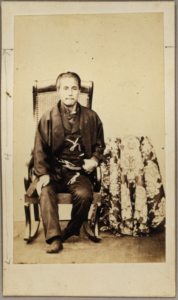
A Note On Katsu Kaishū: A Samurai of the Highest Moral Character

Katsu Kaishū, “the shogun’s last samurai,” was not only an exceedingly interesting man but also one of the highest moral character – an attribute that seems to be sorely lacking among politicians and government officials today. By way of (partial) explanation, I offer the following edited excerpt from my Samurai Revolution:

In early 1868, Katsu Kaishū, as the commander of the forces of the fallen shogun’s regime, was prepared to take drastic measures rather than allow “millions of innocent people to die” in an imminent attack on the shogun’s capital of Edo, modern-day Tokyo, by the army of the new Imperial government. The drastic measures he had in mind were tied to the kenjutsu (Japanese swordsmanship) and Zen training of his youth. “Bushidō is found in dying,” asserts the key line of the memorable first chapter of Hagakure, the classic text of samurai values. Death was preferable to disgrace—there was “nothing particularly difficult” about it. Kaishū had reached that critical boundary line to which, it seems, the author of Hagakure had alluded a century and a half earlier. As ever, he wanted nothing more than peace; but, as ever, he would not have peace at any cost. Only a coward would choose life over death without achieving his objective—and Katsu Kaishū, for all his modern sensibilities, was a samurai through and through. Though his objective might be unachievable, he would never accept disgrace—for himself or for the Tokugawa.

[The photo of Katsu Kaishū, taken just before surrender of Edo Castle in spring 1868, is used in Samurai Revolution courtesy of Yokohama Archives of History.]


Samurai Swordsmen: The Definitive History of the Shinsengumi (Helion, 2026) is now in production.
For professional guidance on Bakumatsu–Meiji Restoration history, see Historical Consulting.
Explore my books at Books at a Glance.

A Note On “Hitokiri Izō”

The three most notorious assassins of the bloody Bakumatsu era (1853 – 1868)—Okada Izō, Tanaka Shimbé, and Kawakami Gensai—were from Tosa, Satsuma, and Kumamoto, respectively. All three bore the nom de guerre Hitokiri, literally “Man-Cutter”—which is really just another term for “murderer.” Izō was the chief hit man of Tosa Loyalist Party leader Takéchi Hanpeita, under whom he studied kenjutsu in Kochi (castle town of the Tosa daimyo) and also at the famed Momonoi Dōjō, one of the three most highly reputed kenjutsu schools in Edo, where Takéchi had served as head of students. As I wrote in Samurai Assassins,

The historical record of Okada Izō is scant. The historical novelist Shiba Ryōtarō writes of the “overly intense physical strength and stamina” with which “Hitokiri Izō” was naturally endowed. By age fifteen, perhaps even before studying under Takéchi, Izō had already started training on his own—not with a bamboo practice sword commonly used in the training hall but with a heavier and lethal oaken sword he had carved himself, “wielding it. . . from morning to night,” with such ferocity that his “body would be wasted,” thus developing extraordinarily powerful arms and the ability to handle a sword with great speed. As Shiba points out, the original purpose of a sword was to kill people. But “in the Tokugawa era it became a philosophy. Izō [however] . . .  taught himself fencing as a means of killing.” [end excerpt]

Izō was “intrepid by nature and fond of the martial arts,” wrote Tosa historian Teraishi Masamichi in 1928 (in Tosa Ijinden/“Biographies of Great Men of Tosa”). His sword “attack came swift, like a falcon, as was apparent in his nature—which was why [Takéchi] was so fond of him,” according to an early Takéchi biography published in 1912 (Ishin Tosa Kinnō-shi/“The History of Tosa Loyalism in the Meiji Restoration”).


Samurai Swordsmen: The Definitive History of the Shinsengumi (Helion, 2026) is now in production.
For professional guidance on Bakumatsu–Meiji Restoration history, see Historical Consulting.
Explore my books at Books at a Glance.