Writing on samurai history and Japanese culture, focusing on the samurai revolution, meiji restoration, sakamoto ryoma, katsu kaishu, yoshida shoin, saigo takamori, takasugi shinsaku, shinsengumi, shogun, Tokugawa, bakufu, bushido, seppuku, sword
This morning, during several hours of writing, I reconfirmed that a single genealogical detail can alter how a chapter – or even an entire book – is interpreted. Precision in historical writing often turns on relationships that may seem minor but reshape interpretation, perhaps especially when the subject is the last shogun, Tokugawa Yoshinobu.
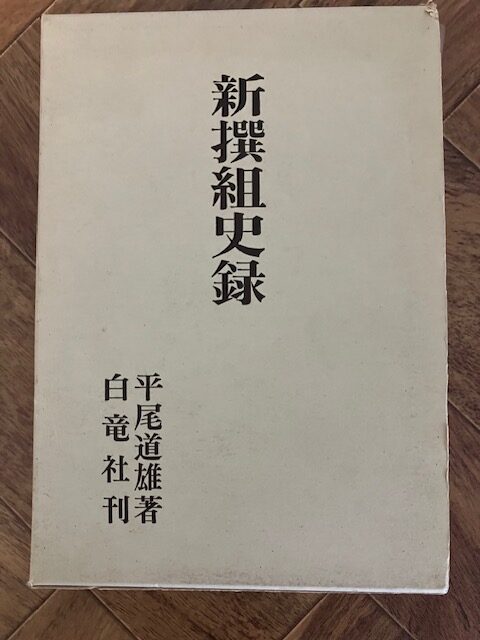
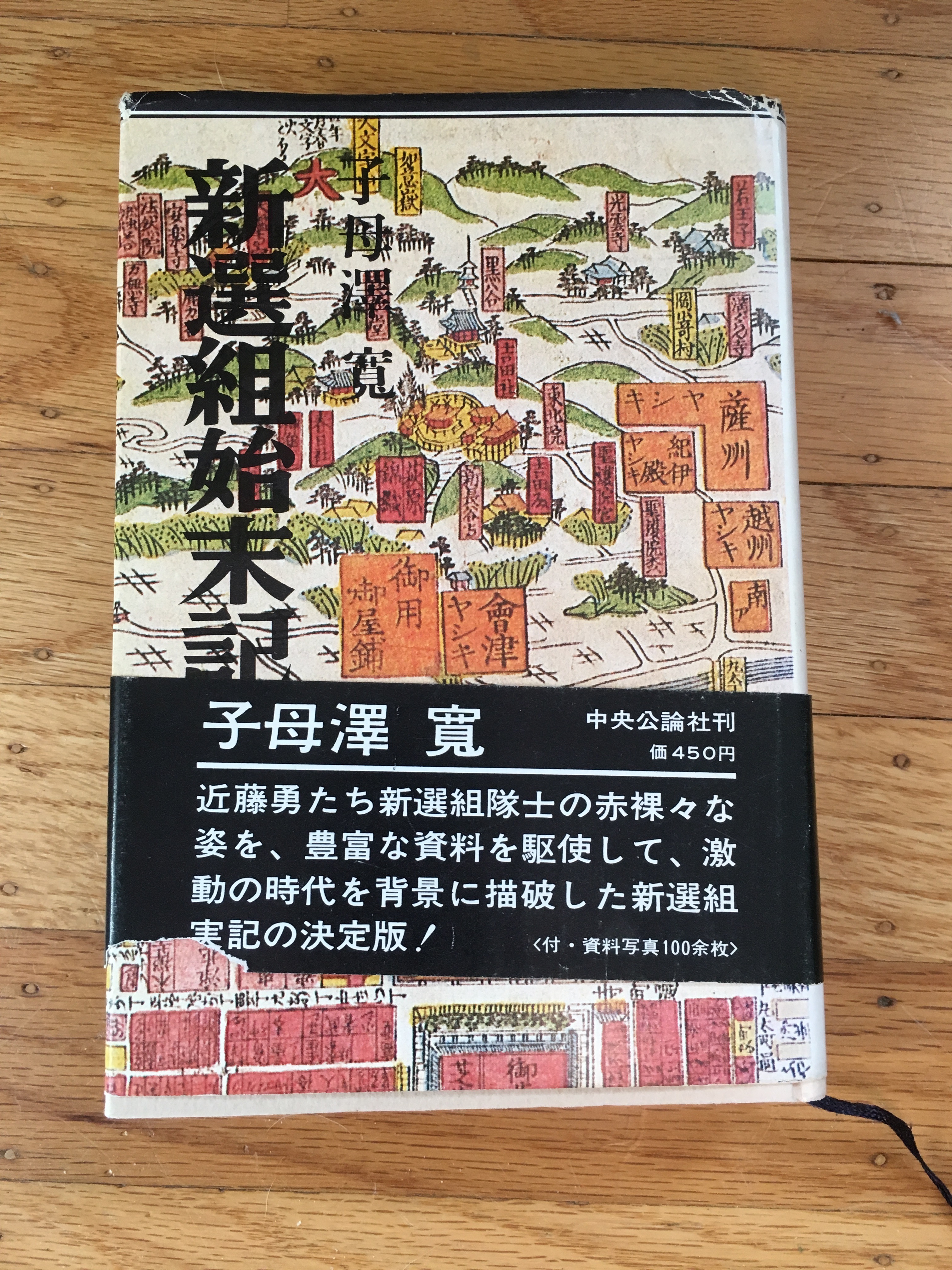
Shimosawa Kan’s Shinsengumi Shimatsuki and Hirao Michio’sShinsengumi Shiroku
Shimosawa’s Shinsengumi Shimatsuki is an early account of the Shinsengumi. It was first published in 1928, just before Hirao’s groundbreaking history Shinsengumi Shiroku (original title, Shinsengumishi). Shimosawa’s book is partially based on interviews with former corpsmen and other people who had direct contact with the Shinsengumi. But he was first and foremost a novelist. He began the preface of his book by stating, “It is not my intention to write history.” Some of his information has been repudiated by more recent studies, whose authors have enjoyed the benefits of nearly a century of subsequent scholarship unavailable to Shimosawa. Accordingly, like other early histories of the Shinsengumi, Shimosawa’s book should best be taken for what it’s worth, and relished for its portrayal of the spirit of the men of Shinsengumi rather than a faithful history.
Hirao, on the other hand, was an historian, widely known for his writings about Tosa history, including biographies of Sakamoto Ryōma, Nakaoka Shintarō, and Yamauchi Yodō. Therefore, his historical narrative is more reliable than Shimozawa’s book, which reads more like a novel than a history—though, as Meiji Restoration historian Matsuura Rei observes, Hirao often does not cite sources and contains occasional errors.
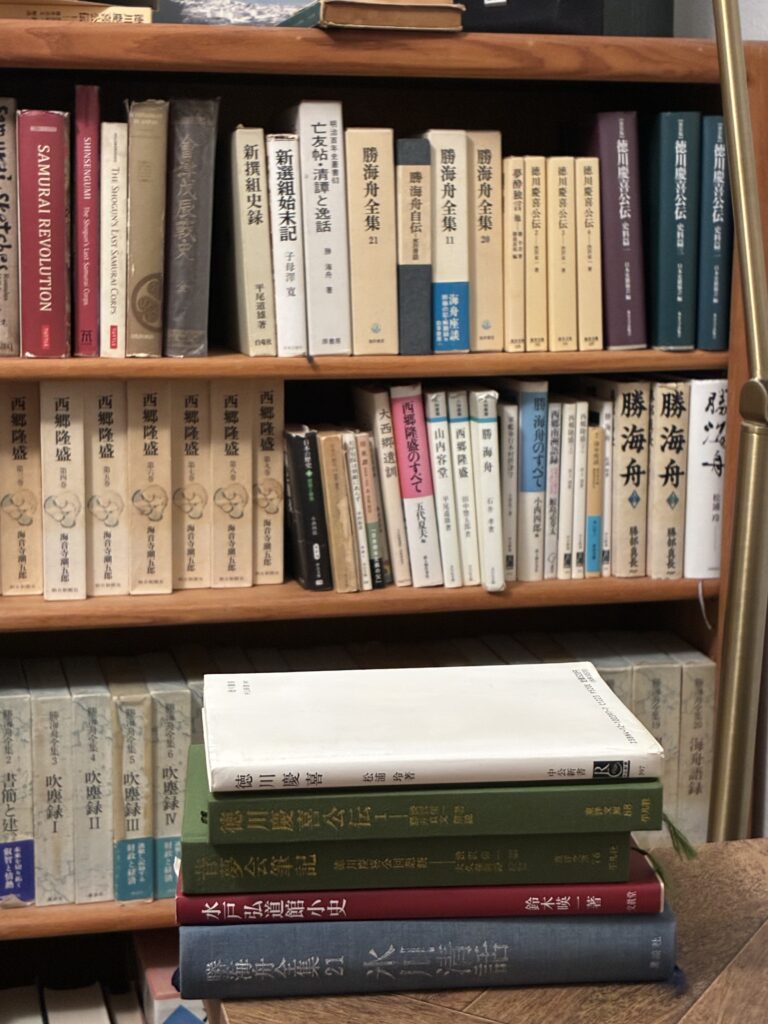
I have many books about the Shinsengumi in my private library. Both of the above editions, two of my prize possessions, were published in 1967. I found them in used bookstores in Tokyo’s Kanda district years ago.
I refer to both books in my forthcoming Samurai Swordsmen: The Definitive History of the Shinsengumi, scheduled for publication in fall 2026 with Helion.
In my forthcoming book Samurai Swordsmen: The Definitive History of the Shinsengumi (1863–1869), I wrote about Shinsengumi Vice-Commander Hijikata Toshizō’s anticipation of a war in Kyoto between Aizu and Satsuma based on the latter’s refusal to support the Bakufu in the imminent war against Chōshū in 1866. Katsu Kaishū, “the shogun’s last samurai” of my Samurai Revolution, was tasked with mediating between the two to resolve the problem peacefully.
Okay so I wrote about that. But as is sometimes the case after spending the day (or week or month or year or even decade) writing about this history, which was played out by men of a completely different time, place and culture than my own, I am struck by a sense of awe at the heaviness of my work—especially given that many of my main sources are in antiquated Japanese written by the men who made this history.
Main sources include three works from Katsu Kaishū, a book of letters by Hijikata Toshizō and Okita Sōji (annotated by Kikuchi Akira), and my own Samurai Revolution.
For more about my forthcoming book Samurai Swordsmen, see the Shinsengumi Hub.
Sakamoto Ryōma is one of the most beloved and iconic figures in Japanese history. A visionary who helped shape the birth of modern Japan, his life story has inspired countless books, television dramas, and even anime and video games. Two of the most widely known works about Ryōma available in English are Shiba Ryōtarō’s Ryōma (an abridged translation of the original, Ryōma ga Yuku) and my own biographical novel, Ryōma: Life of a Renaissance Samurai. Though both books chronicle the same remarkable man, their approaches and aims differ dramatically.
In Japan, Shiba Ryōtarō is a literary giant. His historical novel Ryōma ga Yuku etched Sakamoto Ryōma into the national psyche of Japan. Shiba’s Ryōma is both inspiring and dramatic. He is cast as the Hero of the Meiji Restoration, who led Japan from feudalism into modernity. But Shiba’s book is ultimately fiction—a creative reimagining based loosely on historical events and personages.
While the English translation of Shiba’s book provides a window into this epic narrative, it is abridged and filtered through the limitations of translation. In other words, while the original Ryōma ga Yuku is readily accessible to the average reader in Japan, its cultural and linguistic nuance requires annotation and explanation in English translation. Furthermore, readers unfamiliar with Japanese language, culture, and the broader historical context will not grasp the full extent of Shiba’s masterful portrayal of Ryoma’s character and personality—nor will they recognize how much of Shiba’s book is dramatized or speculative.
Meanwhile, no discussion of Ryōma in English-language historiography is complete without mentioning the seminal scholarship of Marius B. Jansen. While Jansen never wrote a full biography of Ryōma, Sakamoto Ryōma and the Meiji Restoration provides essential academic context that remains foundational for understanding Ryōma’s place in history. Jansen’s portrayal is notably nuanced and historically rigorous. Rather than portraying Ryōma as a lone revolutionary hero à la Shiba Ryōtarō, Jansen situates him within a broader movement of reformers, intellectuals, and visionaries who collectively shaped the path to modern Japan. This perspective offers a vital scholarly counterweight to the more dramatized and romanticized depictions found in Shiba’s Ryōma.
For readers seeking academic depth, Jansen’s insights frame Ryōma’s life and achievements within the real political and cultural dynamics of his era. His work resembles my own effort to place Ryōma in the larger historical narrative—one that balances myth and reality, legend and fact.
Shiba’s Ryōma ga Yuku was the inspiration for my Ryoma: Life of a Renaissance Samurai—a biographical novel grounded in meticulous research and based on definitive secondary sources and primary sources, including letters, memoirs, and official documents. My aim was to portray Ryōma’s life as accurately as possible, cutting through the mythologizing that has so often distorted his image. I sought to portray not the fictional hero Sakamoto Ryōma, as presented by Shiba, nor the academic (and rather dry) historical and political titan as chronicled by Jansen, but the real Ryōma—the progressive thinker, political strategist, Renaissance man, and cultural bridge between the old and new Japan, with all of his complexity, idiosyncrasies, and flaws that set him apart from his contemporaries and endear him to his countrymen of the 20th and 21st centuries.
If you’ve spent any time diving into Bakumatsu history, you’ve probably come across the phrase “Renaissance Samurai.” It’s a neat way to capture the fierce, transformative spirit of figures like Sakamoto Ryōma—a samurai not bound by the old codes but reborn into a rapidly changing world (and a true “Renaissance man” at that).
I coined the phrase in my book Ryoma: Life of a Renaissance Samurai to highlight exactly that—a multi-talented samurai caught between tradition and modernity, blazing a new path.
Lately, I’ve noticed the phrase popping up here and there online, often without a byline or a nod to its origin. Is this plagiarism? Probably not—more like a gentle reminder of the lower end of human nature.
But here’s the thing: words, ideas, and phrases don’t float in a vacuum. They come wrapped in stories, research, and countless hours of writing. When people use a phrase like “Renaissance Samurai” without credit, they’re missing the context, the depth, and the passion behind it.
So, if anyone likes the phrase, that’s great—because it means the story is still alive and resonant. But a little credit would be appropriate, I think—a respectful nod that keeps our collective storytelling honest and vibrant.
To everyone who’s read, shared, or been inspired by Ryoma: Life of a Renaissance Samurai, thank you. Your engagement keeps this history breathing—and “Renaissance Samurai” more than just a catchy phrase.
And to the rest of the internet: maybe next time, dig a little deeper before borrowing. We storytellers work hard to keep history alive—and honest.