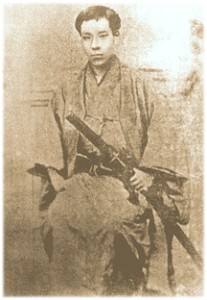
Above an ebony bokutō hangs a portrait of Katsu Kaishū, a pivotal figure in the late Tokugawa and early Meiji eras. Flanking the portrait are my Samurai Revolution and its Chinese translation, 武士革命 — inspired by his life and legacy. For anyone interested in the Bakumatsu or the evolution of Japan’s modern samurai, this book explores that transformative era.

The title of this painting, “Returning from the Surrender of Edo Castle,” is misleading: Kaishū did not attend the formal surrender ceremony. But he did negotiate the peaceful surrender of the castle with Saigō, which of course resulted in the actual surrender. For that he was considered a traitor by many in the Tokugawa camp. In the painting, behind Kaishū is a stonewall of the castle, and to the left stands a fellow Bakufu samurai, sword drawn, as if ready to attack him — a stark reminder of the danger and tension surrounding his actions.
For more on the portrait itself and the artist Kawamura Kiyoo, see my earlier post from 2017 here.