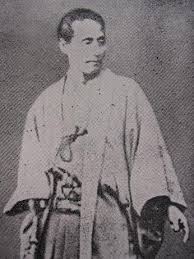
Who Was Serizawa Kamo?

There is not a lot of historically verifiable information about Serizawa Kamo, co-commander and co-founder of the Shinsengumi along with Kondo Isami. According to one contemporary from Aizu, Serizawa “was extremely courageous, but since he was violent, if one of his subordinates did something to displease him, he would beat him nearly to death.” 

I explore the enigma that is Serizawa Kamo in my forthcoming Samurai Swordsmen: The Definitive History of the Shinsengumi amid the Fall of the Tokugawa Bakufu.

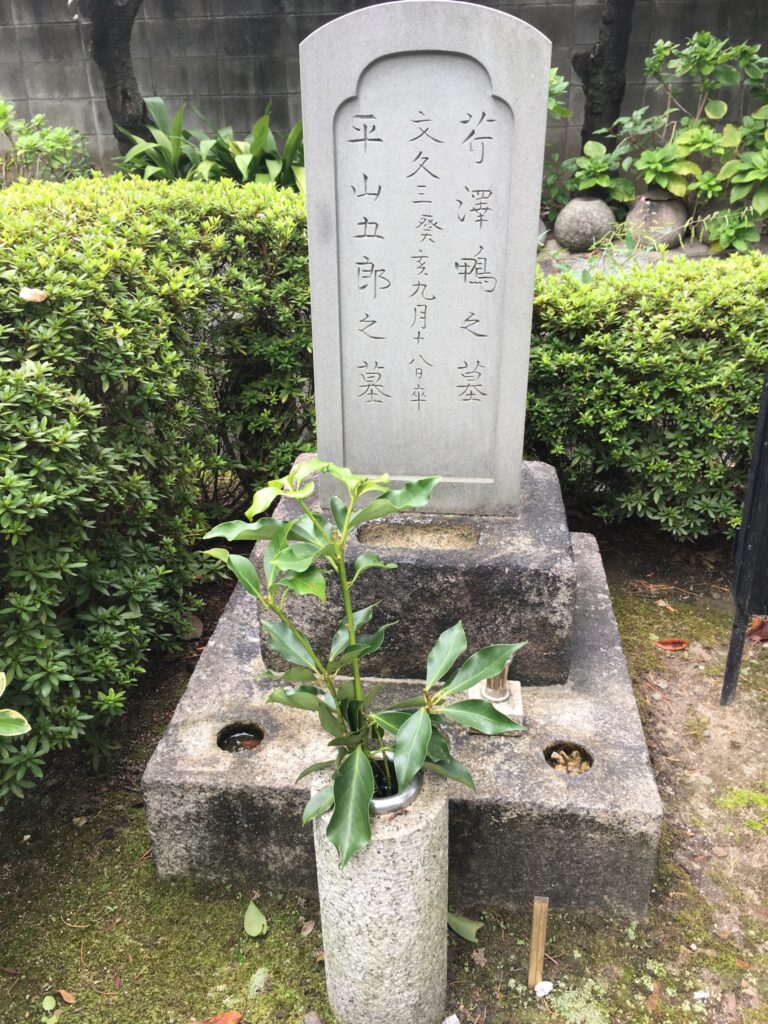
(This photo of Serizawa’s grave at Mibu Temple in Kyoto, shared with that of his cohort Hirayama Goro, was taken on October 11, 2016.)


Samurai Swordsmen: The Definitive History of the Shinsengumi (Helion, 2026) is now in production.
For professional guidance on Bakumatsu–Meiji Restoration history, see Historical Consulting.
Explore my books at Books at a Glance.


The Samurai, the Ship, and the Golden Gate

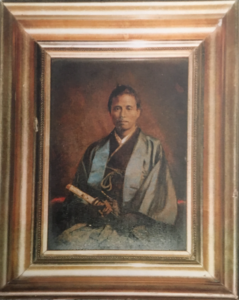
Katsu Kaishu’s portrait by US Navy sailor Edward Kern
On St. Patrick’s Day, 1860, the first Japanese warship to reach North America entered San Francisco Bay—a moment noted in the local Daily Alta California on March 18:

“His Imperial Japanese Majesty’s war steamer Candinmarru, commanded by Kat-sin-tarroh, a Captain in the Japanese Navy, arrived in our harbor yesterday, and anchored off Vallejo street wharf, at three o’clock P.M., after 37 days’ passage from Uragawa. . . .”

The Daily Alta, of course, was referring to the arrival of the Japanese warship Kanrin Maru, captained by Katsu Kaishū, the “shogun’s last samurai” of my book Samurai Revolution. The American journalists really had no way to know the correct transliteration of the Japanese names, probably because at that early date there was still no standardization thereofand they certainly bastardized the pronunciation (Katsu Kaishū was his pseudonym; his given name was Katsu Rintarō).

Following is an excerpt from the book (without footnotes):

At dawn of the thirty-eighth day at sea, Katsu Kaishū caught his first sight of the North American continent—and one can only imagine the intense interest with which he took up his binoculars to view through dense fog the coastal mountains in the distance, “like great waves rising above the clouds,” he wrote in a journal-like account of his San Francisco experience in History of the Navy. The captain would have been standing on the deck of his warship—a white banner emblazoned with the red rising sun flying at the mainmast; at the mizzenmast a signal flag of red and white displaying [Admiral] Kimura’s family crest of an encircled diamond. As the Kanrin passed safely through the strait called the Golden Gate, into San Francisco Bay, Kaishū paid special attention to the forts on the north and south shores, for the state-of-the-art military technology naturally concerned the military scientist who would construct modern batteries on the coast of his own country. To this purpose, during his sojourn in and around San Francisco he kept meticulous notes. The battery at Fort Point, on the south shore, he wrote,”is equipped with tens of large guns. The battery is made entirely of brick, with loopholes at three levels. The flat upper surface, sixty or seventy ken [around 109 or 127 meters] in length and of a suitable width, is large enough to mount smaller guns. From the outside there appears to be plenty of room for posting sentries at the rear. On the hillside on the left [north] shore are lights for targeting vessels entering and leaving the bay.”

From the topography of the city, “with mountains on all four sides,” Kaishū was struck by “its similarity to our Nagasaki.” Presently, a tugboat approached. “Two of its men boarded our ship. . . . We requested them to lead us [further] into the bay.” “They were going to salute us with cannon fire from land,” wrote Fukuzawa Yukichi, who sailed on the Kanrin as a steward to Kimura. “If they were going to salute us, then we had to return the honor.” But the captain hesitated on the grounds that his tiny ship might not withstand the shock. Meanwhile, Senior Officer Sasakura Kiritarō was eager to return the salute. “No,” said the captain. “Rather than attempting to return the salute and failing, it would be better to let the matter alone.” But Sasakura was determined. “I can do it,” he said. “I’ll show you.” “Don’t be stupid,” the captain retorted. “There’s no way you can do it. But if you try and succeed, you can have my head.” Permission granted, Sasakura ordered some of the men to clean the guns and prepare the gunpowder. He returned the salute superbly, as Kaishū probably expected, assisted by Junior Officer Akamatsu Daizaburō, who used an hourglass to time the intervals between shots. Then Sasakura got his feathers fluffed up and strutted right up to his captain. “Your head belongs to me,” he announced for all to hear. “But I think you’d better keep it where it is for a while. I’m sure you’ll be needing it during the rest of our voyage.” Sasakura’s remark drew laughter from the entire company.

[Katsu Kaishū, portrait by U.S. Navy sailor Edward Kern (1860)]

_____________________

Katsu Kaishū is the “shogun’s last samurai” of Samurai Revolution, the only biography in English.

Finished Writing “Ryoma” Over 30 Years Ago

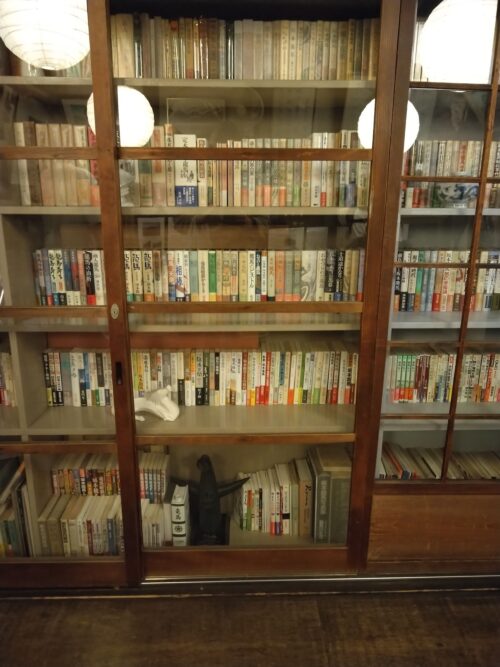
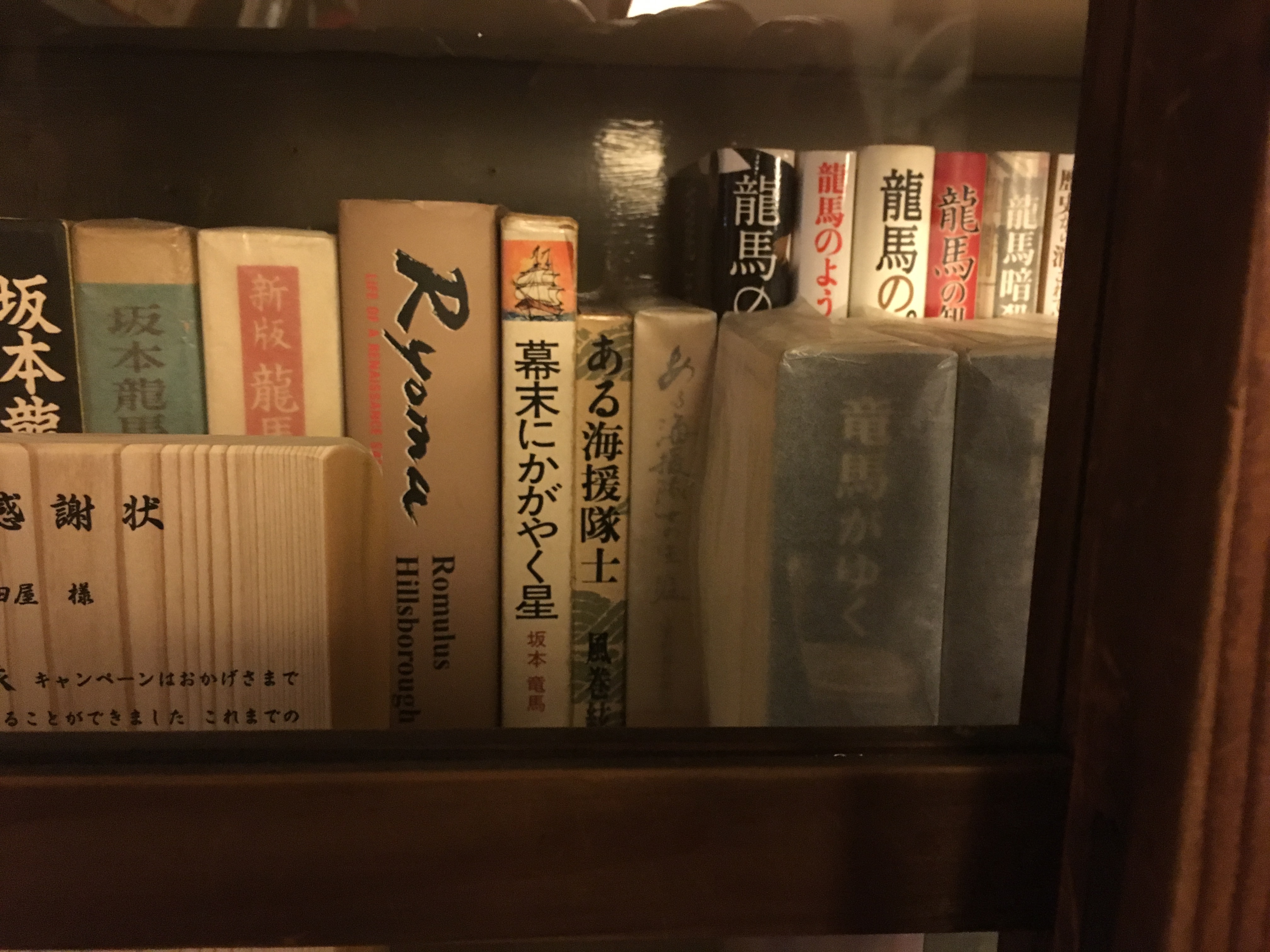
Over thirty years ago I completed the draft manuscript of my first book, Ryoma: Life of a Renaissance Samurai, in my apartment on the Sumida River in Tokyo’s Asakusa district, just a few short blocks from where the statue of Katsu Kaishū stands today. At the time, I wasn’t even sure the book would ever see print—it would be another seven and a half years before publication.

Looking back, it’s remarkable to see the journey this book has taken. From those early days of writing in Tokyo to its place today in libraries and private collections, Ryōma has traveled far. One particularly special moment was seeing the book displayed at the private library of the Teradaya Inn in Fushimi, Kyoto, a location intimately tied to Ryōma’s own history.

These photos taken at Teradaya library capture a personal milestone: the moment my work joined the tangible history of the people and places it portrays. It’s a humbling reminder of how far the book has come and the enduring fascination with Ryōma, the “Renaissance Samurai.”

Reflecting on this milestone not only celebrates the book’s journey but also highlights the enduring relevance of Ryōma’s life and legacy in Japanese history. For anyone interested in exploring his story in depth, you can learn more about Ryoma: Life of a Renaissance Samurai here.

[The top photo was taken by my friend and fellow writer Phillip Jackson, as resident of Kyoto.]

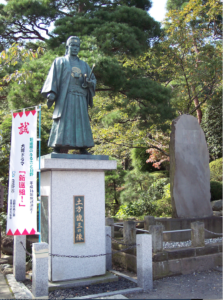
Statue of Shinsengumi Vice-commander Hijikata Toshizō At Takahata Fudo Temple in Hino

Shinsengumi Commander Kondō Isami and Vice-commander Hijikata Toshizō were glorified as heroes upon their return to their native Tama in early 1868, shortly after the fall of the Bakufu. In death, not long thereafter, they were apotheosized. On the grounds of Takahata Fudō temple in Hino (in Tama), the stone Monument of the Two Heroes was completed in 1888, twenty years after Kondō’s execution, nineteen years after Hijikata fell in battle. Over a century later a bronze statue of Hijikata was erected near the monument. As I wrote in the closing of Shinsengumi: The Shogun’s Last Samurai Corps, “[t]he right hand grips a sword. The left fist is clenched. The eyes… the eyes battle-ready, are ever prepared for death, to meet Kondo underground.”

This post relates to my forthcoming book, Samurai Swordsmen: The Definitive History of the Shinsengumi (1863–1869). See the Shinsengumi Hub for additional essays and updates.

Follow me on Facebook | Amazon Author page

Katsu Kaishū’s “Notebook of Deceased Friends”

Katsu Kaishū, “the shogun’s last samurai” of Samurai Revolution, was a prolific writer. Recently I’ve been thinking about one of his books, Bōyūchō (“Notebook of Deceased Friends”), which he wrote in 1877 (at age fifty-seven), nine years after the Meiji Restoration, about ten important historical personages of that era. Following is an edited excerpt (without footnotes) from Samurai Revolution:
 

Though Katsu Kaishū had not mentioned Saigō Takamori’s death in his journal, shortly after Saigō died he produced a small book of late great men of the Meiji Restoration. It is clear that Saigō was foremost on his mind—but he could not explicitly dedicate the book to him. Bōyūchō (Notebook of Deceased Friends) is an annotated compilation of letters, poems, and paintings in the original calligraphic brushwork, which Kaishū personally had received from eight late friends “over my career of thirty years.” (The book actually covers ten men, but Kaishū possessed calligraphic works addressed to himself from only eight of them.) . . . . Included beside Saigō are (in order of appearance): Sakuma Shōzan, Yoshida Torajirō (Shōin), Shimazu Nariakira, Yamauchi Yōdō . . ., Katsura Kogorō, Komatsu Tatéwaki, Yokoi Shōnan, Hirosawa Hyōsuké, and Hatta Tomonori. Yokoi and Saigō are allotted the most space, with three works included from each of them. But Saigō alone is alluded to (if only implicitly) in the Introduction and it was with Saigō’s poem, Zangiku(“Chrysanthemums of Early Winter”), that Kaishū concluded the book.


Samurai Swordsmen: The Definitive History of the Shinsengumi (Helion, 2026) is now in production.
For professional guidance on Bakumatsu–Meiji Restoration history, see Historical Consulting.
Explore my books at Books at a Glance.