“A man of consequence”

ryoma and takechi screen shot

After the assassination of the shogun’s regent, Ii Naosuke, in the Third Month of the Japanese year corresponding to 1860, the revolution was led by samurai of Satsuma, Choshu, and Tosa. Around this time in Tosa emerged two men who would inform the revolution—both charismatic swordsmen originally from the lower rungs of Tosa society.

Takechi Hanpeita was a planner of assassinations and stoic adherent of Imperial Loyalism and bushido, whose political agenda led to his downfall and eventual death. Sakamoto Ryoma, one of the most farsighted men of his time, had the guts to throw off the old and embrace the new as few men ever have—and for his courage, both moral and physical, he was assassinated on the eve of a revolution of his own design. And while Hanpeita and Ryoma were close friends, they had contrasting personalities, as indicated in the following anecdote taken from my Samurai Tales:

[begin excerpt] Known for their ability to consume vast amounts of sake at a single sitting, the young men of Tosa were wont to drink a potent local brew as a condiment to political discourse. One day, upon leaving a political meeting at Hanpeita’s home, Ryoma, as was his habit, relieved himself in his friend’s front garden, so that after he had left the stench of stale urine remained. When Hanpeita’s wife complained about Ryoma’s “sickening habit,” he turned to her and sternly said, “Ryoma is a man of consequence to the nation. I think you can tolerate that much from him.” [end excerpt]

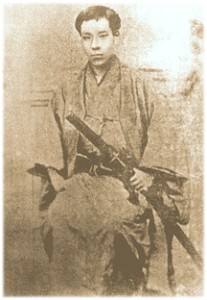
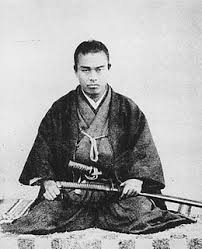
[The above portrait of Takechi Hanpeita is on exhibit at the Sakamoto Ryoma Memorial Museum in Kochi. The statue of Ryoma is at Katsurahama in Kochi.]

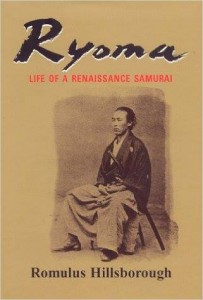
Read more about the lives of both men in Samurai Tales and my historical novel, Ryoma: Life of a Renaissance Samurai.

Saigō’s Letter to Kaishū

In Third Month of the Japanese year corresponding to 1868, around three months after the fall of the Tokugawa Bakufu (Shogunate), the forces of the new Imperial government were set to launch a general attack on the shogun’s capital of Edo (modern-day Tokyo). Meanwhile, Katsu Kaishū, commander-in-chief of the fallen shogun’s military, appealed to Saigō Takamori of Satsuma, the commander of the Imperial forces, to call off the attack, which would have resulted in a bloodbath in that city of well over one million people. Kaishū asked Saigō to meet to discuss terms for a peaceful surrender of Edo and its mighty castle that would be acceptable to both sides. The two commanders met twice, once each on the 13th and 14th of that month.

saigo's letter to kaishu screen shot

This letter from Saigō to Kaishū, dated 3/14, was in reply to a letter from Kaishū informing Saigō that he was waiting to meet him a second time at Satsuma’s warehouse facility (kurayashiki) in the Tamachi district of Edo. Replying that he would arrive shortly, Saigō asked Kaishū to wait for him. Saigō arrived as promised, and as a result of the ensuing “Meeting of the Two Heroes” the attack was called off.

[The letter from Saigō to Kaishu is exhibited in the Edo-Tokyo Museum in Tokyo, Japan.]


Katsu Kaishū is the “shogun’s last samurai” of Samurai Revolution, in which I wrote in detail (Chapters 27-30) about his role in averting civil war, including his talks with Saigō.

Sakamoto Ryoma, the Foreteller

“I’ll only die when big changes finally come. . . .” 私が死日 (シヌルヒ) ハ天下大変にて生ておりてもやくにたゝず

ryoma

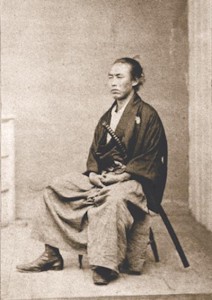
Sakamoto Ryoma was truly a Renaissance man: outlaw-samurai, pistol-bearing swordsman, gifted writer,* freedom fighter, pioneering naval commander, founder of Japan’s first modern trading company, and leader in the “samurai revolution at the dawn of modern Japan.” And, as it turned out, he also foretold the future.

“I don’t expect that I’ll be around too long. But I’m not about to die like any average person either. I’ll only die when big changes finally come, when even if I continue to live I’ll no longer be of any use to the country. Though I was born a mere potato digger in Tosa, a nobody, I’m destined to bring about great changes in the country.”

The above is from a letter Ryoma wrote to his sister in the summer of 1863. Less than four and a half years later, in the fall of 1867, the last shogun, Tokugawa Yoshinobu, announced his decision to abdicate and restore Imperial rule based on a peace plan from the “nobody” from Tosa. The next month, on his 32nd birthday, Ryoma was assassinated.

* [Shiba Ryotaro, the popular historical novelist who immortalized Sakamoto Ryoma in the psyche of the Japanese people, called Ryoma’s famous letter depicting the near fatal attack at the Teradaya inn, “the first piece of nonfiction literature” of the times. (Qtd. in Miyaji Saichiro. Ryoma Hyakuwa. Tokyo: Bungei Shunshu, 1997, p. 152)]

For updates about new content, connect with me on Facebook.


ryoma

Ryoma: Life of a Renaissance Samurai, the only biographical novel about Sakamoto Ryoma in English, is available on Amazon.com.

widget_buy_amazon


Takasugi Shinsaku: The Dynamic Leader of the Choshu Rebels

“Takasugi Shinsaku was young. The times being as they were, he didn’t have the chance to demonstrate his full potential. But he certainly was a dynamic man.”

Takasugi Shinsaku

The above words of Katsu Kaishu, the shogun’s last samurai in my Samurai Revolution, are complemented by biographer Kaoru Furukawa, who writes of Takasugi’s penchant to “think while on the run.”

To be sure, the leader of Choshu’s revolutionary forces had a wild reputation. He was an unruly swordsman who in a drunken rage reportedly cut a feral dog in two. He was a gifted poet whose boyish features were belied by piercing eyes. He was the founder and commander of Japan’s first modern army, who played on the three-stringed shamisen even as the war around him raged. He was a consumptive who kept his saké cup near the sickbed from where he laid his war plans—in bold defiance of the Tokugawa Bakufu and the disease that would finally kill him.

Takasugi “didn’t have the chance to demonstrate his full potential” because he died at age twenty-nine in 1867, around eight months before the fall of the Bakufu. Had he survived the “samurai revolution,” there can be little doubt he would have played a prominent role in the Imperial government after the Meiji Restoration. And it is certain that without him the restoration of Imperial rule would have been delayed by months if not years.

For updates about new content, connect with me on Facebook.


Takasugi Shinsaku features prominently in Samurai Revolution.

644502_247397672083151_1209814990_n

widget_buy_amazon

Sakamoto Ryōma’s Heroic Wife, Oryō

“It was only because of Ryo that I survived.”

After Sakamoto Ryōma  had overseen the conclusion of the military-political alliance between Satsuma and Chōshū in Kyoto in early 1866, thus hastening the fall of the Tokugawa Shogunate (Bakufu) less than two years later, his life was in danger. Though the Satusma-Chōshū Alliance was still secret, and so unknown to the Bakufu, the Tokugawa authorities in Kyoto had been after him for “going back and forth between Bakufu enemies Satsuma and Chōshū,” Ryōma wrote to his family later that year.

On the day after the alliance was concluded, Ryōma was attacked by Tokugawa police, at an inn called the Teradaya, in Fushimi just outside of Kyoto. He had arrived at the inn late at night. As he was about to sleep in an upstairs room, a young maid, Narasaki Ryō (better known simply as Oryō), whom Ryōma had met and married about a year and a half earlier, was downstairs soaking in a hot bath. Following is an excerpt from my Samurai Revolution:

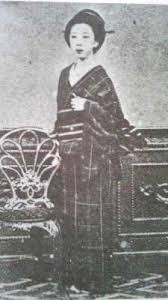
Oryo as a young woman, according to a descendent of her second husband, whom she married after Ryoma’s death. (Miyaji Saichirō. Sakamoto Ryōma Shashinshū. Tōkyō: Shinjinbutsu Ōraisha, 1986).

Oryo as a young woman, according to a descendent of her second husband, whom she married after Ryoma’s death. (Miyaji Saichirō. Sakamoto Ryōma Shashinshū. Tōkyō: Shinjinbutsu Ōraisha, 1986).

The bathroom was located at the rear of the house, near a narrow corridor leading to the rear staircase. Oryō heard the assailants break in, and, as she recalled over thirty years later:

There was a thumping sound, and before I had much time to think about it, someone thrust a spear through the bathroom window, right by my shoulder. I grabbed the spear with one hand, and in an intentionally loud voice, so that I could be heard upstairs, yelled, “Don’t you know there’s a woman in the bath? You with the spear, who are you?” “Be quiet,” [a voice demanded], “or I’ll kill you.” “You can’t kill me,” I hollered back, jumped out of the bathtub into the garden [outside], and still wet and throwing on just a robe, with no time to even put on my sash, ran barefoot [to warn the two men upstairs]. [end excerpt]

Ryōma, with Miyoshi Shinzō, a samurai of Chōfu (branch house of Chōshū), assigned by the Chōshū men as Ryōma’s bodyguard, fought their way out of the inn and managed to escape, though Ryōma was wounded. The enemy, he reported in a separate letter to his sister, Otome, “cut the base of my right thumb, split open the knuckle of my left thumb, and hacked my left index finger to the knuckle bone.” “It was only because of Oryō that I survived.”