Oryō, a Woman Who Changed Japanese History

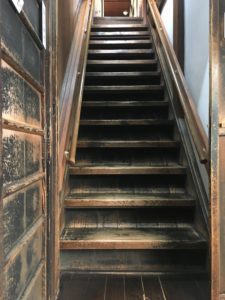
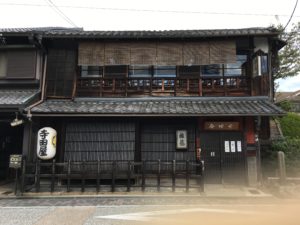
In the early days of Keiō 2, the Japanese year that corresponds to 1866, Sakamoto Ryōma was attacked and nearly killed by a Bakufu police unit at the Teradaya inn in Fushimi (below), just south of Kyōto. A young woman named Oryō, soon to be Ryoma’s wife, was working at the Teradaya. Taking a bath downstairs when the intruders stormed the place, she ran up the stairs to warn her lover that Bakufu men had come to kill him. It was probably because of her quick thinking and courage that Ryoma escaped with his life. Less than two years later the last shogun, Tokugawa Yoshinobu, would announce his intention to step down and restore political power to the Imperial Court, based on Ryōma’s famous plan to avert civil war. For details about Ryōma’s narrow escape from the Teradaya and Oryō’s heroic role therein, see my Samurai Revolution, Chapter 19, and  Ryoma: Life of a Renaissance Samurai, “Attack At the Teradaya.”

(To avoid any misunderstanding, I should add that the original building was destroyed in a fire. The building, as seen in these photos, stands today as a monument of past history. If not an exact replica, it captures the feeling and image of the Teradaya during the Bakumatsu.)
The Assassination of Sakamoto Ryōma (4)

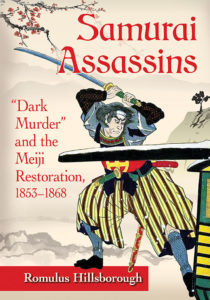
This year marks the 150th anniversary of the assassination of Sakamoto Ryōma, which is the subject of Part III of my new book, Samurai Assassins.

Ryōma’s assassination is shrouded in mystery, and this book provides the first in-depth study of the tragic event in English, based mostly on primary sources. My most important primary sources for Part III include Ryōma’s letters; testimonies and writings by, and interviews of, his alleged assassins; and accounts from people who were either present at the assassination scene or who arrived shortly after the fact. These primary sources, described in Chapter 17, are published in Miyaji Saichirō’s monumental Sakamoto Ryōma Zenshū. (from the Preface)


hillsborough_978-1-4766-6880-2
widget_buy_amazon

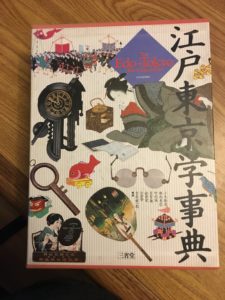
The Edo-Tokyo Encyclopaedia

When I bought this wonderful reference book of Edo-Tokyo history and culture (Sanseido, 1987) at the Kinokuniya Bookstore in Higashi-Shinjuku (Shinjuku Station, East), Tokyo, in 1988, I was writing my novel, Ryoma: Life of a Renaissance Samurai. At over 1,220 pages, it’s been a great reference for around three decades.

Assassination of Sakamoto Ryōma (3)

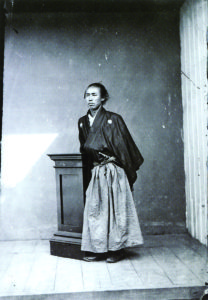
The assassination of Sakamoto Ryōma on the eve of a peaceful revolution of his own design was a tragedy. Following is an excerpt (without footnotes) from Chapter 15 of Samurai Assassins:

Though Ryōma was the author of the plan for the peaceful restoration of Imperial rule, he was also a leading proponent of Tōbaku, “Down with the Bakufu.” These two seemingly contradictory stances underlie the tragedy of his assassination. In a letter to Ryōma dated Keiō 3/9/4 (1867), the Chōshū leader Katsura Kogorō, using the name Kido Junichirō, likened Tōbaku to a “Great Drama,” the final act of which was getting under way in Kyōto, as Satsuma and Chōshū, in collaboration with Court nobleman Iwakura Tomomi, prepared to destroy the Bakufu. With Ryōma’s assassination around two months later, on the eve of a peaceful revolution of his own design, that drama turned tragic.

Ryōma’s murder by multiple sword wounds to the body and a blow to the head from which his brains reportedly protruded even as he was still able to move around and speak, was as horrible as it was tragic. To fully understand the scale of Ryōma’s tragedy, we must realize that he was a visionary and a genius—if genius means to conceive of original ideas and to have the courage and audacity to bring them to fruition. The German philosopher Friedrich Nietzsche, Ryōma’s contemporary, alluded to genius, I think, with the following statement: “When a human being resists his whole age and stops it at the gate to demand an accounting, this must have influence.” Based on his determined resistance to the social iniquities and restraints under the Tokugawa Bakufu and its archaic feudal system, Sakamoto Ryōma influenced “his whole age” through a series of unparalleled historical achievements: Japan’s first trading company, the Satsuma-Chōshū Alliance, and his great plan for peaceful restoration of Imperial rule.


hillsborough_978-1-4766-6880-2
widget_buy_amazon

Bakumatsu/Meiji Restoration (幕末明治維新)

Though I’ve read, researched, written about – and yes, even lived – this history and culture for 30+ years, the fact that I, an American, born and raised in the second half of the 20th century, have the audacity to publish books about it, boggles the mind (or at least my mind). But I do it because I need to – because if I don’t, who will?

I’m making steady progress with my new book about Shinsengumi. I’ll post updates periodically.

A heartfelt thanks to all my readers!