National Diet Library’s Online Database (1)

The National Diet Library’s online database is a treasure trove of primary sources of Bakumatsu-Meiji Restoration history. This one, for example, has been useful in my research on the Shinsengumi:
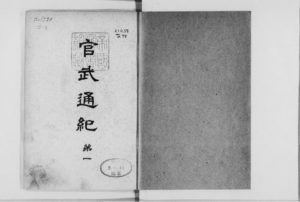
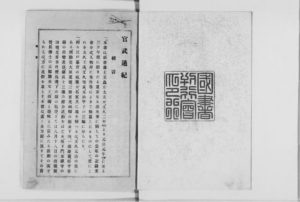
Tamamushi Yoshishigé’s Kanbu Tsūki (官武通紀), a historical record of the three-year period from Bunkyū 2 to Ganji 1 (1862 – 64), was originally published in 1913 by Kokusho Kankōkai. Tamamushi was a samurai of Sendai Han.

Tamamushi’s book is another valuable primary source in my continuing research on the Shinsengumi, particularly for my forthcoming Samurai Swordsmen: The Definitive History of the Shinsengumi (1863–1869). See the Shinsengumi Hub for additional essays and updates.

_____________

Recently I have been focusing on my forthcoming Samurai Swordsmen: The Definitive History of the Shinsengumi (1863–1869), scheduled for publication in fall 2026 with Helion. I also provide consulting on Bakumatsu–Meiji Restoration history and culture to authors, editors, publishers, documentarians, producers, screenwriters, translators, and other professionals who need expert guidance on the era.

To explore my books see Books at a Glance.

Follow me on Facebook | Amazon Author page
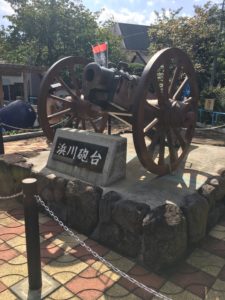
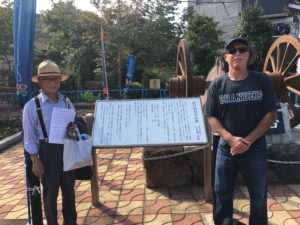
The Hamakawa Battery of Tosa Han, at Shinagawa – and my friend Kiyoharu Omino

“Ryōma fans” at the annual gathering held in Tokyo last October visited Sakamoto Ryōma-related sites. Shinagawa was one of the destinations. Located there was Tosa’s residence at Samezu, where the retired daimyo of Tosa, Yamauchi Yōdō, had lived for a number of years; and where Ryōma and other Tosa samurai had been stationed.

Kiyoharu Omino, the distinguished writer and scholar of Bakumatsu history, gave talks at Yōdō’s alongside gravesite and at the reconstructed Hamakawa Battery of Tosa Han – whose eight guns would not have been able to hit Perry’s ships in Edo Bay in the summer of 19854 even if they had been fired. Ryōma, age twenty at the time, received gunnery training at the Hamakawa Battery as a student of Sakuma Shōzan, Mr. Omino wrote in the explanatory panel at the site.

_____________

Recently I have been focusing on my forthcoming Samurai Swordsmen: The Definitive History of the Shinsengumi (1863–1869), scheduled for publication in fall 2026 with Helion. I also provide consulting on Bakumatsu–Meiji Restoration history and culture to authors, editors, publishers, documentarians, producers, screenwriters, and other professionals who need expert guidance on the era.

To explore my books about Sakamoto Ryōma, Katsu Kaishū and others of the Meiji Restoration, see Books at a Glance.

Follow me on Facebook | Amazon Author page
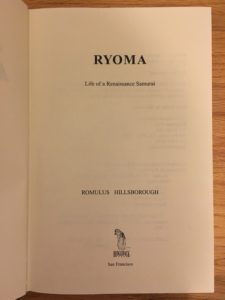
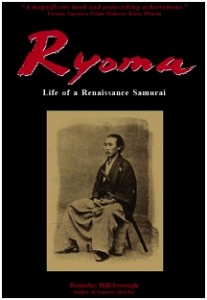
“Ryoma: Life of a Renaissance Samurai”: The 20th Anniversary (1)

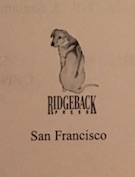
Next year will mark the 20th anniversary of the publication of Ryoma: Life of a Renaissance Samurai. It is the first biographical novel in English of Sakamoto Ryoma, and the only one written originally in English. The publisher, Ridgeback Press, is named for this dog, a Rhodesian ridgeback. His photo was used as the press’ logo – as anyone who owns a copy may recognize.


ryoma
widget_buy_amazon

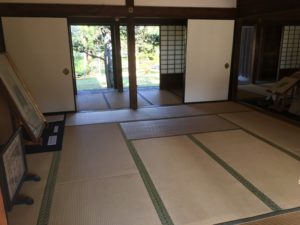
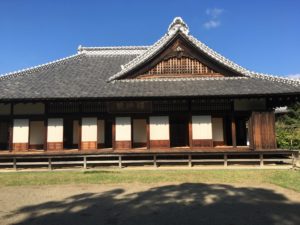
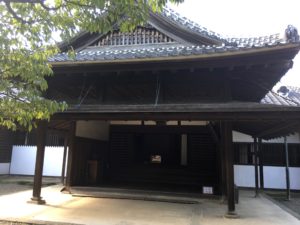
Last Shogun Tokugawa Yoshinobu secluded himself in this room after the fall

The last shogun, Tokugawa Yoshinobu, upon returning to his native Mito on the day his castle was surrendered in spring 1868, secluded himself in this room at the Kōdōkan, the official school of Mito, to demonstrate his loyalty to the new Imperial government. The room, named Shizendō (至善堂), is an Important Cultural Property, designated by the Japanese government. Its name means something like “Hall of Ultimate Virtue.”

Also see .

Kōdōkan of Mito: The Birthplace of the Meiji Restoration

On The 150th Anniversary of the Meiji Restoration (21)

Kyōto, Kōchi, Kagoshima, Hagi, Shimonoseki, major cities of the Meiji Restoration, contain some of the most interesting sites in Bakumatsu history. But the Kōdōkan, the sometimes overlooked official school of Mito Han, is particularly fascinating to me – because Mito is the cradle of Imperial Loyalism (Kinnō), which of course culminated in the Meiji Restoration. It was at the Kōdōkan where Mitogaku (“Mitoism”), the ultra-nationalistic school of thought, attained prominence. Mitogaku was the cornerstone of Imperial Loyalism.