
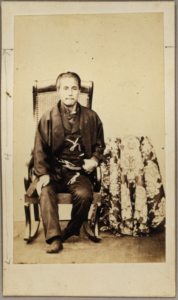
“Went up to the castle.” Katsu Kaishū, “the shogun’s last samurai,” repeated this phrase often in his journal, as vice commissioner and later commissioner of warships. He was, of course, recording his visits to the shogun’s castle, during the heady and dangerous years leading up to the revolution. “Went up to the castle” is the title of Samurai Revolution, Chapter 13, which opens as follows:
“ . . . I frequently encountered danger, which sometimes encouraged me. But sometimes it was difficult to endure the misery, and even when I hoped for death I survived only to suffer numerous more hardships.” (Katsu Kaishū)
The tide of revolution had been on the rise this past decade. The swirl began in Edo with the arrival of Perry’s “Black Ships” in 1853. Occasionally the tide ebbed, as during the reign of Ii Naosuké, only to surge again with the regent’s murder at the castle gate and the spree of assassinations of foreigners in Edo and Yokohama. As the Bakufu attempted in vain to stem the tide—through a union with the Imperial Court, consummated by the marriage between the young shogun and the Emperor’s sister—the architect of the marriage plan was nearly assassinated. Then sometime around the end of 1862 the tide suddenly turned, and the center stage of the gathering revolution shifted from the shogun’s stronghold at Edo to the Emperor’s capital at Kyoto.
[The photo of Katsu Kaishū, taken just before surrender of Edo Castle, is used in Samurai Revolution, courtesy of Yokohama Archives of History.]
___________________
Katsu Kaishu is the “shogun’s last samurai” of Samurai Revolution, the only full-length biography of him in English.