
I have been speaking and writing about “The Ryōma Phenomenon” for most of this summer. But it seems certain that there would not have been a “Ryōma Phenomenon” at all without Katsu Kaishū, “the shogun’s last samurai” of my book, Samurai Revolution: The Dawn of Modern Japan Seen Through the Eyes of the Shogun’s Last Samurai.
When Ryōma fled his native domain of Tosa in the spring of 1862, thus becoming a ronin, he was still very much a man of the sword: i.e., determined to bring down the Bakufu my military force. And he still had strong anti-foreign leanings. In the future, of course, he would devise a plan for the bloodless overthrow of the Bakufu to avoid dangerous civil war and preserve national sovereignty against Western imperialism to usher in the modern age. This vision began to take shape in Ryōma’s mind around the end of 1862, under the Katsu Kaishū’s tutelage. Kaishū was a high-ranking naval officer in the Bakufu. He was a founder of the Japanese Navy who had sailed to San Francisco as captain of the Kanrin Maru, the first Japanese vessel to reach the United States in March 1860. Ryōma, meanwhile, was a political outlaw for having fled Tosa, and a known anti-Bakufu activist.
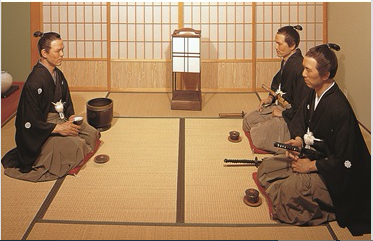
Assassination was rampant at the time. According to Kaishū’s recollection of his first meeting with Ryōma, which took place at Kaishū’s home in Edo, Ryōma intended to kill him. (This depiction of the meeting is from the Ryōma History Museum in Kochi. It is one of a series of depictions of Ryōma’s life using wax figures.)
Of course, Ryōma did not kill Kaishū. Instead, he listened closely as Kaishū spoke of the futility of trying to defend against Western imperialism without a navy, for which Japan needed Western technology. He said that the navy must recruit capable young men from all over Japan, regardless of social class, and not only the privileged elite – radical ideas coming from an elite government official. This naturally would include Ryōma and his friends. Years later Kaishū wrote, “It was around midnight. After I had spoken incessantly about the reasons why we must have a [national] navy, [Ryōma], as if having understood, told me this: ‘I was resolved to kill you this evening, depending on what you had to say. But having heard you out, I am ashamed of myself.’”
Ryōma asked Kaishū to accept him as his student, which Kaishū did. Soon Ryōma recruited several friends from Tosa and elsewhere to work with him under Kaishū. During the following two years, Kaishū would not only change Ryōma’s life, but he would change Japanese history by providing Ryōma with the practical means to bring about the revolution.
Samurai Swordsmen: The Definitive History of the Shinsengumi (Helion, 2026) is now in production.
For professional guidance on Bakumatsu–Meiji Restoration history, see Historical Consulting.
Explore my books at Books at a Glance.