
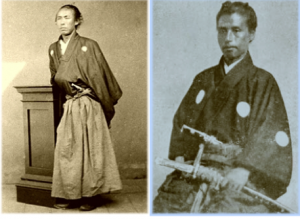
Sakamoto Ryoma & Katsu Kaishu
The outlaw samurai Sakamoto Ryōma first met the shogun’s vice commissioner of warships, Katsu Kaishū, some time between the Tenth and Twelfth Months of the Japanese year corresponding to 1862. In light of Ryōma’s background as a leader of Takechi Hanpeita‘s seditious Tosa Loyalist Party, whose members had been assassinating officials and sympathizers of the shogun’s government over the past several months, it would not be unreasonable to assume that Ryōma had at least entertained the notion of killing Kaishū. “Sakamoto Ryōma came to kill me,” Kaishū recalled in 1896, more than thirty years later. But Kaishū tended to exaggerate and embellish past exploits; and anyway, based on Ryōma’s behavior during those bloody times (he is known to have killed only once, in self-defense), it is hard to believe that he intended to kill Kaishū.
Far from it. In fact, Ryōma became a devoted student of Katsu Kaishū, who in essence headed up the shogun’s nascent navy. Kaishū taught Ryōma the naval arts and sciences, most significantly how to operate and navigate a state-of-the-art steamship toward developing a modern Japanese navy. It was only natural, then, for Ryōma to be protective of his teacher. Which was why a few months after their first meeting, Ryōma recruited one of the most notorious assassins of the time, fellow Tosa samurai Okada Izō, who bore the nom de guerre “Hito-kiri” (literally, “Man-Cutter”), to protect Kaishū on the dangerous streets of Kyoto, the Imperial capital. Following is a slightly edited excerpt from my Samurai Revolution (without footnotes):
“The situation at that time was extremely dangerous,” Kaishū later wrote. “I had arrived [to the region] by ship, and come to Kyoto. It was a bad time to travel because all the inns [in the city] were completely full.” Okada Izō accompanied him that night, probably assigned to bodyguard duty by Ryōma. Kaishū and Izō were each armed with the two swords. As they walked down the street called Teramachi-dōri, running north and south just below the east side of the Imperial Palace, “three samurai suddenly appeared. Without uttering a word, they came at me with swords drawn. I was startled. Okada Izō of Tosa, walking beside me, drew his long sword and immediately jumped in and cut one of them in two. ‘Coward,’ Izō screamed. ‘What do you think you’re doing?’ The other two, completely surprised, fled without looking back. I was amazed by his [Izō’s] technique and lightening speed.
But Kaishū was bothered by Izō’s attitude after the incident. “‘You shouldn’t take pleasure in killing people,’ I told him. ‘Bloodshed is extremely bad. You’d best mend your ways.’ He acknowledged my words, then faintly murmured, ‘If I hadn’t been with you the other day, Sensei, you would have lost your head.’ He stood there smiling. There wasn’t a thing I could say.”
Katsu Kaishū survived the assassination attempt, as he would numerous others, to move forward with a grand scheme to build a modern national navy, to which Sakamoto Ryōma was dedicated. During the first months of 1863, the political outlaw recruited men from Tosa, many from Takechi’s Tosa Loyalist Party, to join him under the leader of the enemy’s navy.
[Read Part 4 of this series here.]
Samurai Swordsmen: The Definitive History of the Shinsengumi (Helion, 2026) is now in production.
For professional guidance on Bakumatsu–Meiji Restoration history, see Historical Consulting.
Explore my books at Books at a Glance.