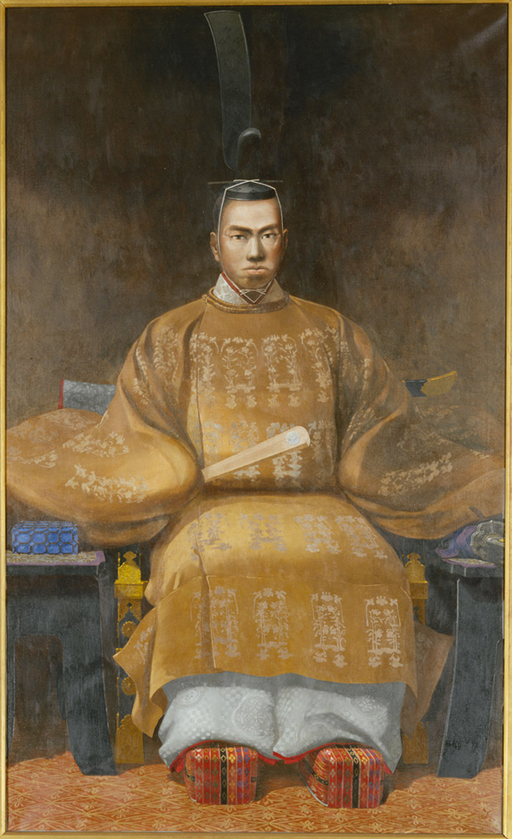
[Portrait of Emperor Kōmei (1831–1867) by Koyama Shōtarō, 1902. Public domain via Wikimedia Commons.]
In the opening days of 1867, Emperor Kōmei of Japan died suddenly at the age of thirty-six. His death came only weeks after he had appointed Tokugawa Yoshinobu as shogun—an act that threatened the ambitions of the Satsuma and Chōshū domains to overthrow the shogunate and restore Imperial rule.
Twenty days before his sudden death, Emperor Komei had conferred upon Tokugawa Yoshinobu the title of shogun, placing him at the helm of the Bakufu, the teetering regime that had ruled Japan for over two and a half centuries. While the samurai clans of Satsuma and Chōshū, in collusion with the radical faction at the Imperial Court, were determined to eliminate Yoshinobu, overthrow the Bakufu, and restore Imperial rule, the Emperor had wanted nothing more than peace in his empire. But that peace had been threatened for over a decade by Western powers that had forced the formerly isolated country to conclude trade treaties against the Emperor’s wishes. The Imperial Court had not ruled in centuries, and so amid such dire straits the Emperor preferred to leave the governance of the country in the tried and true hands of the Bakufu. In fact, the Emperor was the greatest obstacle to Satsuma and Chōshū in their drive to make him the ruler of Japan. Komei’s son and heir, who would become the Emperor Meiji, was just a child who Satsuma and Chōshū expected would be more amenable to their plans to restore Imperial rule.
Komei was just thirty-six years old, robust, and in good health. In fact, the cause and circumstances of his death constitute a grim mystery of Japanese history—a mystery that has never been solved. But it seems certain that the cause of death was either smallpox or poisoning. Those who suspected assassination remained silent for nearly a century out of fear of imprisonment in pre-WWII Japan where the Emperor was worshipped as a god. Before WWII there was not even one document written in Japanese that openly stated that the great grandfather of the wartime Emperor Hirohito had been poisoned. I wrote in detail about the incident and the assassination theory in Samurai Revolution, Chapter 22: The Shōgun, the Emperor, and the Opposition at Court.
For more about my books in English, including Samurai Revolution, visit my Books at a Glance page. Read about my forthcoming Samurai Swordsmen here.
Follow me on Facebook | Amazon Author page