
Kaishū and Ryōma: The Indispensable Relationship (Part 2)

Sakamoto Ryoma & Katsu Kaishu

Sakamoto Ryoma & Katsu Kaishu

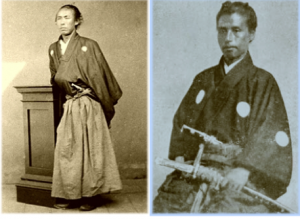
Sakamoto Ryōma became a political outlaw upon fleeing his native domain of Tosa on a rainy night in the spring of 1862, amid unprecedented social and political upheaval. Following is a slightly edited excerpt from my Samurai Revolution, Chapter 11 (without footnotes):

The crime of fleeing one’s han (i.e., feudal domain) was among the most serious in samurai society. It not only entailed forsaking one’s feudal lord and clan, but also abandoning one’s family—cardinal sins in a society based on Confucian morals. But Ryōma, an extremely independent sort, was unlike most men of his time. He was an iconoclast who would prove to be an enigma to many of his confederates in Tosa and other clans. Few if any of his fellow Imperial Loyalists, for all their avowed loyalty to the Emperor (and indeed readiness to die for their cause), had the audacity to throw off their loyalty to their han. But Ryōma did. In fleeing, it seems, he demonstrated his dissatisfaction with feudalism, including feudal lord and clan, and intended to break the feudal bonds forever.

His dissatisfaction had sprung from a gnawing resentment of the iniquities in feudal society (particularly Tosa), and more recently from his rejection of the violence perpetrated by his fellow Tosa Loyalists. While many of his friends were ready and willing to kill men of the Bakufu (i.e., Tokugawa Shogunate) and their supporters, Ryōma, an original member of the Tosa Loyalist Party, would ultimately turn peacemaker, bristling at unnecessary bloodshed even as he opposed the Bakufu to the bitter end. And while other “patriots of high aspiration” clamored to expel the barbarians and overthrow the Bakufu, they were jealous of the position of one another’s han in a post-Tokugawa Japan. Few, however, had a viable plan for the future. But Ryōma did—based on an uncanny foresight by which he saw beyond the boundaries of the feudal domains toward a unified Japanese nation. And it was another famous outsider, Katsu Kaishū, who would nurture that vision in Ryōma’s very supple mind. [end excerpt]

Ryōma’s ultimate objective was the bloodless overthrow of the Bakufu to usher in the modern age, preserving national sovereignty against Western imperialism. His greatest obstacle, as he saw it, was the outdated system of Tokugawa feudalism, with its hundreds of domains and suppressive class structure, which Katsu Kaishū, and three other farsighted and high-ranking samurai within the Tokugawa power structure—whom I have elsewhere dubbed the “Group of Four”—meant to replace with a representative form of government based on Western models. Among the Group of Four were Matsudaira Shungaku, retired daimyo of Fukui and one-time political director of the Bakufu; Ōkubo Ichiō, Kaishū’s fellow Tokugawa samurai who had recruited him into government service; and Yokoi Shōnan, Shungaku’s chief advisor—and the political outlaw Sakamoto Ryōma had direct access to them all.

Ryōma, like many others of Tosa, had studied gunnery under another leading mind of the era, Sakuma Shōzan. Sakuma was Katsu Kaishū’s brother-in-law, who bestowed on him his own pseudonym, “Kaishū” — written with the characters for “ocean” and “ship” — because he believed Katsu would play a pivotal role in building Japan’s future navy. If Kaishū’s most important protégé had learned from Sakuma the impossibility of “expelling the barbarians,” upon fleeing Tosa he would be schooled by the Group of Four on the dire necessity of adopting Western political models. Based on the free-class society that, as he envisioned, would be the natural result of the political and cultural revolution, he intended to engage in free international trade to “enrich the nation and strengthen the military.”

Sometime in the fall of 1862, several months after fleeing Tosa, the outlaw samurai would meet the man who would not only change his life but in so doing alter the history of modern Japan.

[Read Part 3 of this series here.]


Samurai Swordsmen: The Definitive History of the Shinsengumi (Helion, 2026) is now in production.
For professional guidance on Bakumatsu–Meiji Restoration history, see Historical Consulting.
Explore my books at Books at a Glance.
 

Kaishū and Ryōma: The Indispensable Relationship (Part 1)

Sakamoto Ryoma & Katsu Kaishu

Sakamoto Ryoma & Katsu Kaishu

It is well known that Katsu Kaishū and Sakamoto Ryōma had a very close relationship for a couple of years. But their relationship abruptly ended with the dismissal of Kaishū as the shogun’s commissioner of warships and his subsequent house arrest near the end of 1864, for harboring the likes of Ryōma and other known renegades intent on overthrowing the shogun’s government. And though the two men would never meet again, neither could have accomplished his greatest task without the other.

Kaishū taught Ryōma how to navigate a steamship, state-of-the-art technology that enabled him to establish and operate his merchant marine (Kaientai=Naval Auxiliary Corps), by which he ran guns for the revolution after his break with Kaishū. All of that was essential to Ryōma’s greater achievement of brokering an alliance between Satsuma and Chōshū against the shogunate in early 1866. Satsuma was led by Saigō Takamori, to whom Kaishū had introduced Ryōma just before his dismissal from the government – and it is doubtful that without his Kaishū connection Ryōma would have been in the position to even talk to Saigō. Without the Satsuma-Chōshū Alliance, of course, it is highly unlikely that the Meiji Restoration would have happened as and when it did – that is to say, it is doubtful that it would have been led by Satsuma and Chōshū between the end of 1867 and early 1868.

The shogunate was abolished and the Imperial government was established at the end of the Twelfth Month of the year Keiō 3 – January 3, 1868. Saigō represented the Imperial government in the talks with Kaishū to avert all-out civil war in Edo (modern-day Tokyo) in the spring of 1868. Kaishū, as commander of the military forces of the fallen shogun, agreed to surrender the shogun’s castle in Edo to avoid war. But he later remarked that had anyone but Saigō represented the Imperial government, “the talks would have broken down immediately.” Catastrophe would have followed, undoubtedly changing the course of history – and Katsu Kaishū would not have gone down in history as the man who saved the great city of Edo from the ravages of civil war.

[Read Part 2 of this series here.]


Samurai Swordsmen: The Definitive History of the Shinsengumi (Helion, 2026) is now in production.
For professional guidance on Bakumatsu–Meiji Restoration history, see Historical Consulting.
Explore my books at Books at a Glance.
Did Sakamoto Ryōma Hold the Rank of Kaiden? A Historical Reassessment of His Swordsmanship

Sakamoto Ryōma’s level of expertise with a sword has long been a topic of debate among historians, writers, filmmakers, and so-called “Ryōma fans” throughout Japan. That he was an accomplished swordsman has never been questioned. He practiced the Hokushin-Itto style of kenjutsu at Chiba Sadakichi’s school in Edo for several years, receiving the respectable rank of mokuroku. But he famously used a pistol to defend himself during an attack by Tokugawa police at the Teradaya inn in Fushimi in early 1866. And less than two years later, he was assassinated at his hideout in Kyoto. If he was an expert swordsman, some ask, why did he use his pistol instead of his sword at the Teradaya? And why wasn’t he able to defend himself at Kyoto?

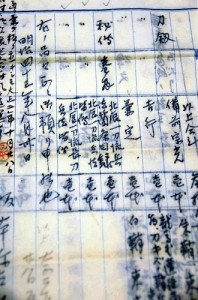
list of Ryoma certifiicates

The mokuroku is the only extant certificate that Ryōma received from Chiba. But notably it was for the halberd (naginata) and not the sword. Nor was it for the rank of kaiden, awarded to a swordsman who had mastered the style. And so, some argue, Ryōma wasn’t such a skilled swordsman after all. But as reported by Yomiuri Shinbun on October 14, 2015, a recently revealed handwritten list of certificates in the Hokushin-Itto style that Ryōma had supposedly received includes certificates of heiho kaiden (“expert in the art of warfare”) for the halberd and the sword, along with a mokuroku for the sword. The scrolled certificates were reportedly kept at the Hokkaido home of a Sakamoto family descendent, which was destroyed in a fire in the early part of the twentieth century.

The late Meiji Restoration historian Mamoru Matsuoka offered a cautious view at the time. In a 2015 note on Facebook, he observed that while the list includes the mokuroku certificate for the sword, it omits the intervening ranks that would normally precede kaiden. Therefore, he considered the “kaiden” entry a copying error for mokuroku.

Saigō Takamori’s “kindness, gentility and modesty”

“I don’t know about difficult things such as affairs of state.” Saigō Takamori

Saigo Takamori

Katsu Kaishu told an anecdote illustrating Saigō’s kindness and gentility—and his modesty. It has to do with a man named Hitomi Yasushi, who had been among those in the Bakufu opposing Shogun Tokugawa Yoshinobu’s abdication. Hitomi had fought against the Satsuma troops at the outbreak of civil war at Toba-Fushimi in Keio 4/1 (1868), and later against the forces of the Imperial government at Hokodate. Not long after the Meiji Restoration of 1868, Hitomi visited Kaishu at his home. Saying that he wanted to meet Saigō, he asked for a letter of introduction. “But it seemed that he intended to kill Saigō,” Kaishu recalled:

“I wrote the letter for Hitomi, but included the following warning: ‘This man intends to kill you. But please meet with him anyway.’ So Hitomi went down to [Saigō’s home in] Satsuma. The first person he met there was Kirino [Toshiaki]. Kirino . . . had a discerning eye. . . . So when he opened and read my letter to Saigō, he understood the situation. Even the fearless Kirino was a little startled—and immediately informed Saigō. But Saigō remained absolutely calm. ‘If he’s got an introduction from Katsu, I’ll meet him,’ he said. So on the next day Hitomi visited Saigo’s home. ‘My name is Hitomi Yasushi,’ he announced. ‘I’ve come to talk to you.’ Saigō was lying down near the front door. Hearing Hitomi’s voice, he calmly got up and said, ‘…I don’t know about difficult things such as affairs of state. Just listen to this. The other day I took a trip. . . . Along the way I got very hungry. So I bought some potatoes and ate them. Certainly you can’t expect a guy like me, who can satisfy his hunger [with just potatoes], to know about the state of things in our country.’ Then he opened his mouth wide and burst out laughing. The impetuous Hitomi was caught off-guard by the sudden words. Far from killing Saigo, he left without saying so much as ‘goodbye.’ He was struck with admiration, and when he got back told me, ‘Saigō is truly a great man.'”

Hikawa Seika (Kodansha, vol. 21, p. 56)

Read more about Saigō Takamori’s philosophy in “Revere Heaven, Love Mankind” (敬天愛人)


For more about my books in English, including Samurai Revolution, visit my Books at a Glance page.

Follow me on Facebook | Amazon Author page


“Revere Heaven, love mankind” (敬天愛人): Saigō Takamori’s Words of Wisdom

敬天愛人

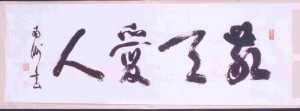
敬天愛人 — “Revere Heaven, love mankind” — was Saigō Takamori’s cherished motto. In Samurai Revolution, I wrote the following:

“Revere Heaven, love mankind” represents a Confucian ethic that dictates the relationship between the people, the government, and the Emperor—in a universe ruled by Heaven. But Heaven cannot feasibly watch over each and every person, assuring peace and harmony in human society. That role, then, is allotted to the Emperor, the Son of Heaven. Assisting the Emperor in his holy obligation are the feudal lords. Assisting each feudal lord in assuring peace and harmony for the people in his domain are the government officials, selected from among the lord’s samurai vassals.

Heavy is the responsibility of the officials who oversee the everyday affairs of the feudal domains. Since they directly control the fate of the people, one blunder by just one official can mean catastrophe for a great number. As a leader of the people, a government official must win the hearts and minds of the people. To do so, he must put aside self-interest for the benefit of the people, who have no choice but to obey him. [end excerpt]

Saigo Takamori

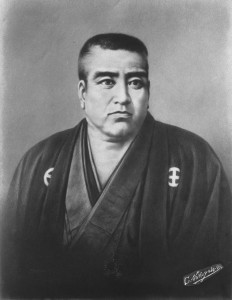
Saigō’s philosophy is timeless. It expresses an enduring moral vision rooted in compassion, duty, and leadership. More than a political maxim, “Revere Heaven, love mankind” embodies the moral foundation of his life and actions—a teaching that continues to illuminate Japan’s transformation in the Bakumatsu–Meiji era.

[The image of Saigō’s calligraphy is from the website of Kagoshima Prefectural Library (鹿児島県立図書館). The image of Saigo is used in Samurai Revolution, courtesy of Japan’s National Diet Library.]

___________________

Read more about Saigō Takamori’s character in Saigō Takamori’s ‘gentility, kindness, and modesty’.

For a full account of Saigō Takamori’s life and philosophy, see Samurai Revolution.