The Quintessence of Samurai Morality

Like many Americans of conscience I am distressed over the current politics and society of our country. And so here are some words of wisdom from Saigō Takamori for these difficult times (slightly edited from Samurai Revolution, without footnotes):

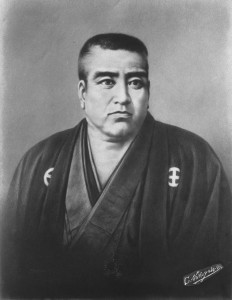
Saigō Takamori, the quintessence of samurai morality, taught that “a great man,” unlike the average man, “never turns away from difficulty or pursues [his own] benefit.” He “takes the blame for mistakes upon himself and gives credit [for meritorious deeds] to others.” He “was physiologically unable to bear” even being suspected of any sort of underhandedness. He had a deep-seated repugnance of “love of self,” which, in his own words, he described as “the primary immorality. It precludes one’s ability to train oneself, perform one’s tasks, correct one’s mistakes,” and “it engenders arrogance and pride.” The ideal samurai “cares naught about his [own] life, nor reputation, nor official rank, nor money,” Saigō taught, even if such a man “is hard to control.”

[The image of Saigo is used in Samurai Revolution, courtesy of Japan’s National Diet Library.]


S644502_247397672083151_1209814990_n
widget_buy_amazon

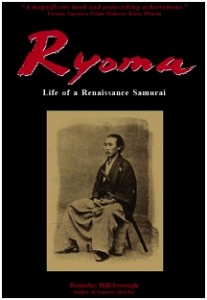
“Ryoma: Life of a Renaissance Samurai”: The 20th Anniversary (9)

There is no way to understand modern Japan without knowledge of Bakumatsu-Meiji Restoration history, and the men who made that history. Which is why I’ve spent the past 30 years or so writing about this subject.

When I decided to write Ryoma, my first book, in late 1986, I had no idea that I would continue with this endeavor for so long.

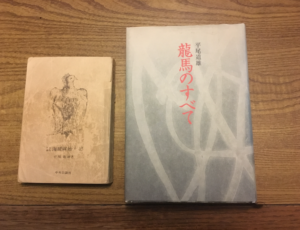
Among the first nonfiction Bakumatsu history books that I read and studied are these two classics of the life and times of Sakamoto Ryoma, both by Tosa historian Hirao Michio: Sakamoto Ryoma: Kaientai Shimatsuki (坂本龍馬  海援隊始末記) AND Ryoma no Subete (坂本龍馬のすべて).

The copy of Shimatsuki shown here is the original copy that I have read and re-read many times. The copy of Subete I bought at a bookstore in Kochi in 1999. (I had lost my first copy during my move from Tokyo to San Francisco some years before that.)


ryoma
widget_buy_amazon

“Ryoma: Life of a Renaissance Samurai”: The 20th Anniversary (8)

He Called Me an “American Ryoma”

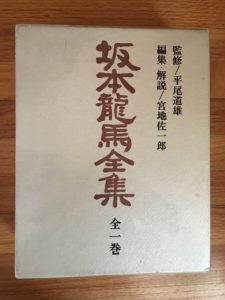
Without this book, Sakamoto Ryoma Zenshu (坂本龍馬全集) (Kōfūsha Shuppan, 1978), by Miyaji Saichiro, my friend and mentor, I could not have written Ryoma. A collection of letters to and from Sakamoto Ryoma, and other important documents related to Ryoma and his history, compiled and meticulously annotated by Miyaji-sensei, Zenshu is a monumental and unsurpassed work of scholarship of Sakamoto Ryoma’s life and times.

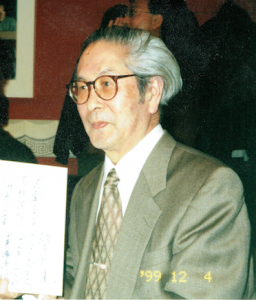
I first met Miyaji-sensei around November 1988, while working as a writer for Flash, a popular weekly magazine in Tokyo. The magazine was doing a special feature on Ryoma to commemorate his upcoming birthday. Since I was working on my novel, the editor, Shindo Toshiya, who is still my good friend, asked me to accompany him to Miyaji-sensei’s home in Mitaka, Tokyo, to interview him. I vividly remember Miyaji-sensei greeting us at the front door, dressed in traditional kimono, then bringing us to the living room for the interview. He must have been more than a bit surprised to meet an American who was writing about Sakamoto Ryoma. I remember him saying something to the effect that he thought of me as an “American Ryoma.”

Also see this past post.

[The above photo of Miyaji Saichiro was taken in Tokyo in December 1999.]


ryoma
widget_buy_amazon

“Ryoma: Life of a Renaissance Samurai”: The 20th Anniversary (7)

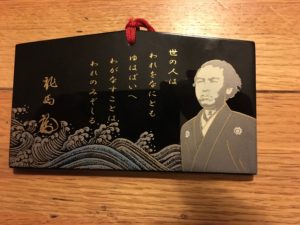
I’ve written in other posts about my inspiration in writing about Bakumatsu history – which I call “the samurai revolution at the dawn of modern Japan.” Ryoma was my first book on the subject. I was inspired to write it by certain authors, but mostly by Ryoma’s personality, as is summed up nicely, I think, in this famous poem by Sakamoto Ryoma:

世の人はわれをなにともゆはゞいへわがなすことはわれのみぞしる

It matters not what people say of me, I am the only one who knows what I must do. [my translation]

National Diet Library’s Online Database (3)

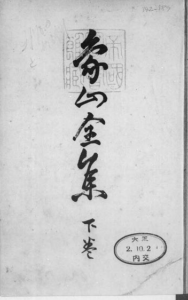
Sakuma Shōzan, teacher of Katsu Kaishū, Sakamoto Ryōma, Yoshida Shōin, and others, was one of the most important figures in Bakumatsu history. He was assassinated in Kyoto in the summer of 1864. His journal of the last four months of his life, Kōmu Nikki, most of which was spent in Kyoto, is important reading for students of the era. It is published in Shōzan Zenshū (photo below), available in Japan’s National Diet Library’s digital collection.

I wrote about Sakuma Shōzan, including his relationship with Katsu Kaishū, “the shogun’s last samurai,” in Samurai Revolution. Sakuma, who also had a brief interaction with the Shinsengumi, including its two leaders, Kondō Isami and Hijikata Toshizō, is also featured in Samurai Swordsmen: The Definitive History of the Shinsengumi (1863–1869) (to be published in fall 2026).