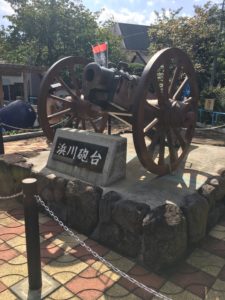
The Hamakawa Battery of Tosa Han, at Shinagawa – and my friend Kiyoharu Omino

“Ryōma fans” at the annual gathering held in Tokyo last October visited Sakamoto Ryōma-related sites. Shinagawa was one of the destinations. Located there was Tosa’s residence at Samezu, where the retired daimyo of Tosa, Yamauchi Yōdō, had lived for a number of years; and where Ryōma and other Tosa samurai had been stationed.

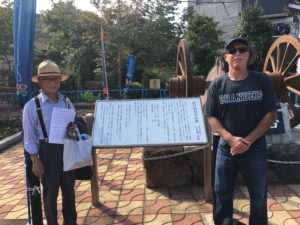
Kiyoharu Omino, the distinguished writer and scholar of Bakumatsu history, gave talks at Yōdō’s alongside gravesite and at the reconstructed Hamakawa Battery of Tosa Han – whose eight guns would not have been able to hit Perry’s ships in Edo Bay in the summer of 19854 even if they had been fired. Ryōma, age twenty at the time, received gunnery training at the Hamakawa Battery as a student of Sakuma Shōzan, Mr. Omino wrote in the explanatory panel at the site.
_____________

Recently I have been focusing on my forthcoming Samurai Swordsmen: The Definitive History of the Shinsengumi (1863–1869), scheduled for publication in fall 2026 with Helion. I also provide consulting on Bakumatsu–Meiji Restoration history and culture to authors, editors, publishers, documentarians, producers, screenwriters, and other professionals who need expert guidance on the era.

To explore my books about Sakamoto Ryōma, Katsu Kaishū and others of the Meiji Restoration, see Books at a Glance.

Follow me on Facebook | Amazon Author page
“Ryoma: Life of a Renaissance Samurai”: The 20th Anniversary (1)

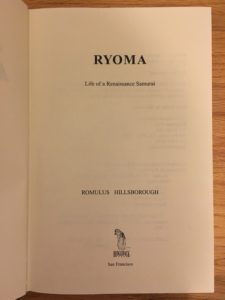
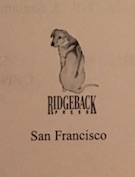
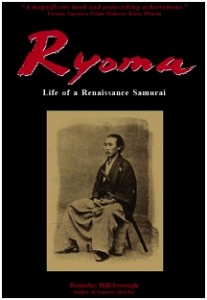
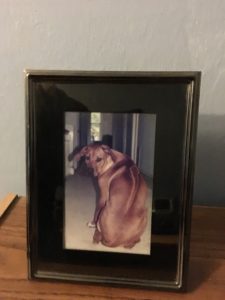
Next year will mark the 20th anniversary of the publication of Ryoma: Life of a Renaissance Samurai. It is the first biographical novel in English of Sakamoto Ryoma, and the only one written originally in English. The publisher, Ridgeback Press, is named for this dog, a Rhodesian ridgeback. His photo was used as the press’ logo – as anyone who owns a copy may recognize.


ryoma
widget_buy_amazon

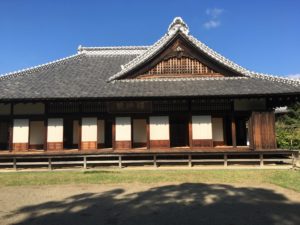
Last Shogun Tokugawa Yoshinobu secluded himself in this room after the fall

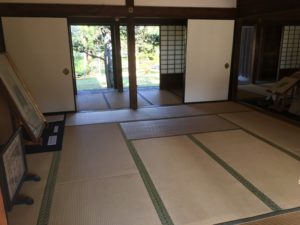
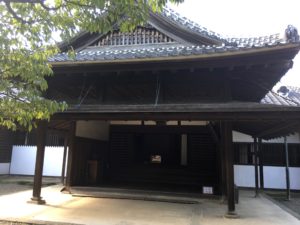
The last shogun, Tokugawa Yoshinobu, upon returning to his native Mito on the day his castle was surrendered in spring 1868, secluded himself in this room at the Kōdōkan, the official school of Mito, to demonstrate his loyalty to the new Imperial government. The room, named Shizendō (至善堂), is an Important Cultural Property, designated by the Japanese government. Its name means something like “Hall of Ultimate Virtue.”

Also see .

Kōdōkan of Mito: The Birthplace of the Meiji Restoration

On The 150th Anniversary of the Meiji Restoration (21)

Kyōto, Kōchi, Kagoshima, Hagi, Shimonoseki, major cities of the Meiji Restoration, contain some of the most interesting sites in Bakumatsu history. But the Kōdōkan, the sometimes overlooked official school of Mito Han, is particularly fascinating to me – because Mito is the cradle of Imperial Loyalism (Kinnō), which of course culminated in the Meiji Restoration. It was at the Kōdōkan where Mitogaku (“Mitoism”), the ultra-nationalistic school of thought, attained prominence. Mitogaku was the cornerstone of Imperial Loyalism.

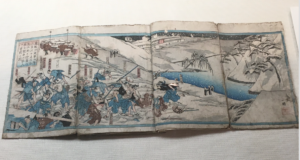
Ii Naosuké’s Assassination, As Depicted in Woodblock Print at Kōdōkan in Mito

Ii Naosuké, regent to the shōgun, was the archenemy of Tokugawa Nariaki, daimyo of Mito. As regent, he was the most powerful man in Japan. He was assassinated in broad daylight at the gate called Sakurada-mon, a main entrance to Edo Castle, on an unseasonably snowy morning in spring 1860, by seventeen Mito samurai and one from Satsuma. The murder was the most brazen offense ever committed against the Tokugawa Bakufu and the most politically significant assassination in an era plagued with assassination and bloodshed. The Bakufu collapsed around eight years later. Following is an excerpt from Samurai Revolution (without footnotes):

The regent’s sedan was surrounded by more than sixty men of [Ii Naosuké’s] Hikoné Han, including bodyguards, foot soldiers, luggage bearers, and sandal carriers. The Hikoné men wore wide-brimmed sedge or lacquered hats and cloaks of oiled paper. Since the hilts of their swords were covered with small cloth pouches to protect against the falling snow they could not readily draw their blades. Suddenly one of the assassins threw off his hat, removed his jacket, drew his sword and cut one of Ii Naosuké’s guards across the forehead, then slashed another man diagonally across the body. One of the assassins fired a pistol, at which signal several others drew their swords and charged. “Look out!” one of the Hikoné men shouted, as the regent issued an order for his guards to remain by his side. But in the chaos all but one of them became separated from the regent, brandishing their swords and spears against the sudden attack. Several of the assailants managed to penetrate the guards’ line and reach the sedan. They stabbed the regent through the side of the vehicle and pulled him to the snowy ground. The one Satsuma man, Arimura Jizaémon, beheaded him, and holding the head up high triumphantly announced that he had killed Ii Naosuké. [end excerpt]

I wrote in detail about the political rivalry between Ii Naosuké and Tokugawa Nariaki in Samurai Revolution. Part I of Samurai Assassins, entitled “The Assassination of Ii Naosuké and the Beginning of the End of the Tokugawa Bakufu,” provides a detailed account of the so-called “Incident Outside Sakurada-mon.”