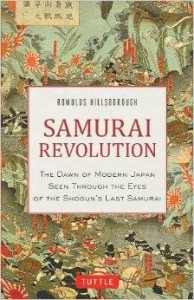
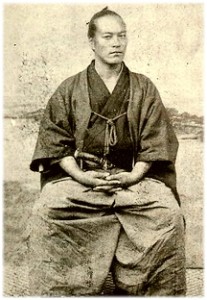
Often I ask myself: Why do I spend so much of my life writing about men of a culture that is completely foreign to my own, who lived and died in the century before my birth? My answer is always the same: Because these guys are the most inspirational, awesome, and just downright likeable men I have ever “known.” Or in the vernacular, they kick ass! Among them are Katsu Kaishū, the focus of my Samurai Revolution; and Yamaoka Tesshū, Kaishū’s close friend and confidant, renowned swordsman, and Zen adept. Following is an excerpt from Samurai Revolution (without footnotes):
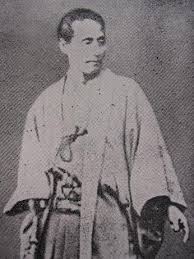
Yamaoka Tesshū died of stomach cancer on July 19 [1888] at age fifty-three. On the day of his death, Kaishū called on him at his home in Tōkyō. Upon entering the house he found the sword master surrounded by visitors and sitting in zazen—the practice of Zen meditation—wearing a “pure white kimono” under a Buddhist robe, “with perfect composure,” Kaishū recalled. He asked his friend if the end was near. “Tesshū opened his eyes slightly and, smiling, replied without [showing] pain, ‘Thanks so much for coming, Sensei. I am about to enter Nirvana.’ Then I said to him, ‘Become Buddha,’ and left.” According to Kaishū’s oral recollection ten years later in October 1898 (Meiji 31), Yamaoka died shortly after he left him. At the time of his death, “he had a white fan in hand.” Chanting a Buddhist prayer, he “smiled at all present, including his wife, children, and relatives,” and, even after he finally died, maintained the proper sitting posture. In manifesting Buddhist enlightenment, Kaishū remarked, Yamaoka demonstrated “just how well he understood bushidō.”
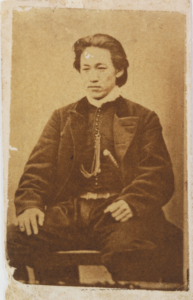
(The photograph of Yamaoka Tesshū is in Samurai Revolution, courtesy of Fukui City History Museum.)
S