
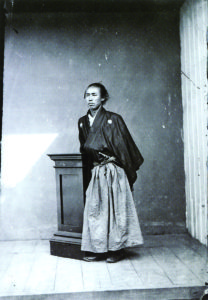
Ryōma: Ten Often Overlooked Facts (2)


2) Gifted Writer of Prose: Sometime in the early hours of Keiō 2/1/24 (1866), two days after overseeing the conclusion of the Satsuma-Chōshū Alliance in Kyōto, Sakamoto Ryōma was attacked, wounded, and nearly killed by a Bakufu police squad at the Teradaya inn in Fushimi, just south of Kyōto. Ryōma described the attack and his narrow escape in a letter to his family, much of which is excerpted in my accounts of the incident in Ryoma: Life of a Renaissance Samurai and Samurai Revolution.

The attack at the Teradaya and the narrow escape (much to the credit of his girlfriend Oryō, who worked as a maid at the inn) have become legendary through literature and film. Similarly storied are the wedding ceremony between Ryōma and Oryō shortly thereafter, and their subsequent honeymoon (said to be the first in Japan) at the hot springs in the Kirishima mountains of Satsuma, where Ryōma recuperated from his wounds and took a much needed rest. Ryōma, whose myriad talents included a vivid, fluent writing style, described all of this and much more in two letters to his family, both dated Keiō 2/12/4 (1866). The first of these letters, in which Ryōma “took a hard look at a critical moment in his own existence, is a rarity in Bakumatsu history,” Miyaji Saichirō remarked. (Ryōma Hyakuwa, p. 150) Shiba Ryōtarō, whose popular novel Ryōma ga Yuku immortalized Sakamoto Ryōma in the psyche of the Japanese people, called the letter “the first piece of nonfiction literature of the Bakumatsu.” (Qtd. in Miyaji, Ryōma Hyakuwa, p. 152) Ryōma’s graphic account of the attack, I believe, captures the violence of the times as few surviving documents do.
Ryōma: Ten Often Overlooked Facts (1)

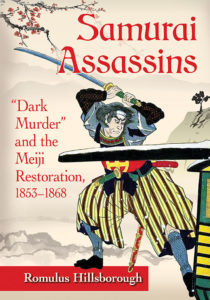
Sakamoto Ryōma’s legacy is based on a series of unparalleled historical achievements during the last few years of his short life: Japan’s first trading company, the Satsuma-Chōshū Alliance, and his great plan for peaceful restoration of Imperial rule. I have discussed these in detail in my books, including Ryoma: Life of a Renaissance Samurai, Samurai Revolution, and Samurai Assassins.

Here I present the first of ten often overlooked facts to take a closer look at Sakamoto Ryōma, the man.

1) GeniusAs I mentioned in Samurai Assassins, Ryōma was a visionary and a genius—if genius means to conceive of original ideas and to have the courage and audacity to bring them to fruition. Nietzsche, Ryōma’s contemporary, alluded to genius with the following statement: “When a human being resists his whole age and stops it at the gate to demand an accounting, this must have influence.” Based on his determined resistance to the social iniquities and restraints under the Tokugawa Bakufu and its archaic feudal system, Ryōma influenced “his whole age” through the historical achievements mentioned above.

Ryōma’s Eerie Foresight

That Sakamoto Ryōma was endowed with an uncanny power of prescience is beyond dispute, as he demonstrated on numerous occasions during the last five years of his life. I have documented these over the years, starting with the biographical novel Ryoma: Life of a Renaissance Samurai, and more recently in Samurai Revolution and Samurai Assassins.

On the 150th anniversary of Ryōma’s assassination let’s consider two striking examples of his apparent foresight of his own death:

• In a letter to his sister, Sakamoto Otomé, about two and a half years before his death, he wrote: “I don’t expect that I’ll be around too long. But I’m not about to die like any average person either. I’ll only die when big changes finally come, when even if I continue to live I’ll no longer be of any use to the country.” (quoted in Samurai Revolution)

• In a letter to a friend written four days before his assassination in Kyōto, he alluded to the great danger facing Japan under the Bakufu and urged his friend to be careful for his life. “Now is the time for us to act. Soon we must decide on our direction, whether it lead to pandemonium or paradise.” (quoted in Samurai Assassins)


Samurai Assassins Part II: Takéchi Hanpeita

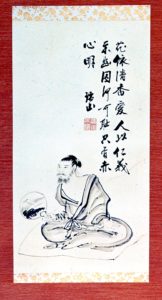
Part II of my new book, Samurai Assassins, is the first in-depth biographical treatment in English of Takéchi Hanpeita, charismatic leader of the Tosa Loyalist Party and mastermind of “divine punishment,” which wreaked terror on the streets of Kyōtō. Takéchi’s important role in the “samurai revolution” is covered in detail, including his meteoric rise to power and his sudden arrest and imprisonment ending with his stunning seppuku (self-disembowelment). I referred to Takéchi’s journals, contained in an early biography published in 1912; and more heavily to his letters from jail to his wife and cohorts on the outside. To the best of my knowledge, Takéchi’s letters have rarely, if ever, been used by Western writers. (Takéchi Hanpeita’s self-portrait, painted in prison at Kōchi in 1864, is courtesy of Kochi Prefectural Museum of History.)


hillsborough_978-1-4766-6880-2
widget_buy_amazon
